
Engineering for Instinct
The spatial psychology of dogs and cats, without treating instinct as a slogan.
- Category
- SPATIAL DESIGN
- Type
- Essay
- Author
- HĀM Studio
- Published
- MAY 2026
- Last updated
- May 2026
- Reading time
- 13 min
Topics
Dogs and cats do not experience a home as furniture first. They experience it as a pattern of safety, visibility, scent, access, temperature, and routine.
Engineering for instinct means translating animal behavior into spatial variables: refuge, view, route, height, scent, material, and resource separation.
01 — Direct answers
What does "engineering for instinct" mean in pet architecture? Engineering for instinct means designing pet space around repeatable animal behaviors: retreat, visibility, scent, movement, resource access, thermal comfort, and social distance. It does not mean forcing every dog or cat into a single product type.
Do dogs need dens inside the home? Some dogs benefit from edge-protected or partially enclosed resting places, but not every dog needs a closed den. Many dogs rest better when they can stay near the household while remaining outside main walking paths and avoidable disturbance.
Do cats need vertical space? Cats often benefit from elevated options because height can improve visibility, control, and social distance. Vertical space works best when it is connected to safe places, clear routes, separated resources, and predictable access.
How should scent be considered in pet space design? Scent should be treated as part of the animal's map of home. Good design avoids harsh fragrance, separates key resources, keeps cleaning practical, and preserves familiar resting or rubbing zones where appropriate.
What is the main design principle? A good pet space gives the animal choices: a place to watch, a place to withdraw, a route to leave, a surface to rest on, and resources that can be reached without conflict.
02 — The problem with "instinct" as a design word
Instinct is an attractive word because it sounds deep. It suggests that a design has reached below trend and touched something older, more biological, more true.
But instinct becomes weak when it is used as a slogan.
In pet products, the word often turns complex behavior into a simple object: dogs need crates, cats need towers, anxious pets need caves, messy pets need hidden storage. These ideas may contain fragments of truth, but fragments are not enough to design a room.
The better question is not "What instinct does this product satisfy?"
The better question is: What spatial condition allows this animal to feel safe enough to behave normally?
That question changes the work. It moves the conversation from object selection to spatial design.
03 — Instinct is not a product category
Dogs and cats have species-specific tendencies, but they are also individuals shaped by age, health, early experience, social environment, and the rhythm of the home. A design that works beautifully for one animal may be ignored by another.
The useful way to work with instinct is to translate it into observable design variables.
| Behavioral need | Dog design translation | Cat design translation | What to observe |
|---|---|---|---|
| Safety | Low-disturbance rest zone, partial edge protection, predictable household access | Safe place sized for one cat, not easily blocked by another cat | Does the pet remain relaxed or leave quickly? |
| Visibility | View of household activity without being in the traffic path | Elevated or edge-protected observation point | Can the pet watch without being approached from every side? |
| Retreat | Bed or alcove with an easy exit, not a trap | Hiding or resting zone with more than one route in multi-cat homes | Can the animal withdraw before conflict starts? |
| Scent | Familiar bedding, washable but not over-perfumed surfaces | Scratching, rubbing, bedding, and stable scent zones | Does cleaning erase every familiar cue? |
| Resource access | Food, water, rest, and exit placed away from congestion | Multiple separated resources, especially in multi-cat homes | Is another animal or human path blocking access? |
| Thermal choice | Warm and cool resting options, shade, airflow | Sun, shade, warm surfaces, cool withdrawal points | Does the pet move between locations during the day? |
| Movement | Clear approach and exit, no slippery entry route | Connected vertical and horizontal routes | Is access possible for the pet's age and body condition? |
| Routine | Consistent location, quiet maintenance, predictable use | Predictable access, stable scent, low surprise | Does the pet use the place repeatedly over time? |
This table is the core of the article: instinct becomes useful when it becomes design information.
04 — Dogs: the den is a variable, not a rule
The common phrase "dogs are den animals" is too simple for good design.
Many dogs do enjoy protected resting places. Some choose the side of a sofa, the underside of a desk, a corner with a view, or a bed placed just outside the main walking path. Protection matters. But a dog is not made comfortable by enclosure alone.
Research on the secure base effect in domestic dogs shows that owner presence can influence how dogs explore and engage with a task. In Horn, Huber, and Range's 2013 PLOS ONE study, dogs manipulated a problem-solving apparatus for longer when their owner was present than when absent, regardless of whether the owner was silent or encouraging. That does not mean every dog bed must sit beside a person, but it does show that social security is part of how dogs use space.
Recent field research also complicates the den story. A 2024 population-level study of free-ranging dogs observed 66 dog groups and 284 dogs over three years in India. Resting site choice was associated with multiple physical parameters, including disturbance, visibility, light, surface, shade, and proximity to food and water. The study found that dogs preferred resting sites that supported visibility, reduced disturbance, and resource awareness.
For residential design, the lesson is straightforward:
A good dog resting place is not automatically a cave. It is a low-disturbance position where the dog can rest, monitor relevant activity, leave easily, and remain socially connected when desired.
That may be an alcove. It may be a bench-integrated rest zone. It may be a mat beside a desk. It may be an open bed with a protected back. The form should follow the dog's behavior, not a simplified myth.
Dog resting design checklist
| Question | Better signal | Warning signal |
|---|---|---|
| Is the dog close enough to the household? | The dog can rest near people without being stepped over | The bed is isolated and rarely used |
| Is the location outside the traffic path? | People can pass without crossing the bed | The dog must move whenever someone walks by |
| Is there edge protection? | One or two sides feel settled, such as wall, sofa, cabinet, or low panel | The dog is exposed from all sides |
| Is exit easy? | The dog can leave without squeezing or turning sharply | The dog is boxed into a narrow cavity |
| Is airflow practical? | Enclosure breathes and does not trap heat or odor | The space is closed, warm, or difficult to clean |
| Is the surface stable? | The mat supports posture and does not slide | The bed collapses, shifts, or blocks entry |
05 — Cats: height matters, but control matters more
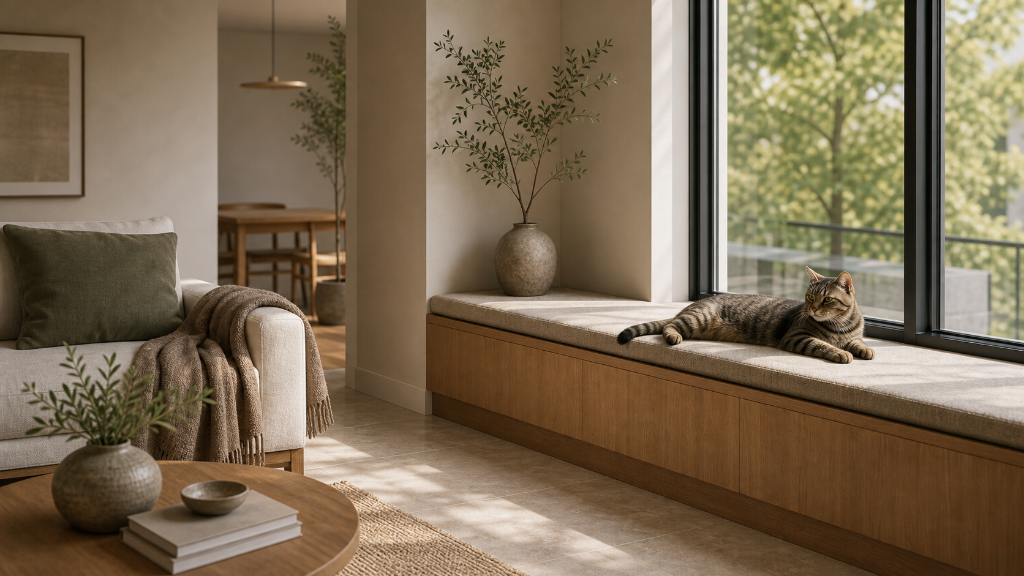
Cats often need vertical options, but height is not the whole story.
The AAFP and ISFM Feline Environmental Needs Guidelines describe a healthy feline environment through five pillars: safe places, multiple and separated key resources, play and predatory behavior, positive human interaction, and respect for the cat's sense of smell. The same guidelines note that elevated areas can increase vertical space and allow cats to monitor the environment.
That is the architectural reason cat design cannot stop at a shelf.
A shelf gives height. A system gives control.
For cats, control often means:
- a safe place sized for one cat
- access that cannot be easily blocked
- a view of approach routes
- separated food, water, toileting, scratching, and resting zones
- scent stability
- vertical options that are reachable for the cat's age and mobility
The 2024 AAFP Intercat Tension Guidelines reinforce this logic for multi-cat homes. Tension often becomes visible only after it has been building invisibly through blocked access, resource competition, ambush points, and lack of retreat.
This is why cat architecture must be designed as circulation, not decoration.
An elevated perch without a route is a display shelf. A high resting place with reachable steps, a protected back, a visible approach, and an unblocked exit is territory.
Cat territory design checklist
| Spatial element | Why it matters | Better signal |
|---|---|---|
| Safe place | Allows withdrawal and stress regulation | At least one single-cat retreat per cat |
| Vertical option | Improves visibility and spatial control | Reachable perch or platform with stable access |
| Separated resources | Reduces competition and blocking | Food, water, litter, scratch, and rest are not forced into one point |
| Exit route | Prevents trapping and ambush | Cat can leave without passing through a conflict point |
| Scent zone | Supports familiarity and orientation | Scratching/rubbing surfaces are allowed and not over-cleaned |
| Mobility access | Respects age, injury, and body condition | Lower platforms, ramps, or closer steps for seniors or kittens |
06 — Scent is part of the floor plan
Humans often treat scent as an odor problem. Pets treat scent as information.
For cats especially, smell is part of how the home is recognized. Facial rubbing, scratching, bedding, and familiar objects all help create a stable scent map. The AAFP/ISFM guidelines warn that unfamiliar scents, harsh changes, and disrupted communal scent profiles can contribute to stress in multi-cat homes.
This does not mean a home should be dirty. It means cleaning and concealment should be designed with animal behavior in mind.
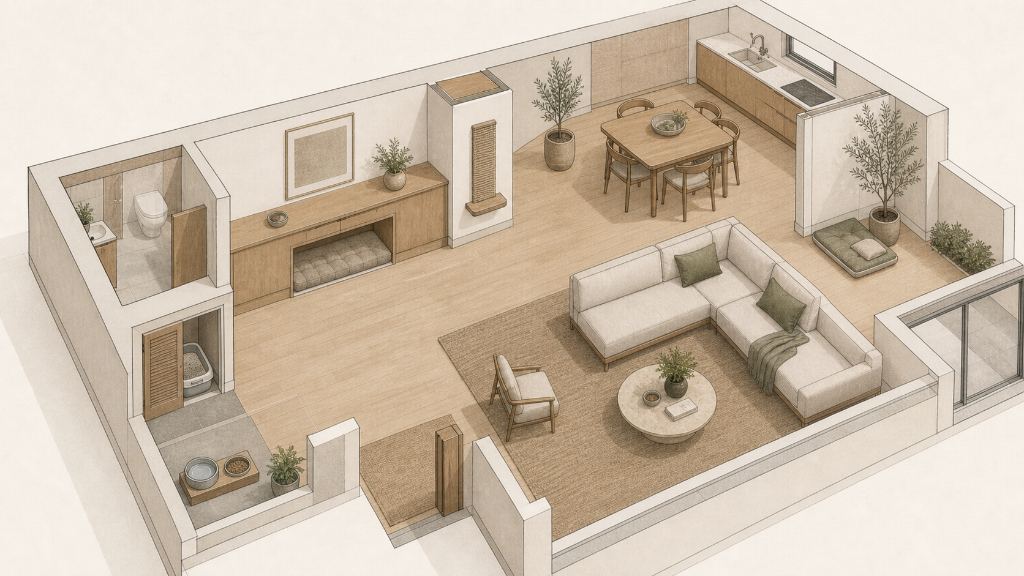
For litter, the goal is not simply to hide the box. The goal is to create a toileting zone that is accessible, private enough, ventilated, cleanable, and not trapped behind a conflict point.
For beds and resting surfaces, the goal is not to erase all scent. The goal is washable comfort that can retain enough familiarity to remain accepted.
For feeding and water, the goal is not to compress everything into one tidy station. Cats in particular often do better when key resources are separated and available in multiple locations.
Scent-aware design is not perfume. It is spatial literacy.
07 — Engineering for instinct means engineering choice
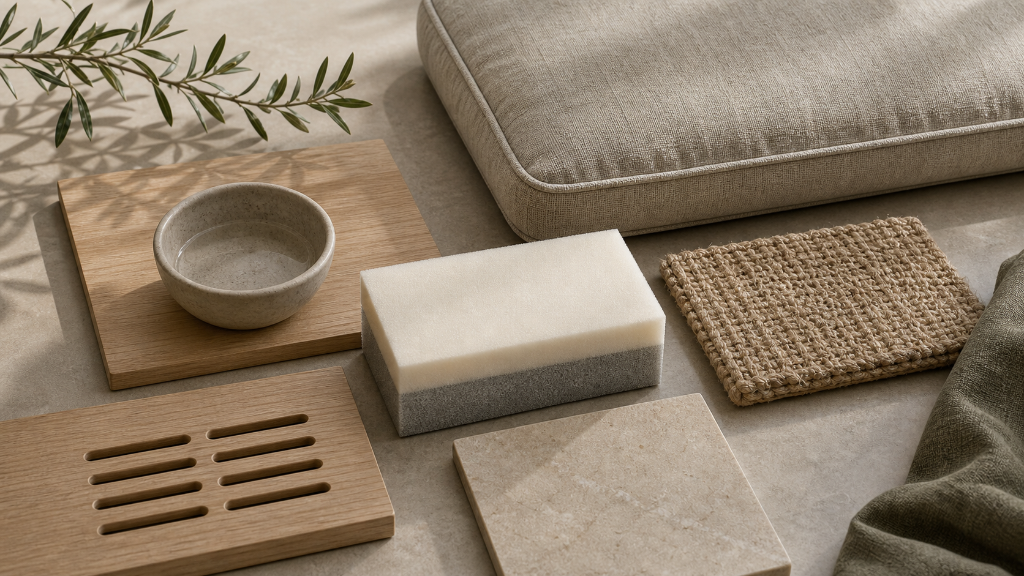
The strongest pet spaces do not force one behavior. They make several good behaviors possible.
| Design variable | What it gives the animal | Residential translation |
|---|---|---|
| Refuge | A way to reduce exposure | Alcove, safe place, covered rest zone, retreat shelf |
| View | A way to monitor without moving | Edge-positioned bed, elevated cat perch, protected outlook |
| Exit | A way to leave before conflict | Open side, secondary route, non-blocked entrance |
| Height | A way to control distance and visibility | Cat platforms, window perches, cabinet-integrated levels |
| Scent | A familiar map of the home | Scratch surfaces, bedding continuity, low-fragrance cleaning |
| Material | Bodily comfort and grip | Stable support, washable covers, non-slip approach |
| Resource separation | Lower social pressure | Distributed food, water, litter, scratching, and rest zones |
| Maintenance | Human follow-through | Removable inserts, ventilated cavities, reachable cleaning paths |
This is the difference between pet furniture and pet architecture.
Furniture asks, "Where can we put the object?"
Architecture asks, "What behavior should this space make easier?"
08 — What this does not mean
This does not mean every dog needs an enclosed den. Some dogs prefer open beds. Some prefer to rest beside a desk or sofa. Some need a quieter room. Some need a lower entry because of age, pain, or body shape. Enclosure is useful only when it improves rest without creating heat, trapping, cleaning difficulty, or avoidance.
This does not mean every cat needs the highest possible shelf. Some cats want height. Some want covered low hiding. Senior cats may need lower, reachable perches. Multi-cat homes need routes and separated resources more than dramatic vertical gestures.
This does not mean architecture replaces veterinary or behavior care. Sudden hiding, aggression, house-soiling, restlessness, pain signs, or major changes in sleep and appetite should be discussed with a veterinarian or qualified behavior professional.
This does not mean the home should become a pet playground. Good design often becomes quieter, not louder. The best pet architecture is integrated enough that the animal can use it and the room can remain a room.
09 — How HĀM applies this in residential design
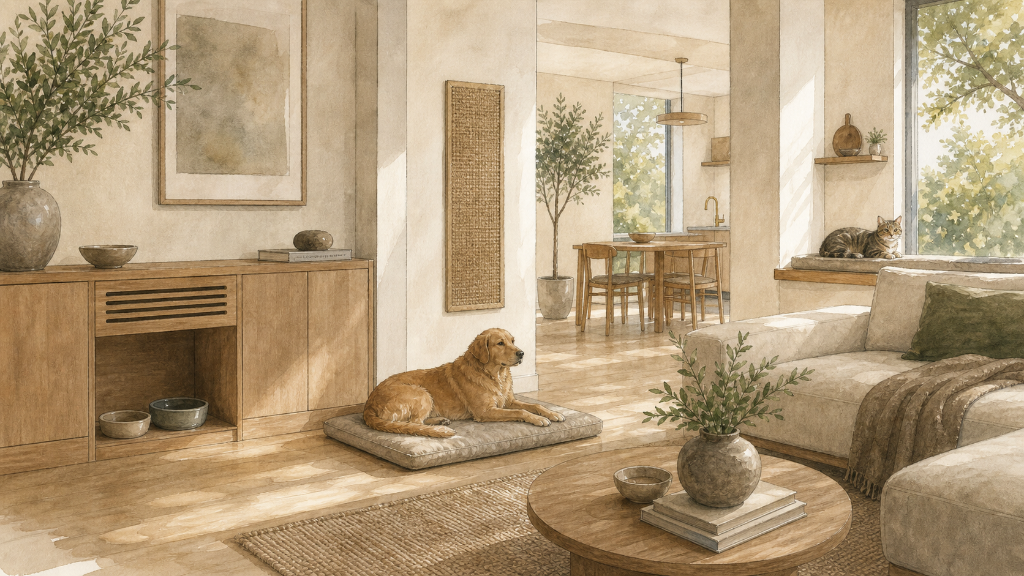
HĀM's role is not to turn every room into a pet zone. It is to make animal needs legible inside residential design.
That begins by reading the home as a set of behavioral conditions:
- Where does the animal choose to rest without being asked?
- Which paths are noisy, narrow, slippery, or frequently interrupted?
- Where can a dog remain near the household without being in the way?
- Where can a cat observe without being approached from every side?
- Which resources are forced too close together?
- Which spaces are easy for humans to clean and maintain?
- Which design details provide choice instead of confinement?
From there, HĀM can translate instinct into architectural decisions: an alcove instead of a loose bed, an integrated rest console instead of a decorative cushion, a reachable vertical path instead of a floating shelf, a ventilated litter zone instead of a hidden odor box, or a rest surface whose dimensions reflect the animal's body rather than generic product sizing.
The point is not to make the pet visible everywhere.
The point is to make the pet's needs structurally accounted for.
10 — Practical design framework
Use this framework before choosing or commissioning any built-in pet space.
| Step | Question | Design output |
|---|---|---|
| 1. Observe | Where does the pet already choose to rest, watch, hide, eat, or avoid? | Behavioral map of the home |
| 2. Identify pressure | What creates stress: traffic, noise, blocking, heat, cold, other animals, cleaning difficulty? | Problem zones |
| 3. Define the need | Is the primary need refuge, view, exit, support, separation, scent stability, or maintenance? | Design brief |
| 4. Choose the form | Should the answer be open, semi-enclosed, elevated, low-entry, washable, ventilated, or distributed? | Spatial specification |
| 5. Test acceptance | Does the animal voluntarily use it over time? | Iteration, not assumption |
The last step matters. A pet space is not successful because it looks correct in a photograph. It is successful when the animal chooses it repeatedly without being forced.
11 — How this connects to the rest of the Journal
This essay is the behavioral layer of HĀM's framework. The companion writing develops each variable in detail:
- The End of Pet Furniture — why animal space now belongs to architecture, not product categories.
- The Science of Space — how spatial fit is evaluated at body, behavior, and room scale.
- Why cats need vertical territory — height, retreat, and the multi-cat home.
- How pets choose resting places — light, temperature, visibility, and escape routes.
- Pet mat size, thickness, and material — body fit, support, and surface choice.
- Pet bowl height, size, depth, and feeding geometry — feeding posture and station placement.
Sources
- Source
The importance of the secure base effect for domestic dogs: Evidence from a manipulative problem-solving task
Horn, L., Huber, L., & Range, F. · 2013
Used forEvidence that social security — owner presence — shapes how dogs engage with and use space.
- Source
A population-level study reveals hidden patterns in resting site choice of free-ranging dogs
Biswas, S., Ghosh, K., Sarkar, K., Benny, L., Katti, M., & Bhadra, A. · 2024
Used forField evidence that dogs choose resting sites by disturbance, visibility, light, surface, shade, and proximity to resources — not enclosure alone.
- Source
AAFP and ISFM Feline Environmental Needs Guidelines
Ellis, Rodan, Carney, Heath, Rochlitz, Shearburn, Sundahl, Westropp · 2013
Used forFive-pillar framework for safe places, separated resources, scent, and elevated areas in residential cat design.
- Source
2024 AAFP Intercat Tension Guidelines: Recognition, prevention and management
Hammerle, M., Horwitz, D., Lloyd, J., et al. · 2024
Used forMulti-cat home logic: blocked access, ambush points, and lack of retreat as design problems.
- Source
Enrichment: Supporting your pet's mental and emotional wellbeing at home
American Animal Hospital Association · 2026
Used forDistributed, accessible enrichment resources as part of normal home life.
- Source
WSAVA Animal Welfare Guidelines
World Small Animal Veterinary Association · 2018
Used forWelfare framed as physical, psychological, social, and environmental wellbeing.
- Source
Will a hiding box provide stress reduction for shelter cats?
Vinke, C. M., Godijn, L. M., & van der Leij, W. J. R. · 2014
Used forEvidence that hiding options can reduce stress — supporting refuge as a design variable, not a slogan.
Limitations
- This article translates animal behavior and welfare research into residential design principles. It is not veterinary, behavioral, or medical advice.
- Recommendations are general design principles. Individual animals vary by age, health, history, and household, so observation always overrides assumption.
- Sudden behavioral changes — hiding, aggression, house-soiling, restlessness, or signs of pain — should be discussed with a veterinarian or qualified behavior professional, not solved by furniture alone.
- Built-in solutions are not always appropriate. A correctly placed loose mat, bed, or perch can outperform a poorly located built-in.
Frequently Asked
Free Resource
Get the Spatial Brief Checklist
A printable A4 checklist covering the measurements, photographs, and companion details needed before commissioning a pet space — the same brief HĀM uses with clients.
We'll occasionally send studio notes on companion space design. No spam, unsubscribe anytime.
Begin with the animal, the room, and the routine
If you are considering a companion space, the next step is not choosing a size. It is understanding the animal, the home, and the way you live together.