The Geometry of Feeding
How bowl height, width, and depth should fit the animal — not a product-size label.
- Category
- SPATIAL SCIENCE
- Type
- Guide
- Author
- HĀM Studio
- Published
- MAY 2026
- Last updated
- May 2026
- Reading time
- 11 min
Topics
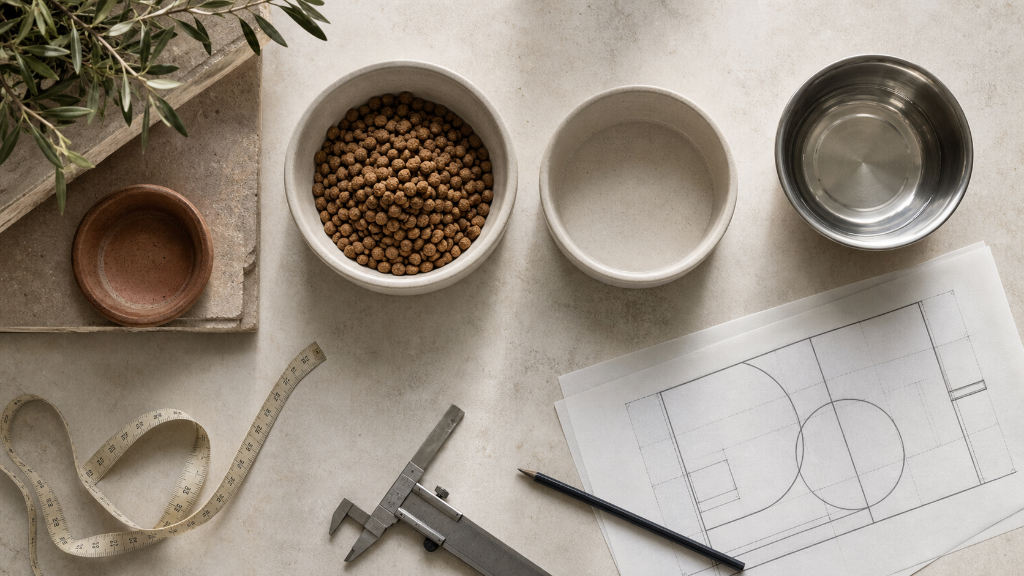
Bowl geometry should be treated as a posture and access problem, not a product-size label.
Most pet bowls are sold as small, medium, or large. That language is convenient for shopping, but it does not answer the questions that matter inside a home: Can the animal reach the food without strain? Is the bowl opening wide enough for the muzzle or whisker span? Is the bowl too deep? Is a raised stand helpful, unnecessary, or potentially risky? Does the water station reflect diet, body size, and daily access?
The best feeding station is not always the tallest bowl. It is the station that lets the animal eat, drink, approach, and leave comfortably without adding avoidable risk.
This is the starting point for the HĀM Feeding Geometry Calculator. It does not ask users to choose a vague product size. It asks for a few body measurements, health flags, and household conditions, then translates those inputs into practical buying and design references.
DESIGN SUPPORT MODEL · ILLUSTRATIVE
HĀM Feeding Geometry Calculator
Bowl geometry is treated as a posture and access problem, not a product-size label. This is a design and shopping reference — not veterinary advice.
Fields auto-filled from breed-typical proportions. Adjust any value to match your animal — changes detach from the selected breed.
Dog-specific
Floor to top of shoulder, standing.
Widest comfortable food-access width.
Caps bowl depth.
Medical risk flags
Floor or low station first.
The current inputs do not show a major risk flag. Start with access, stability, and posture before adding height.
Food height
Floor / low
No automatic elevation.
Minimum opening
14.3 cm
Muzzle width × 2.2 minimum.
Maximum depth
≤ 8.0 cm
Do not exceed muzzle length (or 9 cm).
Water capacity ref.
0.7–1.4 L
Adjusted for water supplied by food.
How to read these numbers: opening is a minimum inner diameter; depth is a maximum or shallow range; height is a conservative posture range; water capacity is a station reference, not a target the animal must drink.
Section — feeding station
Buying translation
Recommended station
- Use floor-level feeding or a very low stable platform as the default.
- Inner opening sized to the muzzle, with room to lick and reach edges.
- Favour shallow, simple geometry that is easy to clean after moist food.
Placement notes
- Use a non-slip base and enough clearance for the dog to stand without twisting.
- Keep water stable, clean, and easy to reach; access matters more than height.
This calculator provides design and product-reference ranges. It does not diagnose medical conditions or replace veterinary advice. Medical signs — repeated regurgitation, known megaesophagus, GDV history, kidney disease, urinary problems, vomiting, weight loss, or sudden changes in eating or drinking — should be discussed with a veterinarian.
01 — Direct answers
What is the right height for a dog bowl? For most healthy dogs, floor-level or low feeding is appropriate. A raised bowl should not be treated as automatically healthier, especially for large, giant, deep-chested, or GDV-history dogs.
What is the right size for a cat bowl? A cat bowl should usually be shallow and wide enough to allow easy access. A practical starting point is a shallow dish around 15 to 18 cm wide, adjusted upward when the cat has a wider whisker span or a flatter face.
What does the calculator output mean? It gives reference ranges, not medical prescriptions. Opening width is a minimum inner diameter, depth is a maximum or shallow range, height is a conservative posture range, and water capacity is a station-capacity reference rather than a volume the animal must drink.
Height, width, depth, and water access should be read as a connected specification.
02 — Why bowl size is not a product label
A feeding station is used every day, often several times a day. Small mismatches in geometry become repeated friction: a deep bowl that traps food at the bottom, a narrow opening that forces the muzzle into the sides, a high stand that looks ergonomic but changes swallowing posture, or one shared water bowl that becomes a contested resource in a multi-pet home.
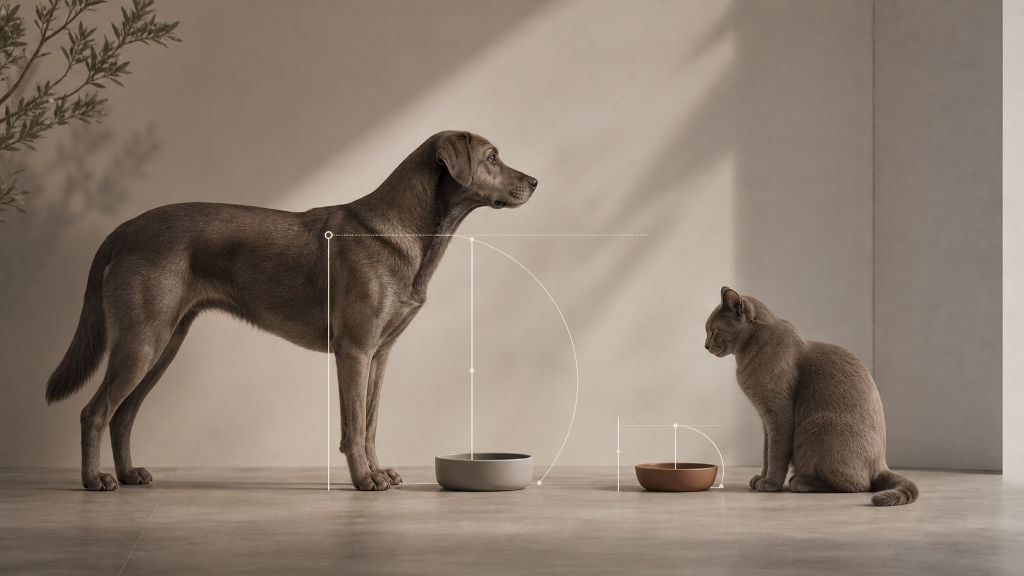
The HĀM method separates feeding geometry into four questions:
| Question | What it changes |
|---|---|
| How high should the food sit? | Neck posture, shoulder load, risk screening, and access |
| How wide should the bowl opening be? | Muzzle clearance, whisker contact, and ease of reaching food |
| How deep should the bowl be? | Whether food remains accessible without pushing the face into the bowl |
| How much water capacity should the station provide? | Daily access, diet moisture, cleaning rhythm, and number of stations |
This is why the calculator does not produce a single magic number. The output is a specification set: height range, minimum opening, maximum depth, water reference, risk flags, and buying translation.
Dog bowl height should be screened for size, mobility, eating speed, and GDV risk.
03 — Height is a risk decision, not a style choice
Height is the part of bowl design that most often gets oversold.
Raised bowls can look cleaner and more architectural. They may also help some animals with limited mobility when used carefully. But height is not a universal upgrade. In dogs — especially large, giant, deep-chested, or GDV-history dogs — elevated feeding needs a conservative risk screen before it becomes a design decision.
The Purina Institute summarises gastric dilatation-volvulus (GDV) as a potentially life-threatening condition seen most often in large and deep-chested dogs, and notes that elevated bowls may increase risk in large and giant breed dogs, while feeding at floor level may help reduce occurrence in at-risk dogs.
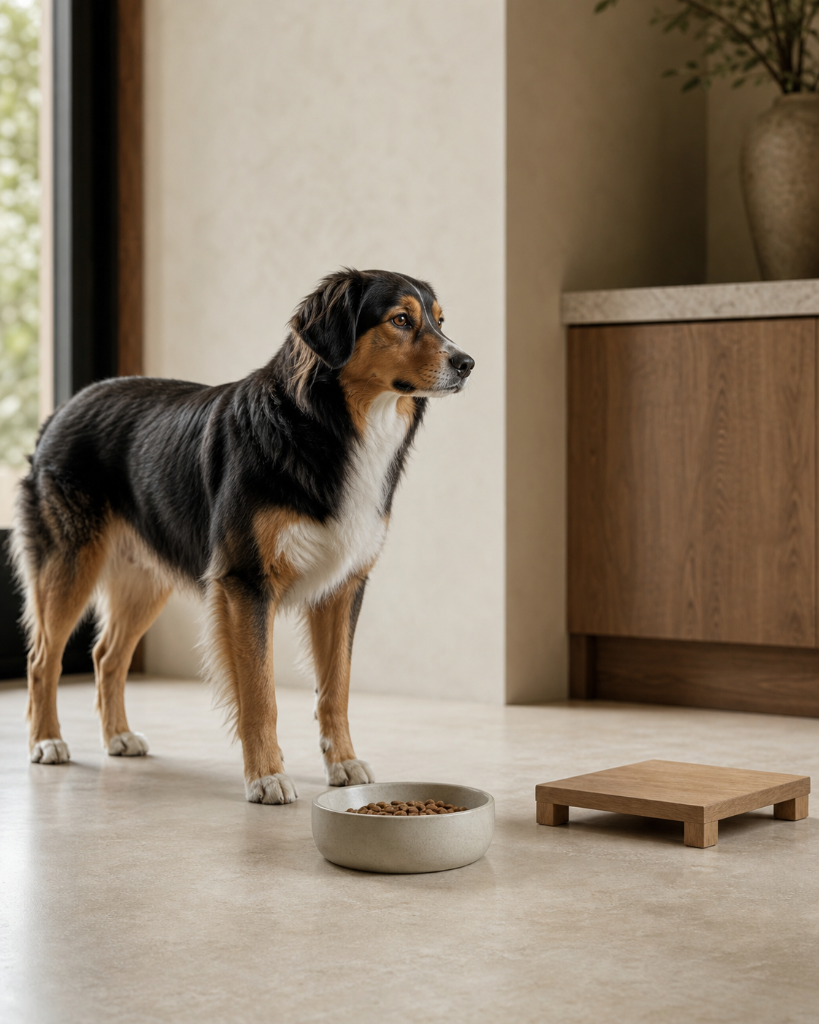
For that reason, HĀM treats high-risk dogs differently:
| Dog condition | Calculator behaviour |
|---|---|
| Large, giant, or deep-chested dog | Floor-level default unless a veterinarian gives different guidance |
| Known GDV history | Avoid automatic raised-bowl recommendation |
| Fast eating | Suggest slow-feeding strategies before changing height |
| Mobility limitation without GDV risk | Consider a low-to-moderate platform range (withers × 0.50–0.65) |
| Megaesophagus or repeated regurgitation | Stop standard calculation and recommend veterinary guidance |
A feeding calculator that recommends a raised stand for every tall dog is not being precise. It is skipping the risk question.
04 — When the calculator stops
Some inputs should not produce a normal shopping recommendation.
If a dog has known megaesophagus or repeated regurgitation, the calculator does not continue as if this were an ordinary bowl-height problem. Megaesophagus can require a medically guided feeding posture, food consistency changes, and post-meal positioning.
In that situation, the calculator should say less, not more. It should point the user toward a veterinarian-guided setup.
For cats, chronic kidney disease, urinary issues, very low water intake, or repeated vomiting also change the role of the tool. The calculator can still help organise bowl and water-station choices, but it should not pretend to diagnose hydration or replace a veterinary plan.
The calculator returns reference ranges, not medical prescriptions.
05 — How to read the numbers
The calculator's numbers are deliberately conservative. They are meant to help users avoid poorly matched products and ask better questions before buying or commissioning a feeding station.
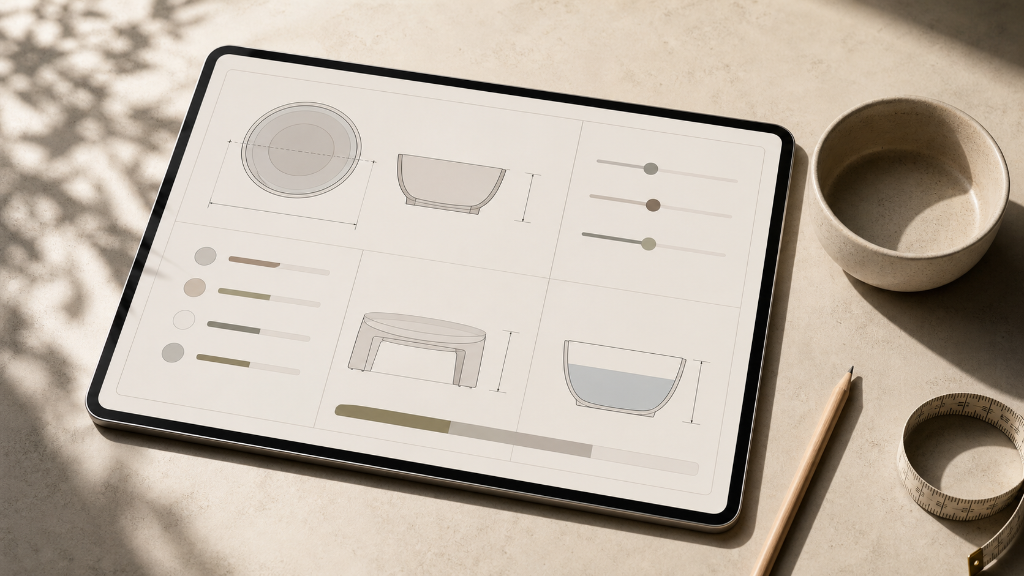
| Output | How to read it | What not to assume |
|---|---|---|
| Minimum opening | The bowl's inner diameter should not be smaller than this reference | It is not the only acceptable width |
| Maximum depth | The bowl should stay shallower than this upper limit, or within a shallow range for cats | A deeper bowl is not better because it holds more |
| Stand range | A posture reference for low or moderate elevation when appropriate | Higher is not automatically more ergonomic |
| Water capacity reference | A station-capacity planning number, adjusted for body weight and diet moisture | It is not the amount the pet must drink from the bowl |
| Risk flags | Conditions that change or stop the normal recommendation | They are not a diagnosis |
The most useful result is often the buying translation, not the raw number. A user does not shop for "muzzle width multiplied by 2.2." They shop for a shallow, stable bowl with a minimum inner opening and a depth that does not force the animal's face into the bottom.
06 — Width and depth shape access
Width and depth are quieter than height, but they often matter more in daily use.
For dogs, muzzle width and muzzle length are practical starting points. The calculator uses muzzle width to estimate a minimum inner opening: for ordinary dogs, the opening starts from a baseline and scales with muzzle width; for brachycephalic or short-muzzled dogs, the opening increases because narrow, deep bowls can make access harder.
For depth, the principle is simple: a bowl should not force the animal to bury the muzzle to reach ordinary food. For dogs, bowl depth is limited by muzzle length. If muzzle length is missing, the calculator asks for it rather than silently inventing a confident result.
For cats, the default is shallower. Cats often do well with low, wide dishes, especially for wet food. The calculator treats 1 to 3.5 cm as a practical shallow depth range, then adjusts when the cat has a flatter face, a wider whisker span, or a pattern of pulling food out of the bowl.
For cats, shallow-wide access is a practical default, not a universal medical claim.
07 — Cats need shallow choice, not marketing claims
"Whisker-friendly" bowls are often marketed as if the science were settled. The better reading is more careful.
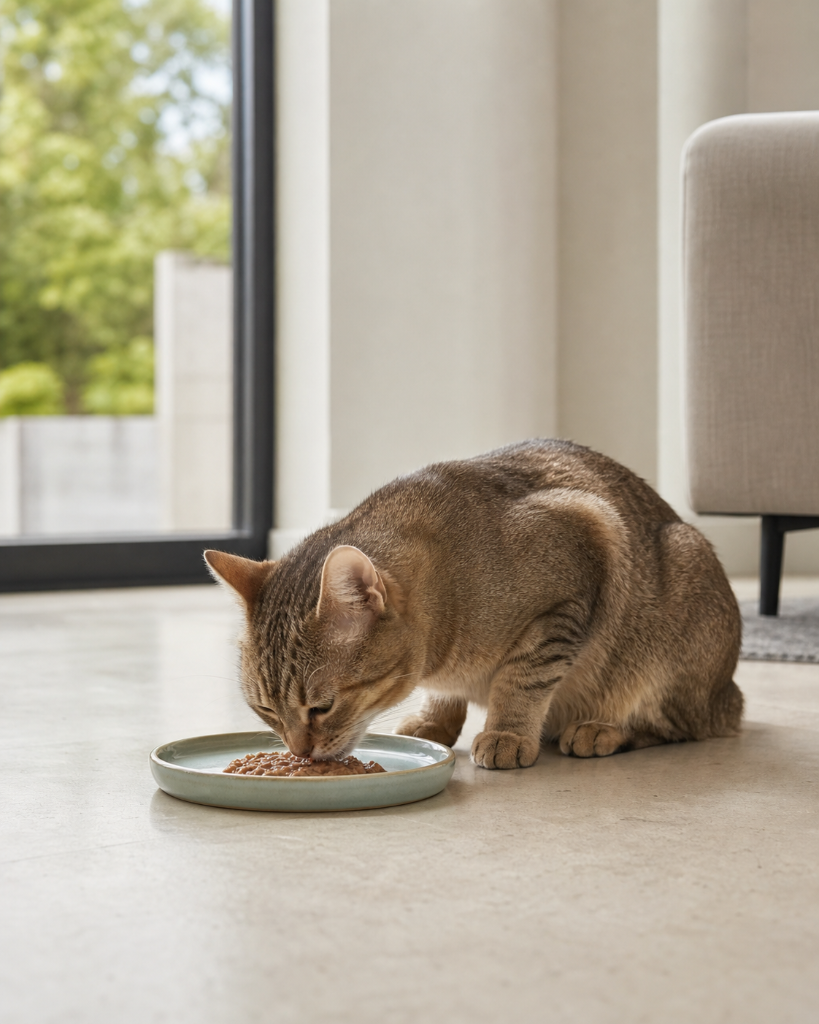
A 2021 study in the Journal of Feline Medicine and Surgery evaluated whisker stress in cats. It did not find significant differences in eating time, amount eaten, or food dropped when cats used a whisker-friendly dish compared with their normal dish. The same study did report that many owner-observed cats preferred the whisker-friendly dish when offered a choice, though the authors cautioned that preference results should be interpreted carefully.
That is enough to support a design principle, but not a medical promise.
For HĀM, the practical conclusion is: a shallow, wide cat dish is a sensible access-first default, but it should not be sold as a proven cure for all feline eating issues.
This is also why the calculator uses whisker span as an input when available. It helps translate "wide enough" into a visible specification, while still keeping the claim modest.
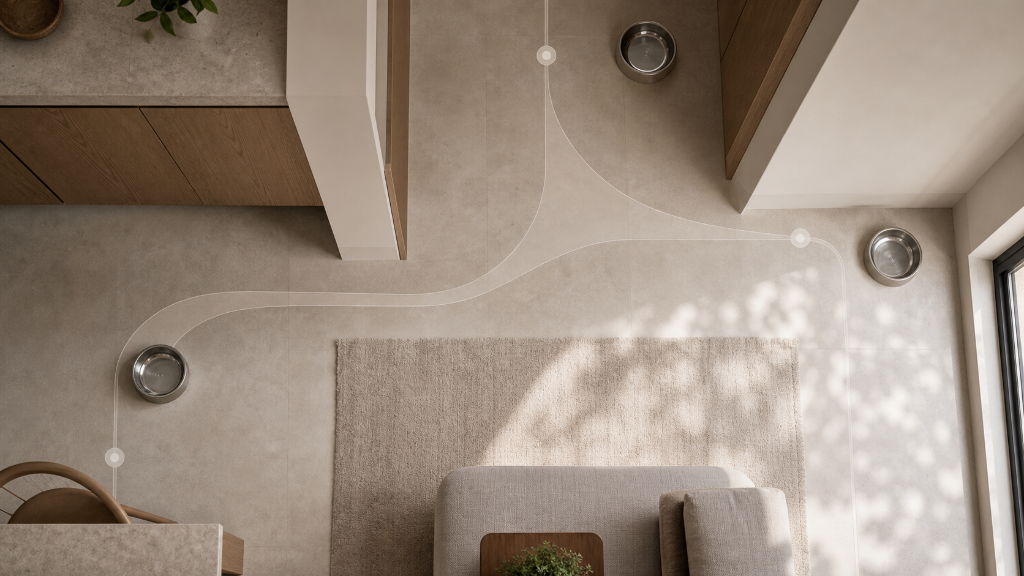
In multi-pet homes, separated water stations are often more useful than one oversized bowl.
08 — Water stations are spatial decisions
Water planning is bigger than bowl volume. It is about access, cleanliness, diet moisture, and placement.
Merck Veterinary Manual notes that healthy dogs and cats generally need water available at all times, that water needs vary by diet, activity, environment, and health status, and that many mammalian species need about 44 to 66 ml/kg of body weight per day in a thermoneutral environment. Canned foods may contain much more moisture than dry foods, so animals eating wet food often drink less from a bowl.
The HĀM calculator uses that reference cautiously. It estimates water-station capacity, then adjusts the drinking-water reference by food type:
| Food type | Drinking-water capacity factor |
|---|---|
| Dry food | 100% of reference range |
| Mixed food | 50% to 70% of reference range |
| Wet food | 25% to 45% of reference range |
| Raw or fresh high-moisture food | 35% to 65% of reference range |
The calculator then adds a capacity margin so the bowl or station is not planned to the last millilitre. This does not mean a wet-fed cat should be prevented from drinking — clean water should always be available. It means the visible bowl volume should not be misread as a required daily drinking target.
For cats, fountains also need sober language. A 2019 study comparing still, circulating, and free-falling water bowls in laboratory cats found no significant average difference in daily water intake across bowl types, though some individual cats showed preferences. A fountain may help one cat and do nothing for another.
HĀM's design conclusion is simple: give water choices, keep them clean, and place them where the animal can use them without pressure.
09 — Multi-pet homes need resource layout, not one bigger bowl
When more than one animal lives in the home, bigger is not always better. A single large bowl can still create social pressure if one animal blocks access, guards the area, or forces another animal to approach through a narrow path.
Feline environmental guidelines from AAFP and ISFM recommend multiple and separated resources, including food and water areas. The same spatial logic is useful in mixed pet homes: separation reduces competition and gives each animal a way to approach, pause, or leave.
For feeding layout, HĀM uses these rules:
| Layout element | Recommendation |
|---|---|
| Number of stations | Prefer multiple stations over one oversized shared station |
| Distance | Separate stations by roughly 1.5 to 2 m where the home allows |
| Sightlines | Avoid forcing animals to eat while directly facing each other |
| Exit routes | Give at least one unobstructed way out |
| Water placement | Keep water stable, clean, and away from litter areas |
A feeding station is part of circulation. It should not trap the animal in a corner.
10 — How HĀM applies this in residential design
HĀM does not treat the feeding area as a loose accessory placed after the room is finished. It is part of the animal's daily route through the home.
In residential design, this changes the questions:
| Design question | HĀM method |
|---|---|
| Where should feeding happen? | Choose a quiet but accessible zone, away from conflict points |
| Should the bowl be raised? | Screen for species, body size, mobility, and risk before deciding |
| How should water be planned? | Use multiple clean access points when needed, not one decorative bowl |
| How should the station be cleaned? | Favour simple geometry and materials that tolerate daily cleaning |
| How does it relate to furniture? | Integrate the station without trapping the animal against walls or traffic |
This is not about making the feeding station more complicated. It is about making it more honest. The animal's body gives the dimensions. The household gives the placement. The medical flags set the limits.
11 — What this does not mean
This article does not mean every pet needs a custom bowl. It does not mean every dog should use a raised feeder. It does not mean every cat needs a branded whisker-friendly product. It does not mean a calculator can diagnose GDV risk, kidney disease, urinary disease, vomiting, or regurgitation.
The purpose is narrower and more useful: to help owners and designers stop guessing from small, medium, and large labels, and start choosing feeding geometry from body size, posture, access, and risk.
<!-- ham-feeding-images-v1 -->Sources
- Source
Canine Gastric Dilatation-Volvulus (GDV)
Purina Institute · n.d.
Used forGDV risk framing and floor-level default for large / deep-chested dogs.
- Source
Canine Megaesophagus
Purina Institute · n.d.
Used forStop condition for standard bowl-height rule; vertical / vet-guided feeding posture.
- Source
Nutritional Requirements of Small Animals
Merck Veterinary Manual · n.d.
Used for44–66 ml/kg/day water reference used as station-capacity baseline.
- Source
Evaluation of whisker stress in cats
Slovak & Foster · 2021
Used forCautious framing of whisker-friendly dish claims; shallow-wide as access default.
- Source
Quantified water intake in laboratory cats from still, free-falling and circulating water bowls
Robbins et al. · 2019
Used forFountain claims kept modest; multiple clean stations preferred to single device.
- Source
Pet feeding habits and microbiological contamination of dog food bowls
Raspa et al. · 2023
Used forMaterial recommendation (stainless / glazed ceramic, avoid scratched plastic).
- Source
AAFP and ISFM Feline Environmental Needs Guidelines
Ellis et al. · 2013
Used forMultiple and separated resources principle for multi-pet feeding layout.
Limitations
- The calculator is a design and shopping reference, not a veterinary diagnosis tool.
- It does not handle breed-specific clinical databases, BCS, per-meal calories, or post-operative recovery.
- GDV, megaesophagus, regurgitation, CKD, urinary disease, and sudden behavioural changes always require veterinary guidance.
- Numeric outputs are conservative ranges and assume reasonable measurement accuracy of body inputs.
- Fountain preference is treated as individual; the tool does not claim a fountain raises intake on average.
Frequently Asked
Free Resource
Get the Spatial Brief Checklist
A printable A4 checklist covering the measurements, photographs, and companion details needed before commissioning a pet space — the same brief HĀM uses with clients.
We'll occasionally send studio notes on companion space design. No spam, unsubscribe anytime.
Begin with the animal, the room, and the routine
If you are considering a companion space, the next step is not choosing a size. It is understanding the animal, the home, and the way you live together.