
Spatial science · MAY 2026
The Geometry of Rest
How pet mats should fit dogs and cats — a body-fit decision, not a decorative accessory.
- Type
- Guide
- Author
- HĀM Studio
- Published
- MAY 2026
- Updated
- May 2026
- Reading time
- 12 min
- Topics
- Rest matBed sizingPressure-aware supportIntegrated insertMaterial & care
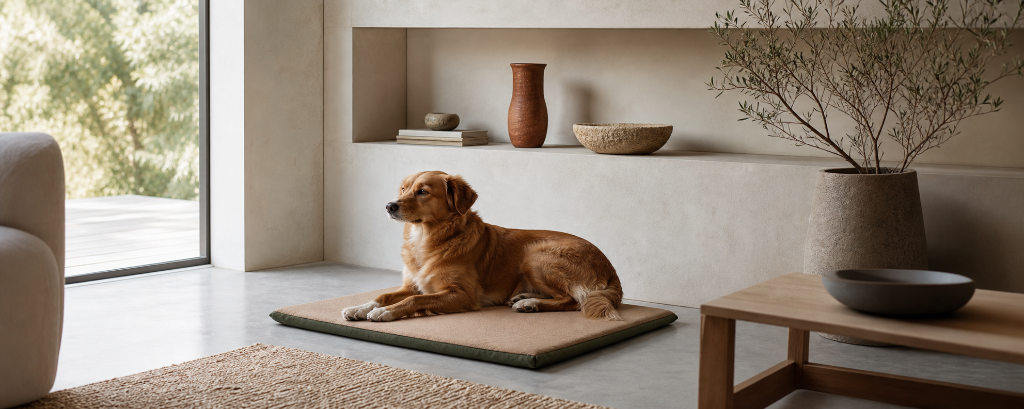
A pet mat should not be chosen by softness alone. It should fit the animal's body size, sleeping posture, pressure risk, entry ability, heat needs, material tolerance, and cleaning routine.
The right pet mat is a body-fit decision, not a decorative accessory.
Most pet beds are sold through broad labels: orthopedic, calming, cooling, washable, anti-scratch, waterproof. Some of those features can be useful. The problem is that they are often presented as if the label itself answers the question. It does not. A 4 kg indoor cat, a 22 kg senior dog, and a thin post-surgery dog do not need the same rest surface simply because a product says "soft" or "orthopedic."
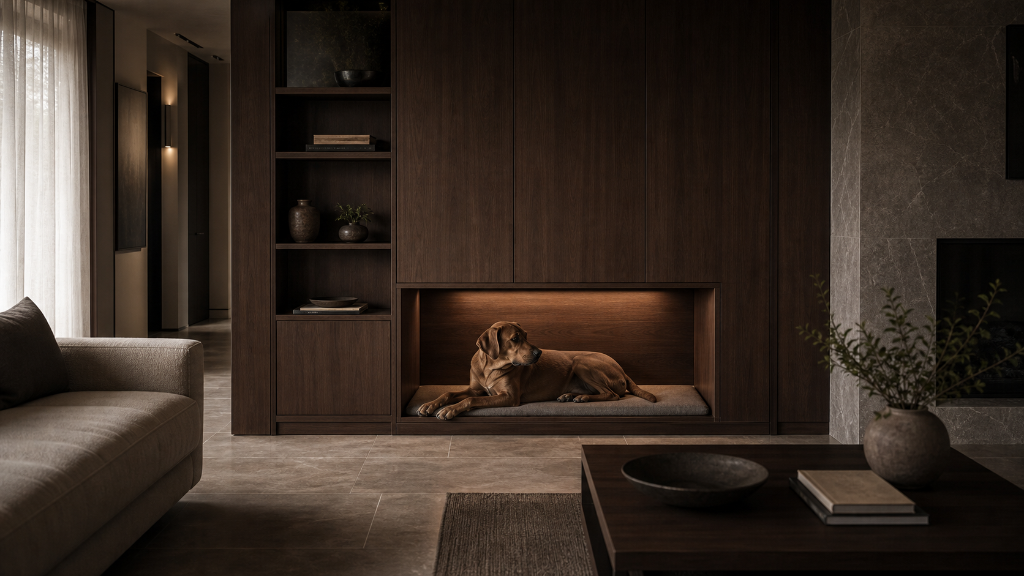
For HĀM, the mat is the contact surface between the animal's body and the designed space. In a cabinet, alcove, crate, platform, sanctuary, or quiet corner, the mat is where architecture becomes bodily experience.
Rest mat fit
A bed that fits the way they sleep.
Tell us who is resting and how they lie. We size the bed and suggest the support and fabric to look for.
Who is resting
Breed
Weight
22.0 kgNose to base of tail
Widest point of the body
How they sleep
Bed
Age
Health
Fine-tune
Body condition
Moving around
Temperature
Coat
Accidents and skin
Habits
Bed size
96 cm × 60 cm
Size L. They don’t need to fill every centimetre.
- Thickness
- 6–9 cm
- A guide; support matters more
- Support
- Medium
- Edges
- Any height
Plan — mat · Section — thickness
Good to know
- Removable washable cover over a dryable insert.
Where to put it
- Place rest mats away from feeding and toileting zones; keep a retreat route available.
How we work this out
Bed length = body length × how they sleep (curled 1.05, side 1.20, stretched 1.35, a mix 1.25), plus 12 cm for a loose bed. Width works the same way with body width, and curled beds stay close to round.
Each weight has a practical minimum, so a small reading never shrinks the bed. A built-in insert gets 3 cm all round for lifting out, cleaning and airflow.
Results were checked against common retail sizing. A cooling option for flat-faced dogs follows evidence that they have about twice the odds of heatstroke.
The sleep factors, minimum sizes, thickness ranges and the foam-density benchmark are HĀM design assumptions. Severe arthritis, wounds and recent surgery go to a vet.
Sources: FCI / AKC / TICA breed standards; retail bed sizing guides; Hall, Carter & O'Neill 2020 (Sci Rep).
A design and shopping reference. It does not diagnose pain, arthritis, pressure sores or skin conditions.
01Direct answers
A good pet mat is not defined by softness alone; it should distribute pressure, fit the animal's sleeping posture, allow easy entry, and remain cleanable over daily use.
For senior, thin, or mobility-limited dogs, pressure relief matters more than plush thickness because a soft-looking mat can still allow high-pressure contact at the shoulder, hip, and ribs.
Cats often need a resting surface that combines softness with security: the mat should support curling, scent familiarity, concealment, and retreat.
Thickness is not the same as support. A thick mat that collapses under body weight may perform worse than a thinner mat with a stable support core.
In an integrated pet space, enclosure size and mat fit are related but not identical. Enclosure size determines entry, turning, ventilation, and choice; mat fit determines how the body is supported during rest.
02What good pet mat fit includes
| Element | Why it matters | Design reference |
|---|---|---|
| Usable length | Lets the animal sleep in its normal posture | Body length × posture factor |
| Usable width | Supports side sleeping, curling, and limb position | Body width × posture factor |
| Support core | Reduces bottoming out under body weight | Weight, age, body condition, mobility risk |
| Surface texture | Affects warmth, grip, scratching, scent, and cleaning | Coat, behaviour, and hygiene needs |
| Entry access | Determines whether the pet can actually use the mat | Low or open-side entry for senior or mobility-limited pets |
| Washability | Affects odour, allergens, urine, vomiting, long-term use | Removable cover, dryable insert, liner when needed |
| Placement | Changes whether the mat feels safe or exposed | Low-traffic, separated resources, retreat route |
This is why HĀM treats a rest mat as a specification set, not a single shopping dimension.
03Why softness is not enough
Softness is the first thing humans notice. Support is what the body feels after weight is applied.
A plush mat can look generous while collapsing under a large dog. A thin mat can feel clean and minimal while offering too little pressure buffering for a thin senior animal. A warm fleece surface can be comforting for a short-haired cat and uncomfortable for a heat-prone dog. A high bolster can feel secure for one pet and become a barrier for another.
The useful question is not "Is this mat soft?" The better question is:
Can this animal enter it, rest on it, leave it, and keep using it after daily cleaning?
That question is less glamorous than marketing language, but it is much closer to how dogs and cats actually experience a resting surface.
04What research can support
The evidence around pet mats is not a single neat sizing standard. There is no universal peer-reviewed table that says every 18 kg dog needs one exact bed length, one exact foam thickness, and one exact material. The science is stronger in the principles around pressure, access, environmental choice, hygiene, and risk boundaries.
In a 2019 veterinary study comparing supports used for pressure sore prevention, Caraty and colleagues measured contact pressures in laterally recumbent dogs. Recurrent risk zones included the scapula-humeral area, the greater trochanter, and the thirteenth rib. Pressure-relieving mats reduced pressure compared with standard mats or blankets, but the study also warned that static mats alone were generally insufficient to keep all risk zones below safe pressure thresholds, especially in thin patients.
That finding matters for ordinary pet homes because it separates two ideas that are often blurred: a bed can look soft and still fail as support.
Research on laboratory beagles also suggests that soft bedding can matter for use and preference, especially in older dogs, though it should not be stretched into a universal product rule for every breed or health condition. For cats, Crouse and colleagues reported that adding soft pillows to laboratory cat environments increased use of the soft surface and reduced lying in litter pans. The study is old and context-specific, but the direction is still useful: softness can affect where a cat chooses to rest.
Feline environmental guidelines from AAFP and ISFM add another layer. Cats need safe places, separated key resources, predictable scent cues, and environments that allow retreat. A cat mat is part of that resource map, not a cushion floating by itself.
Dog housing research also supports the idea that rest location matters. Wagner and colleagues observed 579 shelter dogs over 4440 observation days in double-compartment kennels. When dogs eliminated inside the kennel, urination and defecation were much more likely to occur on the side opposite the bed, food, and water area. The home is not a shelter kennel, but the principle is useful: resting areas should not be crowded into toileting or high-soiling zones.
05Dogs: size, pressure, age, and entry
For dogs, mat fit begins with body size and sleeping posture, but it should not end there.
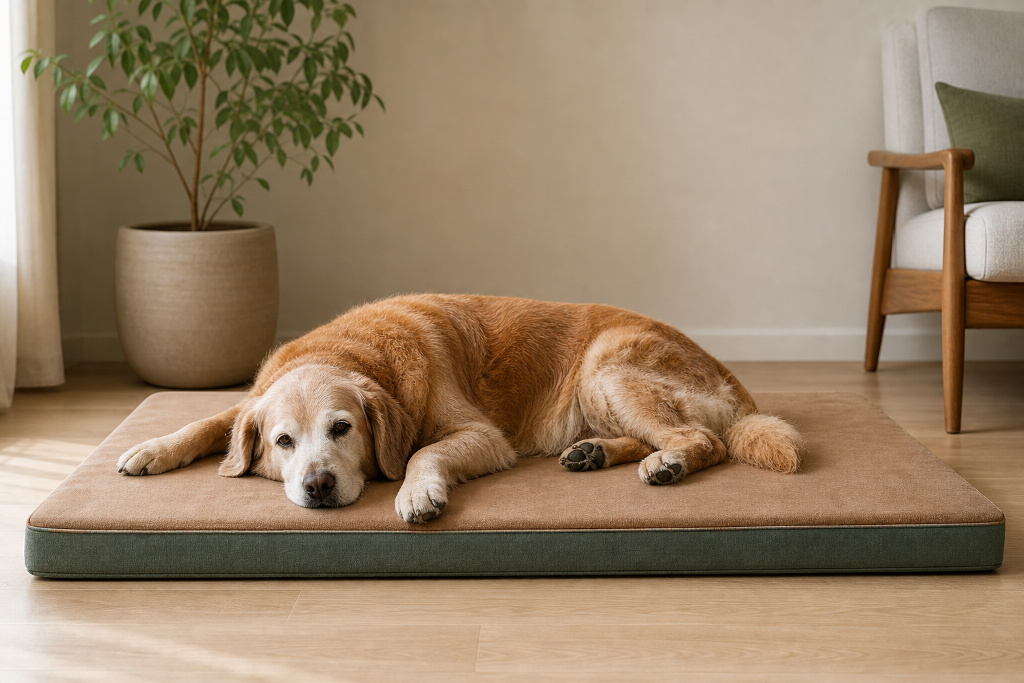
A side-sleeping dog needs more usable width than a curled sleeper. A stretched sleeper needs length. A large or overweight dog may need a denser support core because soft fill can compress until the body is close to the floor. A thin dog may need pressure buffering at the shoulder, hip, ribs, and elbows. A senior dog may reject a bed that looks comfortable because the edge is too high.
| Dog condition | Design direction |
|---|---|
| Healthy adult, no mobility flag | Comfort or medium-support mat, sized to posture |
| Senior dog | Low entry, stable support, avoid full-height bolsters on all sides |
| Thin dog | Pressure-aware support; avoid hard thin mats |
| Overweight or large dog | Stable core; do not judge by thickness alone |
| Heat-prone dog | Breathable or cooling surface as an option |
| Incontinence or vomiting | Waterproof liner plus washable cover |
| Heavy chewer | Durable low-risk construction before comfort claims |
The goal is not to turn every dog bed into medical equipment. It is to stop treating all dogs as if body weight, posture, and entry access do not matter.
06Cats: softness, security, scent, and choice
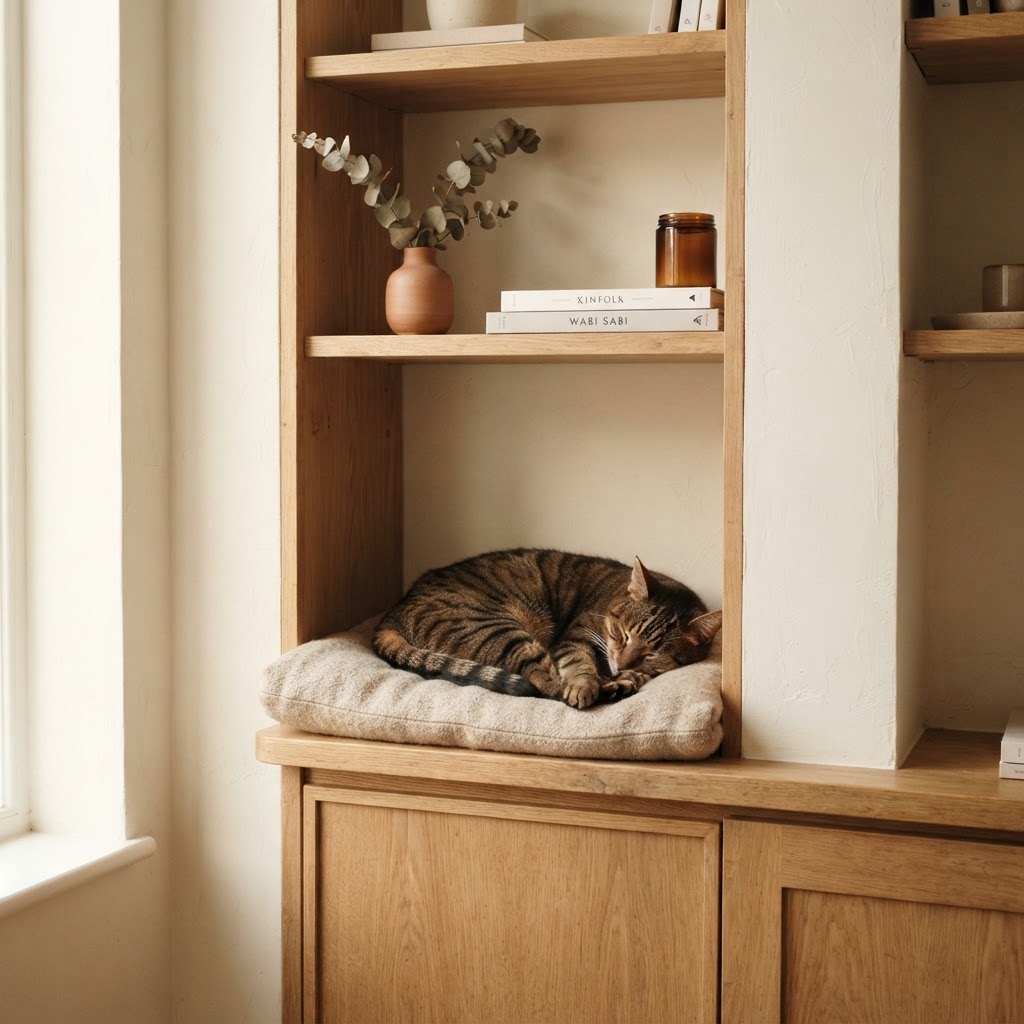
Cats often use rest surfaces differently from dogs. A cat may choose a mat because it is soft, but also because it is warm, familiar, hidden, elevated, near a wall, near a human, or away from other animals.
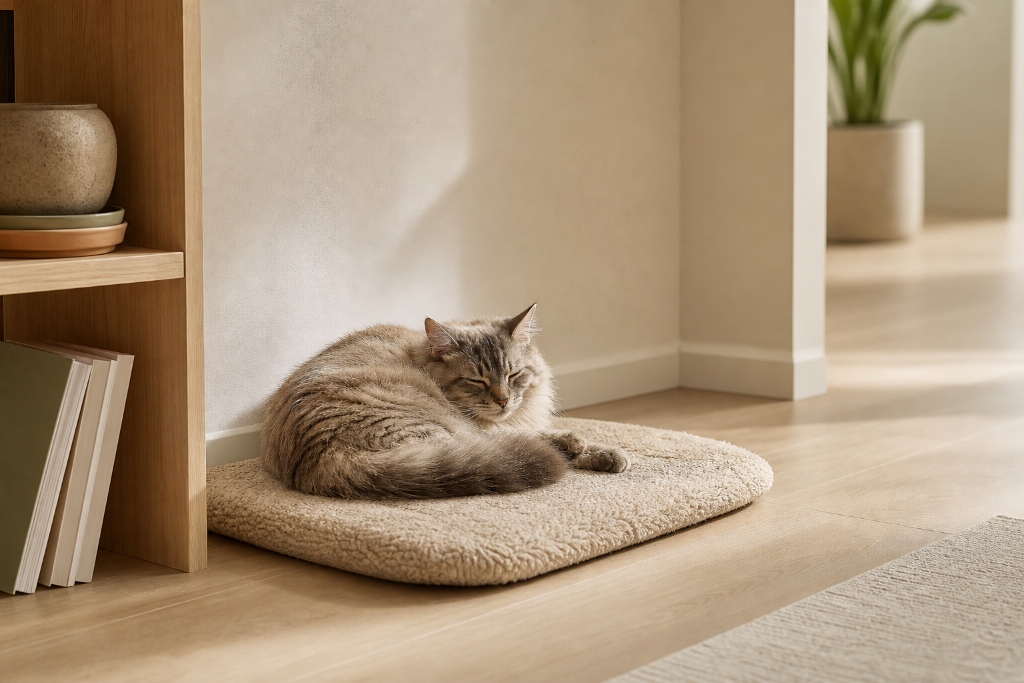
For cats, the surface itself and the location are hard to separate.
| Cat need | Mat or placement response |
|---|---|
| Curling | A surface large enough for the curled body, rather than a tiny pad |
| Security | Semi-enclosed or edge-adjacent placement if the cat prefers cover |
| Scent familiarity | Fragrance-light cleaning and gradual introduction |
| Retreat | A route away from people, dogs, or other cats |
| Multiple resources | More than one resting surface in multi-cat homes |
| Senior access | Low entry, lower placement, or stepped access |
This does not mean every cat needs a plush nest. Some cats prefer flat mats, cardboard, woven surfaces, or a perch pad. The useful point is that cat mats should be evaluated as part of the cat's resource system, not as isolated decor.
07How the calculator reads the result
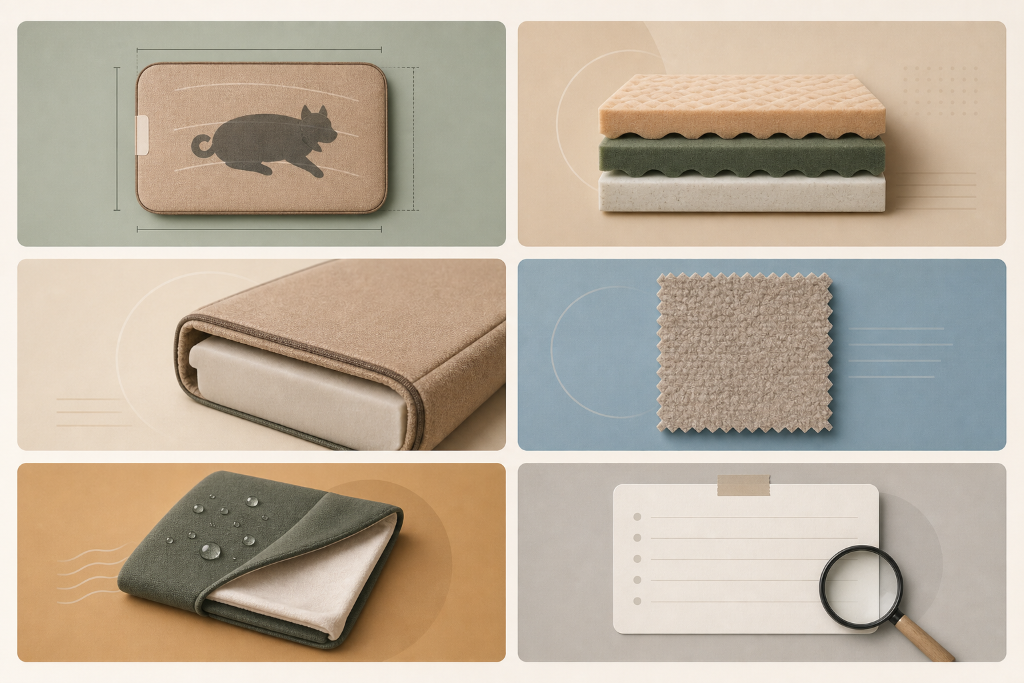
The calculator uses a decision panel with six labels:
| Label | Meaning |
|---|---|
| Volume | The usable rest-surface scale: S, M, L, or XL |
| Support | The material-support category, from comfort to pressure-aware |
| Entry | Whether a normal, low, or open-side entry is better |
| Material | The broad material direction: foam, warm, cooling, waterproof, durable, layered, or washable |
| Care | Cleaning and maintenance priority |
| Evidence | Whether the result is a design reference, pressure-aware result, review flag, or vet-guided case |
These labels are not decorative. They are a compact way to show what the algorithm is doing. A person shopping for a mat needs a practical answer first: size, support, material, entry, and care.
08The sizing logic
The calculator uses body measurements and sleeping posture to estimate the minimum usable rest surface.
minimum_length = body_length × posture_length_factor + margin
minimum_width  = body_width  × posture_width_factor  + margin
The posture factor changes because a curled sleeper, a side sleeper, and a stretched sleeper do not use the same rectangle.
| Sleeping posture | Length factor | Width factor | Design meaning |
|---|---|---|---|
| Curled | 1.05 | 1.25 | Compact body shape; security and edge feel may matter |
| Side sleeper | 1.20 | 1.60 | Extra width for shoulder, hip, ribs, and limbs |
| Stretched | 1.35 | 1.35 | Extra length; avoid short beds |
| Mixed / unknown | 1.25 | 1.45 | Conservative default when posture is unclear |
The result is then checked against a practical minimum floor by species and weight. This prevents the calculator from returning an unrealistically small mat when a user enters a short body measurement.
The number should be read as a minimum usable surface, not as a command that the pet must fill every centimetre.
09Standalone mats vs integrated inserts
A standalone floor mat can include posture margin around the body. It can be larger because it sits in open space.
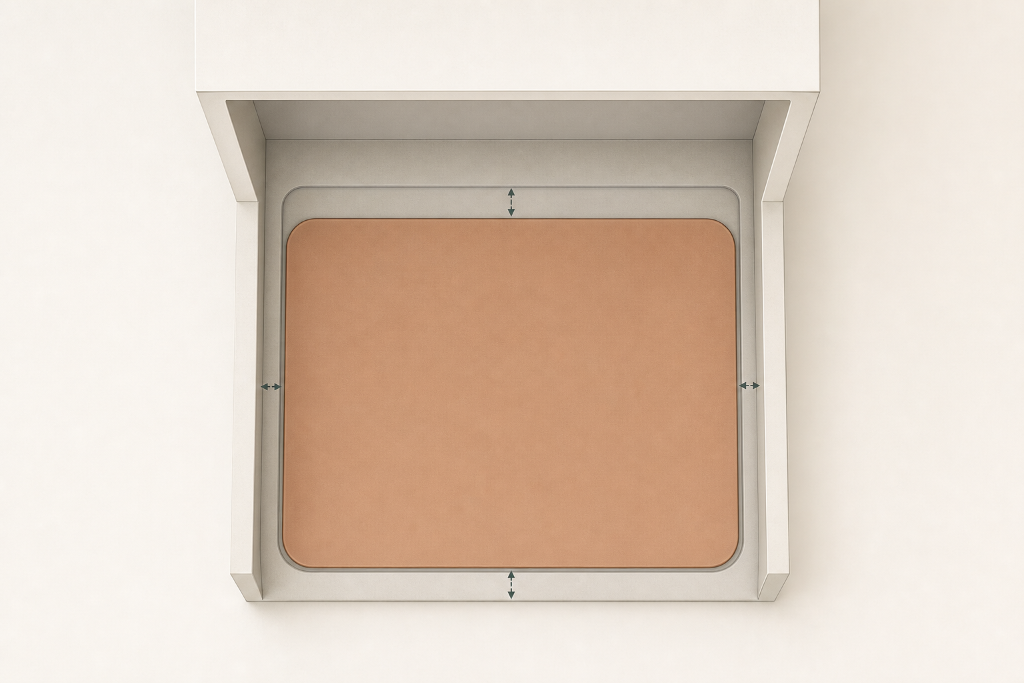
An integrated insert inside a cabinet, crate, alcove, or sanctuary has a different job. It must fit the internal clear space while leaving practical allowance for removal, cleaning, airflow, seams, cover thickness, and small material movement.
HĀM's calculator therefore separates two outputs:
| Output | Meaning |
|---|---|
| Recommended insert size | The mat or pad surface the pet rests on |
| Recommended inner cabinet size | The internal clear space needed after installation allowance |
By default, the calculator does not ask users to validate an existing cabinet. It first tells them what insert size and inner cabinet size should be planned together. Existing-cabinet validation belongs in advanced mode, because it is a check against a real constraint, not the main recommendation.
This matters because a smaller cabinet should not automatically shrink the recommended mat and make the result look acceptable. If the entered cabinet is too small, the answer should say there is a cabinet-size conflict.
10Thickness is a reference, not the answer
Thickness is easy to measure, which is why people overtrust it.
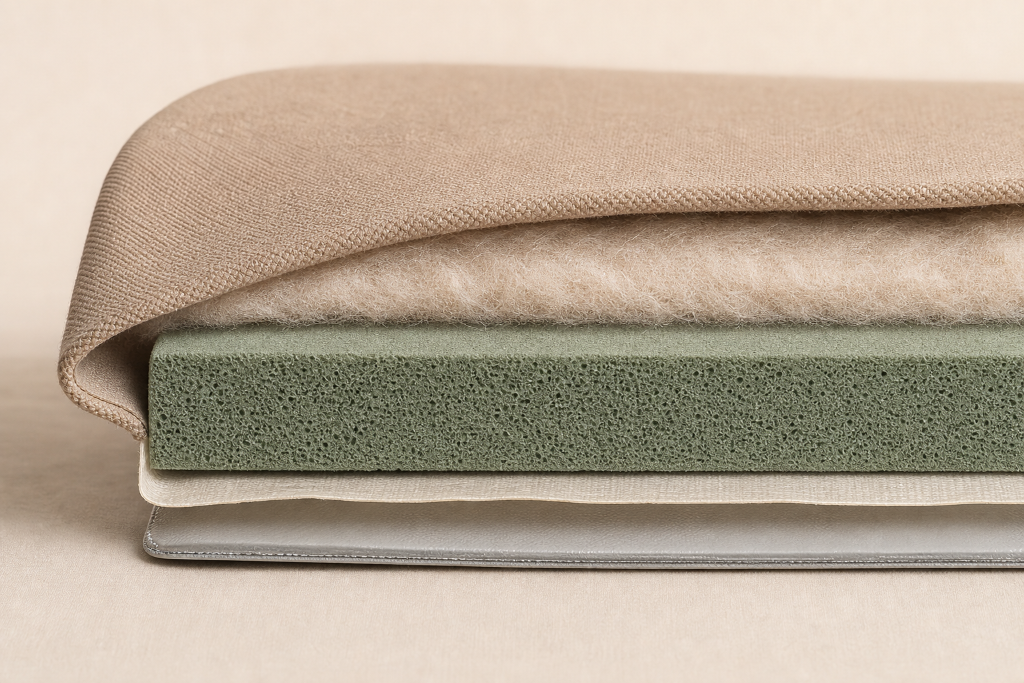
The calculator gives a thickness reference range, but support depends on structure: foam density, indentation behaviour, layering, cover stretch, weight distribution, body condition, and whether the mat bottoms out.
For many medium and large dogs, a layered structure is more useful than a single thick slab of very soft foam:
| Layer | Role |
|---|---|
| Comfort top | Reduces hard contact and improves acceptance |
| Stable support base | Resists collapse under body weight |
| Washable cover | Makes daily use realistic |
| Waterproof liner, when needed | Protects the core from urine, vomiting, and odour |
For cats and smaller healthy pets, a lower-profile textile mat or soft cushion may be enough, especially when security, scent, and placement matter more than load-bearing support.
11Marketing terms vs useful specifications
| Marketing term | Better question |
|---|---|
| Orthopedic | Does it resist bottoming out under this animal's weight? |
| Memory foam | Is there a stable support base, or only a soft top layer? |
| Calming | Does the placement give security, scent familiarity, and retreat? |
| Cooling | Does the animal actually seek cooler surfaces? |
| Waterproof | Is the inner core protected, and is the cover washable? |
| Anti-scratch | Is the weave low-pile, tight, and replaceable? |
| Washable | Can the cover be washed often without destroying the insert? |
This is the shift HĀM wants the user to make: from buying a claim to reading a specification.
12What this does not mean
This article does not say that a mat can treat arthritis, pressure sores, anxiety, skin disease, or chronic pain. It does not say memory foam is always better. It does not say every cat needs a plush bed. It does not say every senior dog needs the thickest possible mat.
It does say that a rest surface should be chosen with the animal's body and home context in mind. That is a design standard, not a medical promise.
If a pet has an open wound, pressure sore, sudden mobility decline, severe arthritis signs, post-surgery immobilization, or persistent pain, mat choice should be guided by a veterinarian.
13How HĀM applies this in residential design
HĀM does not treat the mat as an afterthought. In a built pet space, the mat changes the way the animal experiences the enclosure.
The same internal cabinet can feel generous with the right insert and cramped with the wrong one. A stable surface can make an alcove usable for a senior dog. A low-entry pad can make a sanctuary easier to enter. A cat mat placed with scent and retreat in mind may be used more readily than a beautiful cushion placed in an exposed hallway.
HĀM treats resting surfaces, feeding geometry, vertical territory, and enclosure size as different ways the animal's body meets the home.
References
Sources
- 01
Comparison of the different supports used in veterinary medicine for pressure sore prevention
Caraty et al. · 2019
Used for: Pressure-aware support framing; risk zones at scapula, trochanter, 13th rib; warning that static mats alone are often insufficient in thin patients.
- 02
Use of beds by laboratory beagles
Döring et al. · 2018
Used for: Soft bedding preference signal in older dogs; cautious generalisation only.
- 03
Soft surfaces: a factor in feline psychological well-being
Crouse et al. · 1995
Used for: Direction that softness can affect where a cat chooses to rest.
- 04
AAFP and ISFM Feline Environmental Needs Guidelines
Ellis et al. · 2013
Used for: Safe places, separated resources, scent cues, and retreat — cat mats as part of a resource map.
- 05
Elimination behavior of shelter dogs housed in double compartment kennels
Wagner et al. · 2014
Used for: Principle that resting areas should not be crowded into toileting or high-soiling zones.
- 06
Functional linear modeling of activity data shows analgesic-mediated improved sleep in dogs with spontaneous osteoarthritis pain
Gruen et al. · 2019
Used for: Sleep / rest matters in osteoarthritic dogs; supports pressure-aware framing.
- 07
Associations between osteoarthritis and duration and quality of night-time rest in dogs
Smith et al. · 2022
Used for: Connects rest quality to musculoskeletal status in dogs.
- 08
Effectiveness of laundry washing agents and conditions in the removal of cat and dust mite allergen from bedding dust
Tovey et al. · 2001
Used for: Washability · allergen management framing for cover and liner choices.
Scope
Limitations
- 01This calculator is a design and product-reference tool, not a veterinary diagnosis instrument.
- 02It does not treat arthritis, pressure sores, anxiety, skin disease, or chronic pain.
- 03Open wound, pressure sore, post-surgery immobilization, severe arthritis, sudden mobility decline, or persistent pain require veterinary guidance.
- 04Thickness alone does not equal support — read alongside the Support label and product structure.
- 05Existing-cabinet input is a validation check; it should not be used to shrink the recommended mat to fit a constrained cabinet.
Questions
Frequently asked
Free resource
Get the Spatial Brief Checklist
A printable A4 checklist covering the measurements, photographs, and companion details needed before commissioning a pet space — the same brief HĀM uses with clients.
We'll occasionally send studio notes on companion space design. No spam, unsubscribe anytime.
Continue reading
Read next
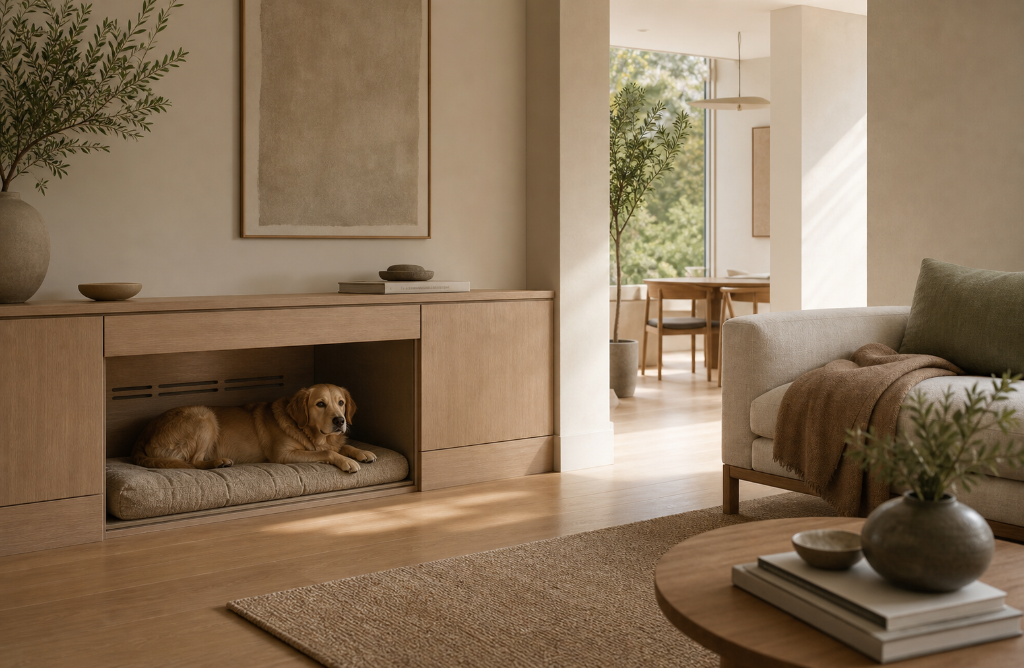
Begin with the animal, the room and the routine
If you are considering a companion space, the next step is not choosing a size.
It is understanding the animal, the home, and the way you live together. A free concept is the place to begin.