
Why Cats Need Vertical Territory, Not Just Floor Space
Indoor cats experience space through height, visibility, and retreat — not square footage alone. A look at the welfare evidence behind genuinely cat-friendly homes.
- Category
- SPATIAL DESIGN
- Type
- Essay
- Author
- HĀM Studio
- Published
- MAY 2026
- Last updated
- May 2026
- Reading time
- 7 min
Topics
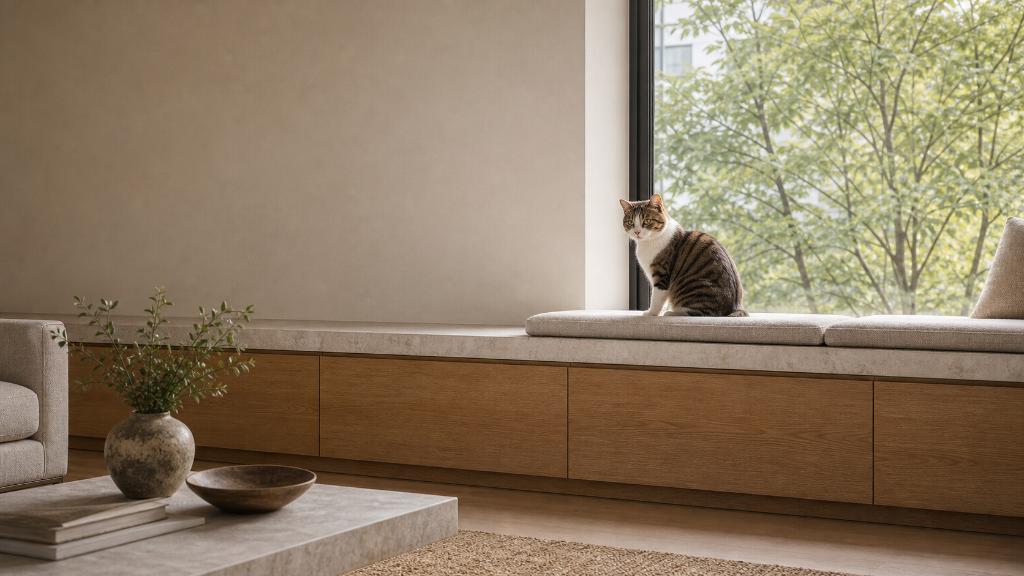
Indoor cats do not experience space only by square footage. They experience it through height, visibility, hiding, scent, access, and the ability to move away before conflict begins.
Cats need vertical territory because height gives them visibility, retreat options, and greater control over social distance inside the home.
A larger room can still feel poor to a cat if every resource sits on the floor, every route is exposed, and every resting place is easy for people, dogs, or other cats to interrupt. A smaller home, designed with levels, cover, and choice, can often give a cat a better sense of control.
This is the difference between floor space and territory.
Floor Space Is Only One Dimension
Floor area tells us how much room exists on a plan. It does not tell us whether a cat can observe the room without standing in the middle of it. It does not tell us whether one cat can avoid another. It does not tell us whether a resting place feels protected.
For cats, territory is three-dimensional.
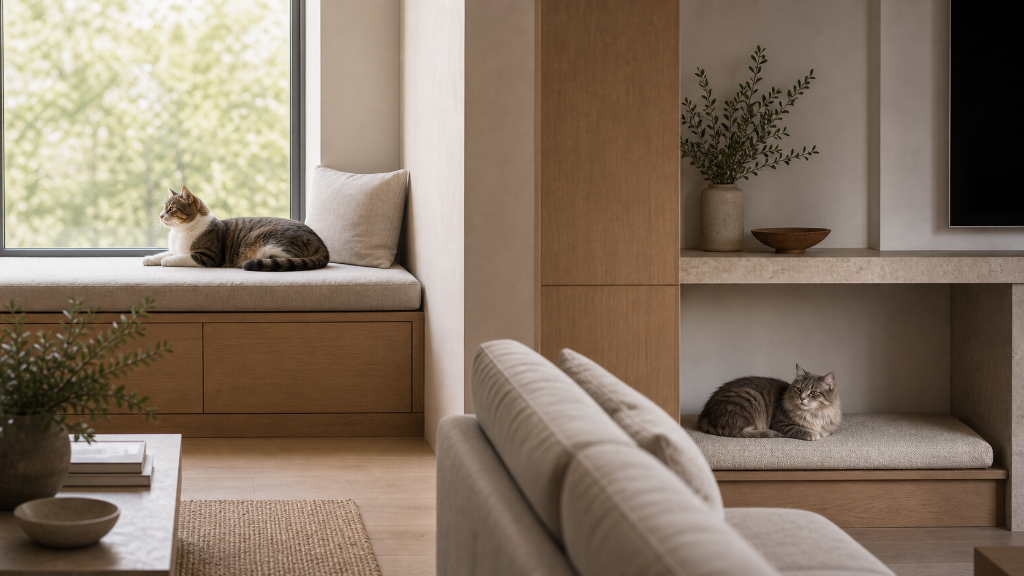
A chair back, a window ledge, the top of a cabinet, a wall shelf, a stair landing, or a semi-enclosed perch can all become part of the usable environment. These places matter because they change what the cat can see, how exposed the body feels, and how easily the cat can leave.
The 2013 AAFP/ISFM Feline Environmental Needs Guidelines describe environmental needs as essential to feline wellbeing. The same guidelines describe safe places as private, secure areas that are often raised and offer enclosure or seclusion.
In residential design, that point matters. A cat-friendly home is not made by adding one object called cat furniture. It is made by designing a home where the cat has several ways to rest, observe, retreat, scratch, move, and avoid pressure.
Height Gives Cats a Sense of Control
Cats are hunters, but they are also animals that rely on avoidance. They protect themselves by reading a room early.
An elevated place gives a cat a wider view of movement in the home. From height, it can watch doors, people, dogs, children, and other cats without standing in the traffic path. That visibility can make the environment feel more predictable.
The AAFP/ISFM Guidelines include elevated areas as part of a cat's environmental resources. Height increases usable vertical space and gives a cat more ways to monitor its surroundings.
This does not mean every cat needs a dramatic wall of shelves. Some cats want height. Some want cover. Older cats may need lower steps, ramps, or intermediate platforms. The better question is not how high can the cat go? It is: can the cat see, rest, and leave by choice?
A Safe Place Is Often an Elevated Place
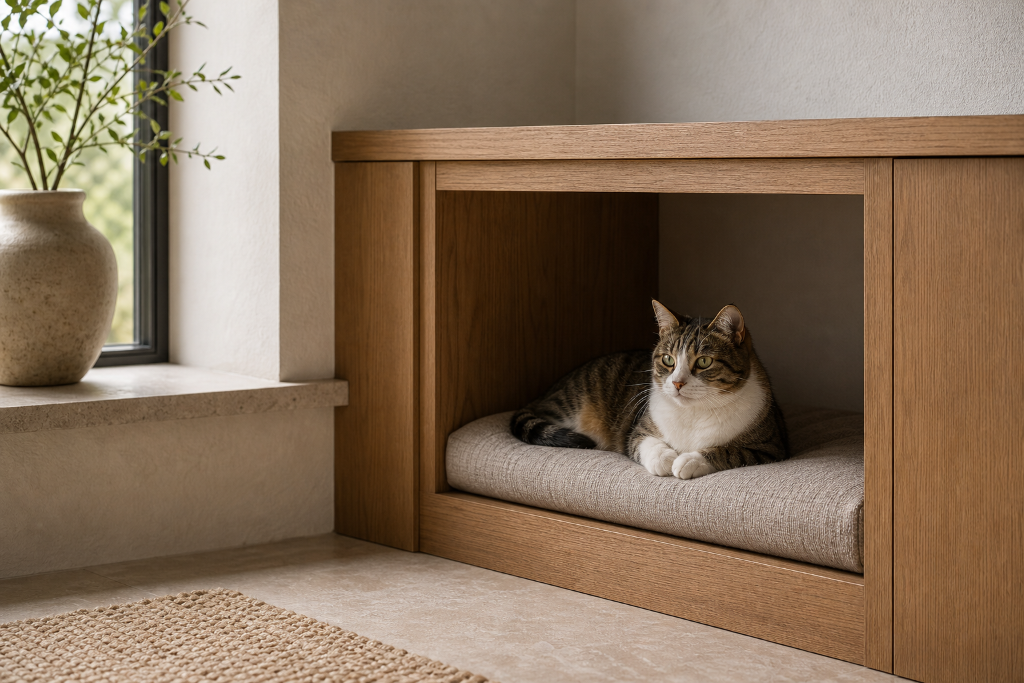
A safe place is not just a hiding spot. It is a place the cat can choose when it wants less exposure.
The 2013 AAFP/ISFM Guidelines recommend individual hiding places and note that perches and shelves should be wide and long enough for a cat to stretch fully. They also recommend multiple safe places in separate areas, especially in multi-cat homes.
A 2019 randomized controlled trial found that shelter cats with hiding boxes recovered from behavioral stress seven days earlier than cats without hiding boxes.
That study focused on shelter cats, not private homes. Still, the principle travels well: cats cope better when the environment gives them a protected place to withdraw. In a home, that protected place may be a semi-enclosed shelf, a built-in perch, a quiet cabinet alcove, a window-adjacent retreat, or a raised resting surface with partial visual cover.
The point is not concealment for its own sake. The point is choice.
Vertical Space Helps Indoor Cats Behave More Naturally
Indoor life can protect cats from outdoor risks, but it can also flatten their world. Many indoor cats live with limited climbing, limited hiding, repeated human interruption, and resources placed too close together.
Environmental enrichment helps by making the indoor habitat more complex and usable.
A 2015 study on communally housed cats found that refuges changed how cats used available space. The same study reported that cats spent longer periods in refuges placed at 0.5 m than in ground-level refuges, although ground-level refuges were entered more often.
That distinction is useful. Ground-level places can invite exploration. Elevated refuges can support longer resting and observation. A well-designed home does not force one solution. It gives the cat a small system.
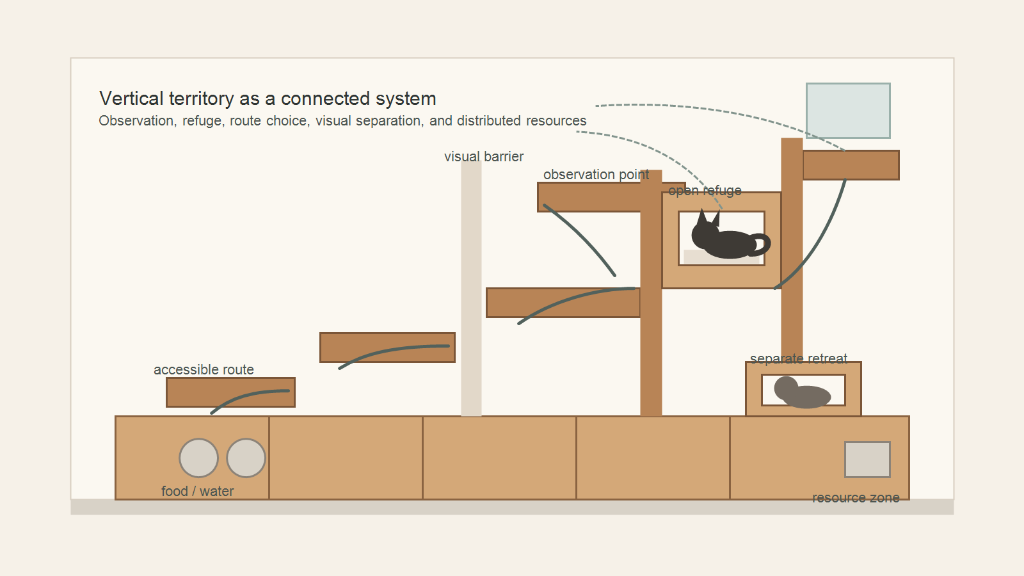
Good vertical territory is not a single cat shelf; it is a connected system of elevated observation points, protected resting places, escape routes, and separated resources.
In Multi-Cat Homes, Height Can Reduce Pressure
Multi-cat homes need more careful spatial design. Conflict is not always loud. It may appear as staring, blocking, avoidance, hiding, interrupted feeding, or one cat quietly losing access to favored areas.
The 2024 AAFP Intercat Tension Guidelines report that surveys have found signs of intercat tension in 62.2% to 87.7% of multi-cat households.
In multi-cat homes, vertical places such as shelves, furniture, and cat trees can increase a cat's control over the environment by allowing climbing, perching, and monitoring of other cats.
The same guidelines recommend safe places for every cat — generally one per cat plus one additional place — so cats have choice and competition is reduced. They also emphasize separated resources, visual barriers, and access routes that cannot easily be blocked by another cat.
This is where many homes fail quietly. They may have enough total area, but not enough separation. They may have a cat tree, but it sits in a corner with one way up and one way down. They may have multiple cats, but every food bowl, litter box, and resting place belongs to the same exposed floor zone.
For cats, peace often depends on the ability to avoid each other before tension becomes visible.
What Good Vertical Territory Actually Includes
| Element | Function | Design Recommendation |
|---|---|---|
| Elevated observation point | Visibility, control, environmental monitoring | A stable perch that lets the cat observe the room while staying above floor-level activity; no fixed height standard |
| Semi-enclosed resting refuge | Security, stress regulation, sleep | At least one protected resting place per cat; in multi-cat homes, one per cat plus one extra |
| Connected vertical route | Movement choice, escape, exercise | Avoid isolated dead-end shelves; create more than one way up or down where possible |
| Visual barriers | Less staring, less social pressure | Use furniture, walls, partitions, or staggered levels to interrupt direct sightlines |
| Separated key resources | Reduced competition | Separate food, water, litter, scratching, rest, and play areas rather than clustering them |
| Accessible lower levels | Senior cat access, inclusive comfort | Ramps, lower steps, or intermediate platforms for older or less mobile cats |
This table should not be treated as a rigid formula. Cats differ by age, mobility, confidence, health, and social history. The stronger standard is behavioral: can the cat observe, withdraw, move, and access resources without being forced into exposure?
How HĀM Applies This in Residential Design
HĀM treats cat space as a three-dimensional residential system, not as a decorative accessory.
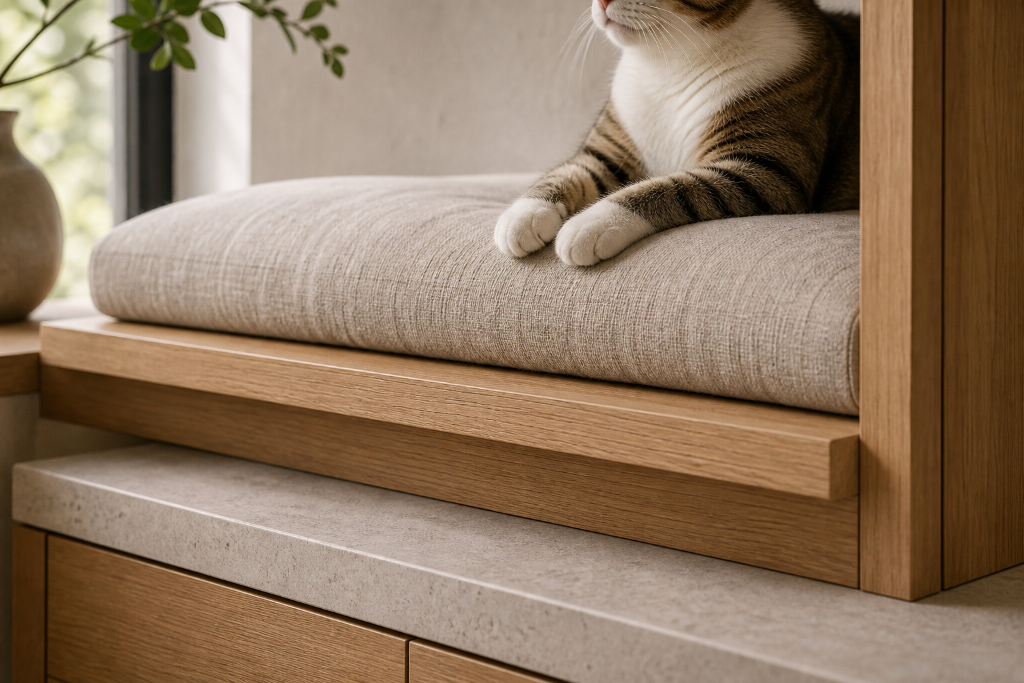
That means we look at height, sightlines, entry and exit points, surface stability, material feel, resting posture, human circulation, and the relationship between cat routes and the architecture of the home.
The goal is not to add more visible pet furniture. The goal is to make the home more legible and usable for the cat.
A good cat environment should answer several quiet questions:
- Can the cat rest without being stepped over?
- Can it watch the room without standing in the room?
- Can it leave without confrontation?
- Can two cats use the same home without being forced into the same path?
- Can an older cat still reach comfort without strain?
These are design questions before they are product questions. When they are answered well, the result does not feel like a pet zone added after the home was finished. It feels like the home understood who lives there.
Sources
- Source
AAFP and ISFM Feline Environmental Needs Guidelines
Ellis, S. L. H., Rodan, I., Carney, H. C., Heath, S., Rochlitz, I., Shearburn, L. D., Sundahl, E., Westropp, J. L. · 2013
Used forFoundational welfare framework defining environmental needs, safe places, and elevated resting areas for cats.
- Source
The effect of a hiding box on stress levels and body weight in Dutch shelter cats; a randomized controlled trial
van der Leij, W. J. R., Selman, L. D. A. M., Vernooij, J. C. M., Vinke, C. M. · 2019
Used forEvidence that access to a hiding place accelerates behavioral recovery from stress.
- Source
The Use of Refuges by Communally Housed Cats
De Oliveira, A. S., Terçariol, C. A. S., Genaro, G. · 2015
Used forEvidence that elevated refuges support longer resting and that height changes how cats use available space.
- Source
2024 AAFP Intercat Tension Guidelines: recognition, prevention and management
Rodan, I., Ramos, D., Carney, H., DePorter, T., Horwitz, D. F., Mills, D., Vitale, K. · 2024
Used forPrevalence data on intercat tension and design principles for multi-cat homes (safe places, visual barriers, separated resources).
Limitations
- Vertical territory does not mean covering every wall with shelves. Every cat differs in age, mobility, confidence, and social history.
- Vertical space alone cannot resolve anxiety, aggression, house-soiling, or medical conditions. Behavior changes can have medical causes.
- Older cats may avoid height because of pain or reduced mobility. Sudden behavior changes should be discussed with a veterinarian or qualified feline behavior professional.
- Good design supports welfare. It does not replace care.
Frequently Asked
Free Resource
Get the Spatial Brief Checklist
A printable A4 checklist covering the measurements, photographs, and companion details needed before commissioning a pet space — the same brief HĀM uses with clients.
We'll occasionally send studio notes on companion space design. No spam, unsubscribe anytime.
Begin with the animal, the room, and the routine
If you are considering a companion space, the next step is not choosing a size. It is understanding the animal, the home, and the way you live together.