
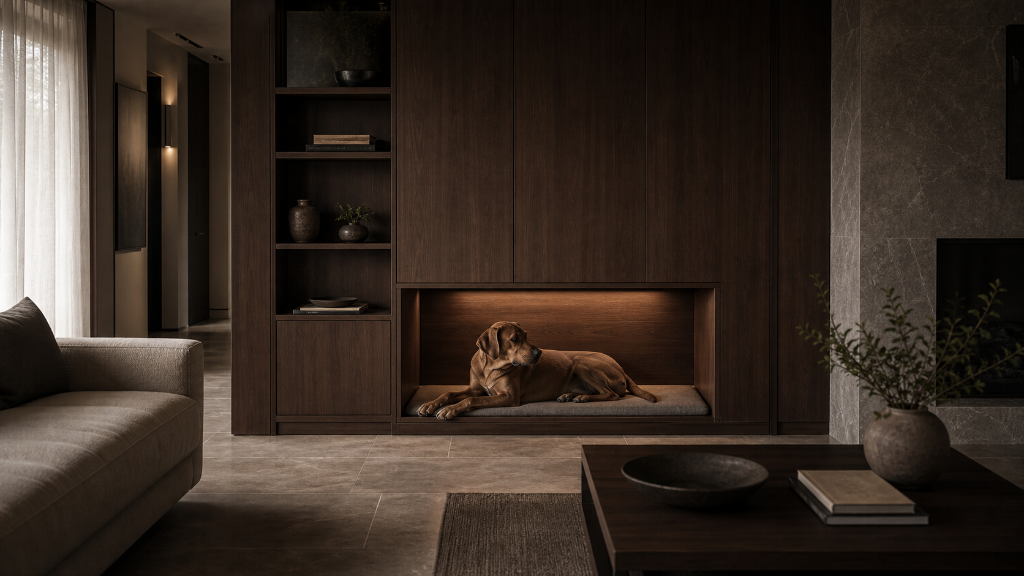
The Science of Space: Inside the HĀM Spatial Framework
- Category
- PHILOSOPHY
- Author
- HĀM Studio
- Published
- MAY 2026
- Reading time
- 8 min
How much space does a dog actually need inside a home? Most pet furniture answers this by intuition. A box is chosen because it looks about right; a crate is sold in S, M, L. Behind those dimensions sit no formulas, no thresholds, no peer-reviewed references.
HĀM Studio was founded on a different premise: that the space a companion animal occupies inside a home is an architectural problem. HĀM uses measured data as one input in a broader spatial design process — alongside behaviour, room geometry, material performance, and the rhythm of the people who live there.
Disclaimer. The HĀM Spatial Framework is a proprietary design methodology informed by animal welfare literature, spatial psychology, and commission-specific measurements. It is not a veterinary standard, legal standard, or peer-reviewed universal formula.
What follows is the public version of the framework that underpins every commission we accept: a synthesis of forty years of animal welfare science, three jurisdictions of regulatory thinking, and four independent dimensions of individual correction.
This is not a manifesto. It is a methodology.
Key Takeaways
- A dog's minimum floor area scales with the two-thirds power of bodyweight (Petherick's allometric principle, A = k × W⁰·⁶⁶), not linearly with mass.
- The welfare threshold sits at k = 0.033; below it, controlled studies measured statistically significant stress responses.
- HĀM commissions calibrate to k = 0.047 ('dynamic space') and apply four corrections — breed morphology, activity, age, and nesting behaviour.
- For dogs, the framework prioritizes open-access refuge, movement clearance, resting posture, and connection to the household.
- For cats, the framework considers vertical territory, access, privacy, and clean integration of litter or resting functions.
- Final recommendations are made through a written spatial brief, not by formula alone.
Defined Terms
Pet architecture — the design of companion-animal spaces as integrated parts of the home, considering animal behaviour, human routine, material performance, and residential spatial integrity.
HĀM Spatial Framework — a proprietary, research-informed design methodology used to review companion-animal spatial needs within residential interiors.
Open-access refuge — a protected resting zone an animal can enter and leave voluntarily, unlike a locked crate or forced confinement space.
01 — How Much Space Does a Dog Need? The Allometric Premise
In 1983, the Australian animal behaviour scientist J.C. Petherick published a deceptively simple equation. The minimum floor area an animal requires, he proposed, scales not linearly with body mass but with the two-thirds power of weight:
A = k × W⁰·⁶⁶
Where A is floor area in square metres, W is bodyweight in kilograms, and k is a coefficient that varies according to what the animal is being asked to do in that space. The exponent 0.66 reflects a geometric reality — as a body grows in mass, its projected footprint grows more slowly. A 60 kg dog does not need ten times the floor area of a 6 kg dog; it needs roughly 4.6 times.
The allometric principle is a useful reference point, but residential companion-animal design requires additional judgement. What matters in practice is the k, and how it is corrected for the individual animal living in a real room.
02 — The k-Value Spectrum: Welfare Thresholds for Companion Animals
Between 1981 and 2009, Petherick and his collaborators established a complete spectrum of k-values — the same formula, applied to seven different behavioural contexts. Each value defines a different quality of space.
FIGURE · k-VALUE SPECTRUM
Seven coefficients, one formula.
Petherick et al. (1981–2009) established a complete k-spectrum. HĀM commissions baseline at k = 0.047 and refuse to fall below the welfare red line at k = 0.033.
k = 0.033 — Welfare red line. Below this value, controlled mammalian experiments measured statistically significant increases in aggression, physiological stress markers, and cortisol.
k = 0.047 — HĀM baseline. Dynamic space: stand, turn fully, lie down without restriction. Default coefficient for every HĀM commission before individual corrections.
The red line sits at k = 0.033. Below this value, controlled mammalian experiments — including those synthesised by Averós et al. (2010) — measured statistically significant increases in aggressive behaviour, physiological stress markers, and cortisol levels. The animal welfare science community treats this not as a design preference but as the boundary beneath which space itself becomes a source of harm.
HĀM commissions are calibrated to a baseline of k = 0.047 — Petherick's dynamic space coefficient, sufficient for a companion animal to stand, turn fully, and lie down without restriction. After the four correction dimensions below are applied, the resulting effective k must not fall below 0.033. When it does, our internal review flags the design for further spatial adjustment.
03 — Why One Formula Fails Across Dog Breeds
Petherick's equation assumes geometric similarity between animals of the same weight. A 10 kg dog is treated identically whether it is a Whippet or a Dachshund. That is a useful simplification for laboratory species. It is not a serviceable assumption for the breed diversity of companion canines.
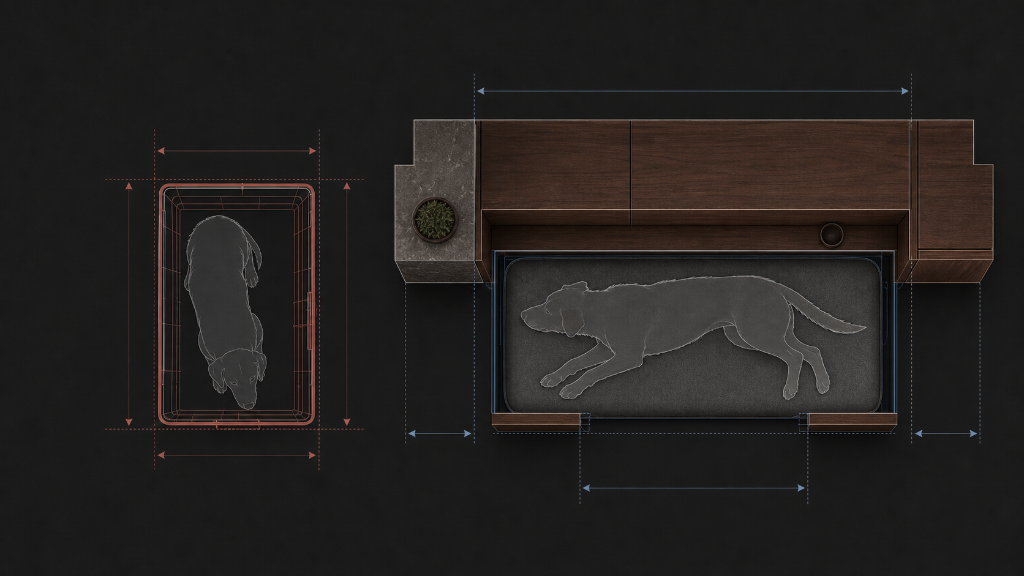
A dachshund's body length-to-shoulder-height ratio is approximately 1.5 times that of a German Shepherd of equivalent mass. Their spatial geometries are not interchangeable. Sutter et al. (2008), in a principal component analysis of 1,155 dogs across 109 breeds, confirmed that morphometric variation between breeds is driven by independent genetic components — not by a single scaling rule.
To translate Petherick into a usable design input for individual companion animals, we apply four corrections.
Correction 1 — Morphometric Ratio (R)
The breed's body-length-to-height ratio, normalised against the Petherick reference (R ≈ 1.05, the moderate body type). A Dachshund-oriented commission uses R = 1.50; a German Shepherd, R = 1.00. This correction is what allows the same equation to address a Whippet's narrow envelope and a Labrador's square stance without forcing one to live inside the other's geometry.
Correction 2 — Activity Multiplier (A)
Two dogs of identical mass do not use space identically. A Border Collie and a Bulldog occupy different behavioural envelopes; a working Malinois again differently. We apply a conservative four-step multiplier (1.00 / 1.15 / 1.30 / 1.50) drawn from canine behavioural ecology — and we note plainly that breed-specific randomised trials remain pending.
Correction 3 — Geriatric Factor (G)
Dogs with osteoarthritis or advanced age require a wider hip envelope during the stand-to-lie transition — the arc of motion expands by approximately 20–25%. We apply G = 1.21 for confirmed geriatric or orthopaedic cases. Drawn from veterinary orthopaedic clinical observation; we do not present it as a universal value.
Correction 4 — Nesting and Turning Reference
In an observational study of 62 dogs, Coren (2016) documented that 55% performed at least one full rotation before lying down on uneven surfaces. We do not treat this as a universal rule, but as a behavioural reference: for rectangular-bodied breeds, internal clear length should accommodate body length plus a turning margin (a working ratio of L ≥ body length × 1.2). The number is a guideline; the brief decides.
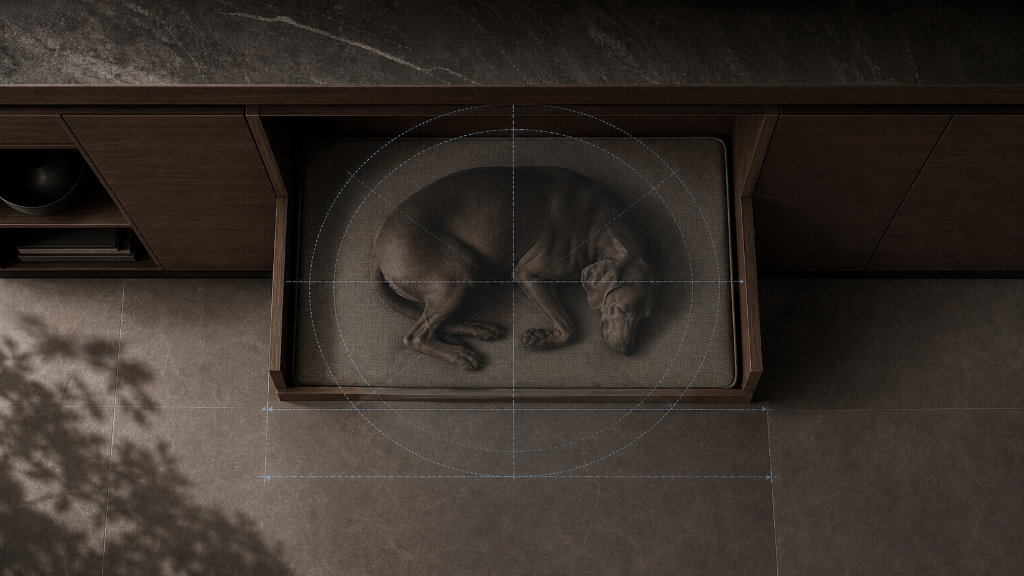
Coren, S. (2016). Why Do Dogs Turn in Circles Before Lying Down? Psychology Today, n = 62.
04 — Designing Space for Dogs at Home
The corrections above translate most directly into dog-oriented residential design. HĀM commissions for dogs typically address:
- Open-access refuge. A protected resting zone the dog can enter and leave voluntarily — never a locked crate. The threshold is open by design; the geometry is what makes it feel held.
- Resting suite integrated into the room. A dog rests where the household lives. A reading-room dog suite, a bedroom companion zone, or a living-room sanctuary keeps the animal socially connected without compromising the human plan.
- Movement and nesting clearance. Internal clear length set against full body length plus turning margin. The animal should be able to enter, circle, and settle without the geometry asking it to fold.
- Shoulder-height clearance. Internal clear height set against comfortable entry and resting transitions, not against the smallest box that will fit.
- Separation companion suite. For households with a working day, a thoughtfully placed resting zone may support a calmer resting routine during separation. HĀM does not treat anxiety; we design the room.
- Senior and orthopaedic adjustment. For older dogs, the G correction widens the hip envelope, and material specifications shift toward orthopaedic-grade supports.
05 — The HĀM Spatial Review Model
The formula and its corrections come together in a single internal tool: the HĀM Spatial Review Model. It is a design-support model, not a public calculator — used to translate a companion animal's weight, morphology, activity, and health into a preliminary spatial envelope, with welfare thresholds and review triggers built in.
DESIGN SUPPORT MODEL · ILLUSTRATIVE
Preliminary Design Envelope Preview
Preliminary spatial estimate based on HĀM Formula v1 (S = k × (R / 1.05) × W0.66 × α × G × 1.6, k = 0.047 dynamic space). One input among several in a HĀM brief — not a final specification.
Recommended floor envelope (S)
Recommended daily-routine envelope, not a minimum.
Survival-minimum reference: 0.51 m² (Petherick lower bound). Range reflects body ratio variation (R) within this profile type.
Plan — recommended floor envelope
Length (L)
0.85–1.00 m
Recommended for daily routine
Width (Wd)
0.81–0.95 m
Recommended for daily routine
Interior height (H)
0.70–0.82 m
Enclosure interior, not room ceiling
Body length
70 cm
FCI / AKC measurement
Effective k
0.0540
k × (R/1.05) × α × G
Use case
Resting / open-access refuge
Shapes the brief
No baseline threshold conflict detected
Effective k = 0.0540 ≥ 0.033 HĀM review threshold.
What this means
A starting range for resting, turning, and open-access refuge. Not a final built dimension.
What HĀM still reviews
Room geometry · Sightlines · Daylight · Acoustics · Material feel · Access routes · Household routine
The number does not design the room. It tells us where the review begins.
This is a preliminary spatial estimate for design review. It is not a final specification, veterinary recommendation, legal standard, or welfare certification. Final dimensions are resolved through a HĀM written brief and project-specific review.
The model returns a range, not a final dimension. Below the welfare threshold of k = 0.033, it flags the configuration for further spatial review. Final dimensions are resolved through a written HĀM brief, not by the model alone.
06 — From Framework to Bespoke Pet Architecture
The HĀM Spatial Framework is one input into a written brief. A full commission also reviews room geometry, sightlines, daylight, acoustic conditions, material performance, and the routine of the household. The animal is one of several clients in the room.
When the brief is complete, the resulting piece — a credenza, a suite, a sanctuary, an integrated bed — is one of the few in the home where every dimension can be defended in writing, against published research and against the specific animal it was made for.
That is what HĀM means by bespoke pet architecture. Not decoration. Not aspiration. A measured response to a real animal, in a real room, made by people who treat both as architectural clients.
References
- Petherick, J.C. (2007). Space allowances for confined livestock and their determination from allometric principles. Applied Animal Behaviour Science, 117(1–2), 1–12.
- Averós, X., Brossard, L., Dourmad, J.Y., et al. (2010). A meta-analysis of the combined effect of housing and environmental enrichment characteristics on the behaviour and performance of pigs. Applied Animal Behaviour Science, 127(3–4), 73–85.
- Sutter, N.B., Mosher, D.S., Gray, M.M., Ostrander, E.A. (2008). Morphometrics within dog breeds are highly reproducible and dispute Rensch's rule. Mammalian Genome, 19(10–12), 713–723.
- Coren, S. (2016). Why Do Dogs Turn in Circles Before Lying Down? Psychology Today, n = 62.
Frequently Asked
Free Resource
Get the Spatial Brief Checklist
A printable A4 checklist covering the measurements, photographs, and companion details needed before commissioning a pet space — the same brief HĀM uses with clients.
We'll occasionally send studio notes on companion space design. No spam, unsubscribe anytime.
Begin with the animal, the room, and the routine
If you are considering a companion space, the next step is not choosing a size. It is understanding the animal, the home, and the way you live together.