
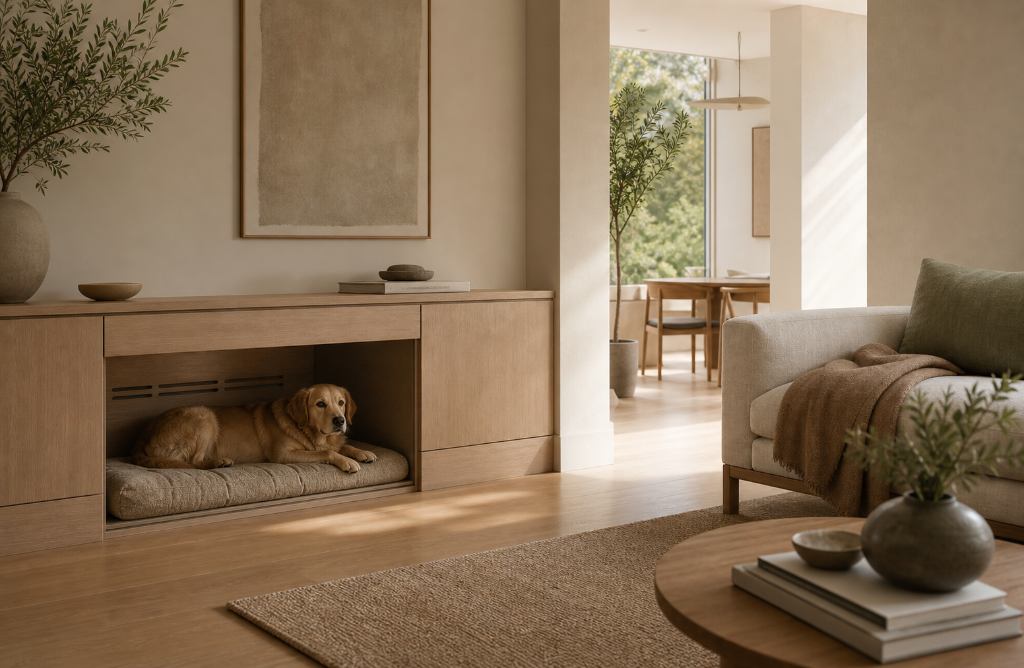
The End of Pet Furniture
Why animal spaces now belong to architecture.
- Category
- PHILOSOPHY
- Type
- Essay
- Author
- HĀM Studio
- Published
- MAY 2026
- Last updated
- May 2026
- Reading time
- 8 min
Topics
The end of pet furniture is not the end of beds, bowls, crates, or cat trees. It is the end of treating animal space as a loose object added after the room is finished.
Pet architecture begins when the animal's body, behavior, routine, and resources are planned into the home rather than hidden after the fact.
01 — Direct answers
What does "the end of pet furniture" mean? It means the end of treating pet products as disconnected objects. A dog bed, cat tree, litter cabinet, crate, or feeding station works better when it is planned as part of the room's circulation, material language, cleaning routine, and animal behavior.
Why is traditional pet furniture often not enough? Traditional pet furniture often solves one product problem while ignoring the room. A bed may be soft but badly placed. A crate may contain the dog but disrupt daily circulation. A cat tree may add height but fail if it blocks the room, lacks a stable route, or does not relate to the cat's safe places.
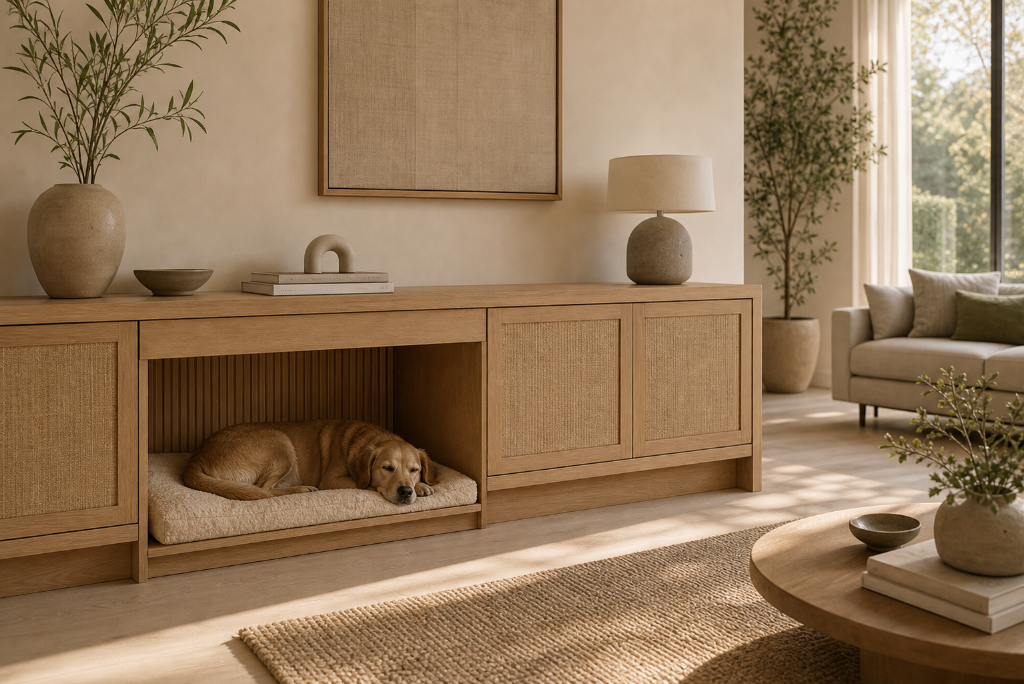
What is pet architecture? Pet architecture is the design of animal space as part of the home. It considers body size, species behavior, visibility, retreat, airflow, cleaning access, material durability, household traffic, and how the object meets the surrounding architecture.
Is HĀM saying all pet furniture is bad? No. Many pet products are useful. The problem begins when a product is expected to solve a spatial question by itself. HĀM's position is that animal needs and interior architecture should be designed together.
02 — How to judge a pet space
A pet space should be judged by how it works for both the animal and the room. Access, visibility, retreat, airflow, cleaning, material durability, and household movement all matter — and a piece that fails on any one of them rarely succeeds for long.
Good pet design is not a more expensive version of the same object. It is a better relationship between the animal, the product, and the architecture around it.
03 — Why the object-first approach falls short
For years, the default answer to living with animals indoors was to buy another object. A bed for the corner. A crate for the living room. A litter box enclosure. A scratching post. A feeding station. Each item solved something, but most of them were designed as objects first and spatial decisions second.
That is the real problem.
Pets do not use furniture the way humans use furniture. They read position, scent, light, exits, height, temperature, social distance, and interruption. A dog bed is not only a cushion. It is a territory beside a route, a person, a wall, a doorway, or a source of noise. A cat tree is not only a tall object. It is a vertical route, a lookout point, a scratching surface, and sometimes a pressure point in a multi-cat home.
When those things are ignored, the home ends up with visual clutter and the animal still may not get a usable space.
04 — The market has already moved
Pet space is no longer a small accessory category. The American Pet Products Association reported that U.S. pet industry expenditures reached $158 billion in 2025 and projected continued growth in 2026. Grand View Research estimates the global pet furniture market will continue growing through 2030. IKEA's UTSÅDD collection, launched with input from veterinarians and pet product experts, is another signal: large furniture companies now treat eating, sleeping, playing, and hiding as ordinary parts of life at home with pets.
That mainstream movement matters, but it does not finish the problem.
Most of the market still thinks in products. HĀM thinks in rooms.
05 — What traditional pet furniture gets wrong
| Traditional pet furniture assumption | Architectural pet-space question |
|---|---|
| "Does this object look nice?" | Does it belong to the room's material, proportion, and circulation? |
| "Is the bed soft?" | Does the animal have the right support, size, temperature choice, and location? |
| "Can the crate fit here?" | Can the animal enter, turn, rest, see, retreat, and leave without conflict? |
| "Can we hide the litter box?" | Can the cat access it safely, with ventilation, cleanability, and separated resources? |
| "Can the cat climb it?" | Is the vertical route stable, connected, and useful for observation or retreat? |
| "Can the bowl be tucked away?" | Does the feeding position support posture, cleaning, water separation, and routine? |
| "Does it match the sofa?" | Does it support both the animal's welfare and the home's long-term use? |
This is why an expensive pet object can still fail. It can be beautiful and badly located. It can be solid and hard to clean. It can be integrated visually but wrong for the animal's route, posture, or social pressure.
06 — The animal needs a system, not a prop
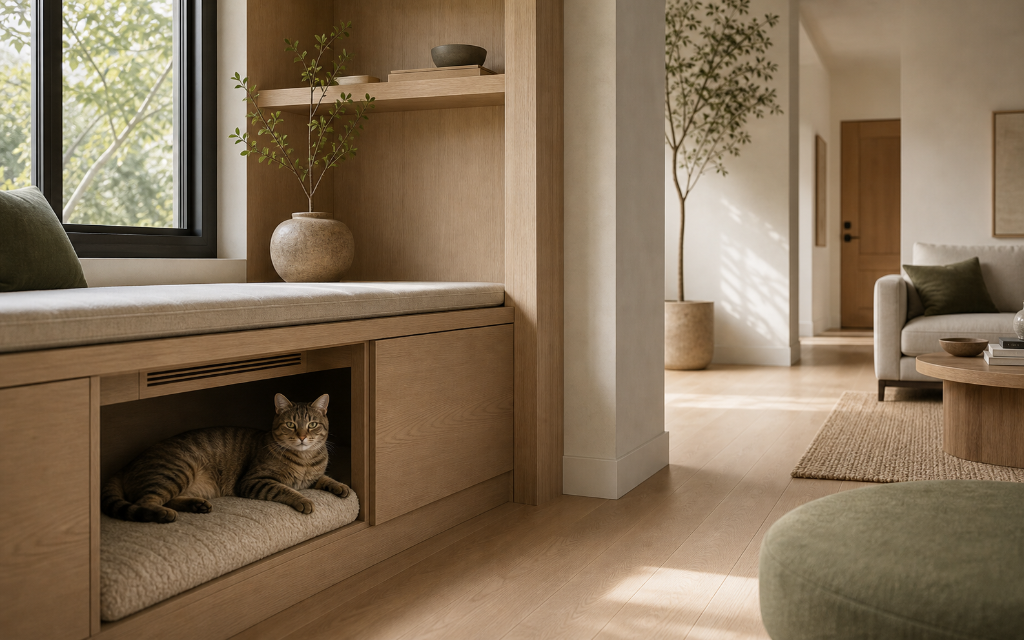
Veterinary and welfare guidance points to the same direction, even when it does not use architectural language.
The AAFP and ISFM feline environmental needs guidelines describe safe places, separated key resources, scratching/resting areas, and an environment that respects scent. AAHA's enrichment guidance also emphasizes resources that are easy to access and spread through the home. WSAVA's animal welfare guidelines frame welfare beyond physical health, including psychological, social, and environmental wellbeing.
Translated into residential design, this is straightforward:
| Animal need | Architectural translation |
|---|---|
| Safe place | A protected refuge, alcove, elevated platform, or wall-backed rest zone |
| Resource separation | Food, water, litter, scratching, resting, and play areas placed with enough distance and access |
| Movement | Routes that let the animal enter, turn, climb, observe, leave, and avoid conflict |
| Scent and familiarity | Materials and locations that can hold familiar scent without becoming unhygienic |
| Rest | A surface and position that support posture, quiet, temperature choice, and low interruption |
| Cleaning | Removable inserts, wipeable zones, ventilation, access panels, and durable finishes |
| Coexistence | Pet space that supports animal behavior without breaking the room's use for humans |
The point is not to medicalize the home. The point is to stop pretending that a single object can carry the whole job.
07 — From product to spatial infrastructure
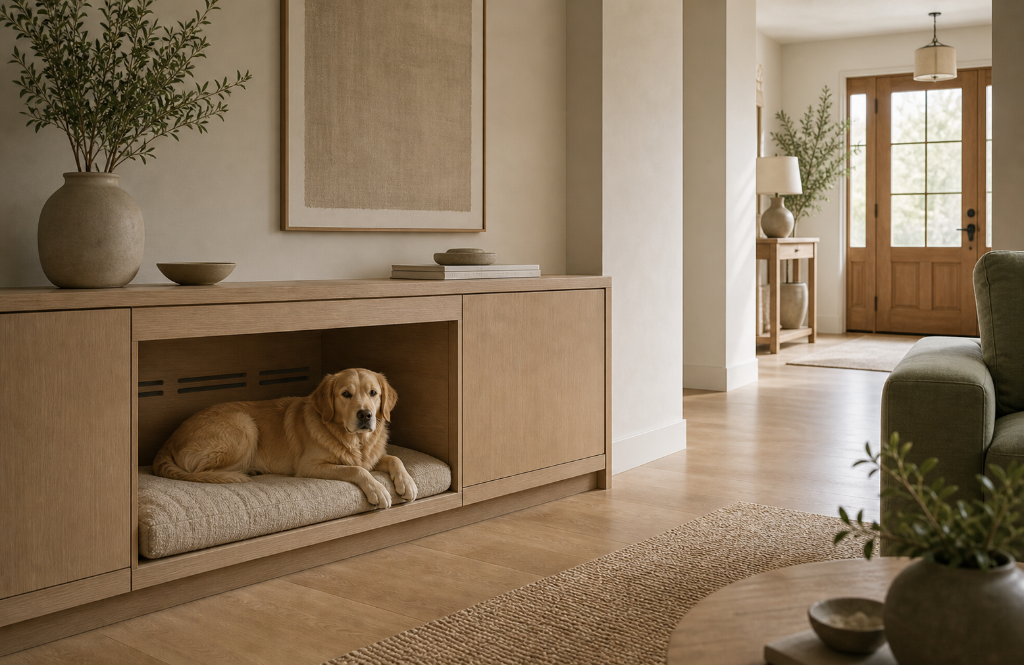
HĀM uses the word architecture because the design problem is structural.
A pet space has to answer several questions at once:
| Design layer | What HĀM evaluates |
|---|---|
| Body geometry | Can the animal stand, turn, lie down, eat, drink, climb, or retreat without forced posture? |
| Behavior | Does the space support species-specific needs such as hiding, observation, chewing, scratching, nesting, or social proximity? |
| Placement | Does it sit in the right part of the home, away from traffic but connected to routine? |
| Material | Can the surface handle claws, moisture, cleaning, odor, abrasion, and aging? |
| Air and hygiene | Is there ventilation, removable lining, and access for maintenance? |
| Human use | Does the design preserve storage, circulation, sightlines, and interior coherence? |
| Adaptability | Can the system adjust as the animal ages or as the household changes? |
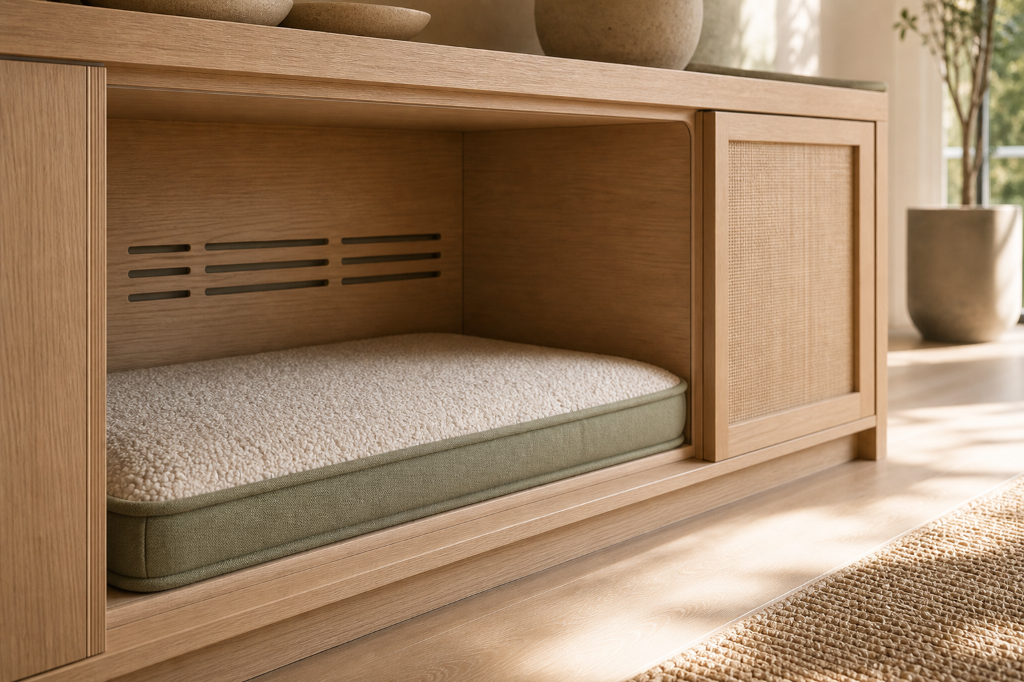
That is a different question from "which pet furniture should I buy?"
08 — What this does not mean
This article does not mean every home needs custom joinery. A simple washable mat in the right place can be better than a beautiful built-in in the wrong place.
It also does not mean that all mass-market pet furniture is poorly designed. Some products are thoughtful, safe, easy to clean, and useful. IKEA's recent pet collection is a good example of the market taking pet life at home more seriously. The limit is that product design still has to be placed correctly inside a specific home.
And it does not mean architecture should erase the animal. A home with pets should not pretend no animal lives there. The goal is not concealment at all costs. The goal is a calmer relationship between pet needs and human space.
09 — HĀM's position
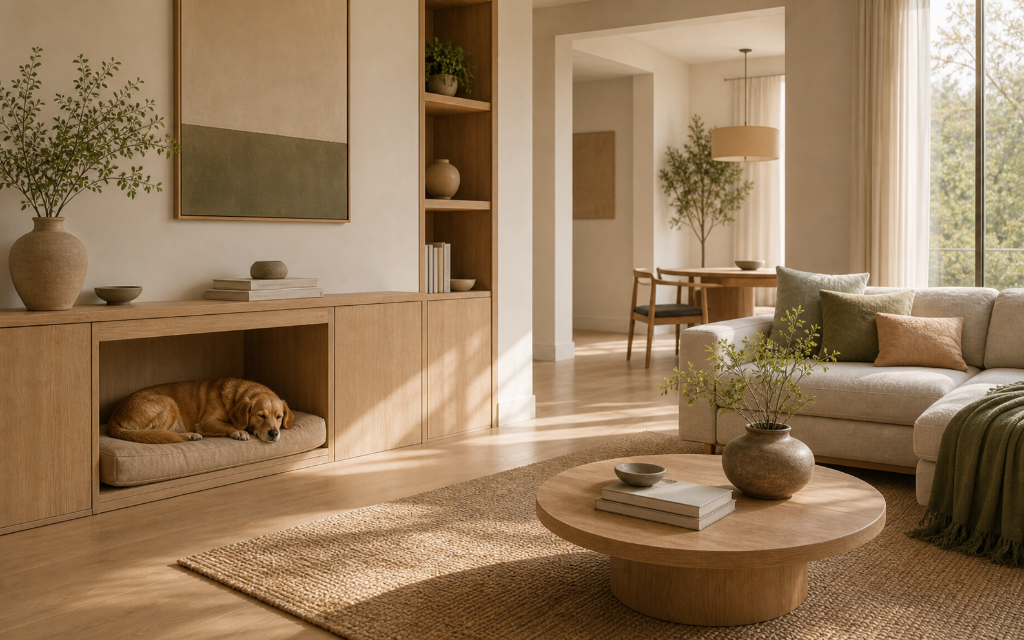
HĀM does not begin with a product category.
We begin with the animal, the room, and the routine. Where does the dog choose to rest? Where does the cat watch the room? Which routes create conflict? Where does cleaning happen? What material will age well? Which part of the home can hold a pet function without becoming clutter?
Only after those questions do we decide whether the answer is a credenza, a mat, a low platform, a feeding wall, a vertical route, a crate alternative, or nothing new at all.
That is the actual end of pet furniture: not fewer objects, but fewer disconnected ones.
10 — How this connects to the rest of the Journal
This essay is the philosophy behind the system. The companion research and field notes give the working detail:
- The Science of Space — how HĀM evaluates spatial fit at body, behavior, and room scale.
- Why cats need vertical territory — height, retreat, and safe-place logic.
- Pet bowl height, size, depth, and feeding geometry — feeding posture, bowl format, and station placement.
- Pet mat size, thickness, and material — body fit, support, and surface choice.
- How pets choose resting places — light, temperature, visibility, and escape routes.
Sources
- Source
U.S. Pet Industry Reaches $158 Billion in 2025, Poised for Continued Growth in 2026
American Pet Products Association · 2026
Used forMarket size and growth signal that pet space is now a mainstream design category.
- Source
Pet Furniture Market Size To Reach $2.44 Billion By 2030
Grand View Research · 2025
Used forIndependent market forecast supporting the same shift to pet-aware interiors.
- Source
Meet UTSÅDD: the new IKEA collection for cats, dogs and pet-loving humans
IKEA Global · 2024
Used forMainstream signal that eating, sleeping, playing, and hiding are now part of home design.
- Source
The life of pets at home: UTSÅDD pet collection
IKEA Global · 2024
Used forEditorial framing of how furniture companies now describe living with pets.
- Source
AAFP and ISFM Feline Environmental Needs Guidelines
Ellis, Rodan, Carney, Heath, Rochlitz, Shearburn, Sundahl, Westropp · 2013
Used forSafe places, resource separation, and environmental needs as the basis for residential cat design.
- Source
Enrichment: Supporting your pet's mental and emotional wellbeing at home
AAHA · 2026
Used forPractical enrichment principles — accessible, distributed, and home-integrated resources.
- Source
Animal Welfare Guidelines
WSAVA · 2018
Used forWelfare framed as physical, psychological, social, and environmental wellbeing.
Limitations
- This article is a design philosophy, not veterinary or behavioral advice. It does not diagnose anxiety, aggression, pain, or medical conditions.
- Recommendations are general design principles. They do not replace site-specific architectural drawings, structural review, or local building code.
- Market and industry figures reflect the sources cited at the time of writing and may change in future reports.
- Built-in solutions are not always appropriate. A simple loose product in the right place can outperform a poorly located built-in.
Frequently Asked
Free Resource
Get the Spatial Brief Checklist
A printable A4 checklist covering the measurements, photographs, and companion details needed before commissioning a pet space — the same brief HĀM uses with clients.
We'll occasionally send studio notes on companion space design. No spam, unsubscribe anytime.
Begin with the animal, the room, and the routine
If you are considering a companion space, the next step is not choosing a size. It is understanding the animal, the home, and the way you live together.