
How Pets Choose Resting Places
Light, temperature, visibility, and escape routes.
- Category
- SPATIAL SCIENCE
- Type
- Research Note
- Author
- HĀM Studio
- Published
- MAY 2026
- Last updated
- May 2026
- Reading time
- 4 min
Topics
A pet bed succeeds only when the location works. Dogs and cats choose resting places by reading light, temperature, visibility, household traffic, escape routes, and social pressure.
Pets choose resting places by reading the whole site, not only the bed. Temperature, light, visibility, traffic, scent, escape routes, and social pressure all affect whether a location feels usable.
A good pet resting place should let the animal rest without being trapped, watched too closely, overheated, chilled, or interrupted by household movement.
01 — Direct answers
Where should I put my pet bed? Put a pet bed where the animal can rest without being trapped, overheated, chilled, watched from every side, or interrupted by household movement. The best location usually combines thermal choice, gentle light, protected visibility, low traffic, and at least one clear exit route.
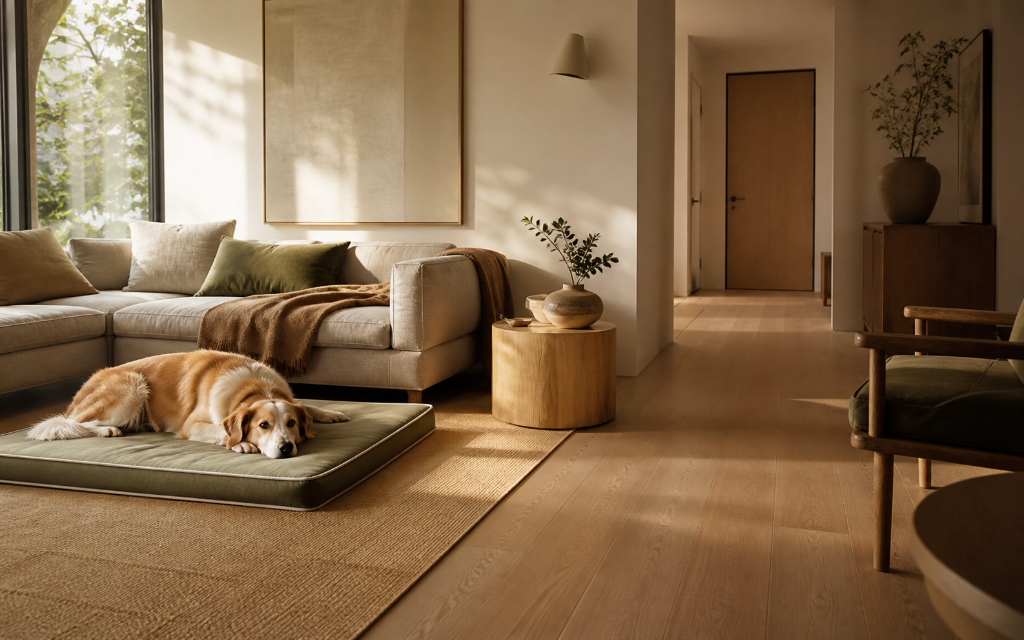
Where should I put my dog bed? Dogs generally rest better near the household but outside the main walking path. A sofa-adjacent side position, quiet wall edge, or calm corner often works better than a doorway, hallway, or chair zone.
Where should I put my cat bed? Cats generally rest better where one side is protected, approach is visible, and the exit is not blocked. A wall-backed corner, window-side perch with shade, sofa back, or partially enclosed nook can work if the cat can leave easily.
What makes a pet ignore a bed? A pet may ignore a comfortable bed if the location feels exposed, hot, cold, noisy, too busy, socially pressured, or easy for another animal to block.
02 — Try the HĀM Pet Resting Place Scorecard
Use this scorecard to test a bed, mat, alcove, platform, or corner. It evaluates the location, not only the product.
SPATIAL TEST · DESIGN REFERENCE
HĀM Pet Resting Place Scorecard
Use this scorecard to test a bed, mat, alcove, platform, or corner. It evaluates the location, not only the product. This is a design reference — it does not diagnose anxiety, pain, heat illness, arthritis, or behavioral disorders.
Who is using this resting place?
Start with age and access. Senior pets are less forgiving of height, dead ends, and repeated disturbance.
Resting place score
98/100
This spot reads as a strong resting location. It offers comfort without trapping the animal in traffic, heat, or social pressure.
Thermal
Balanced
Choice feels available.
16/16
Light
Soft
Light supports orientation.
10/10
Visibility
Protected
Can read the room.
15/17
Escape
Clear
Leave before pressure.
22/22
Traffic
Quiet
Low interruption.
14/14
Social fit
Connected
Fits social style.
9/9
Adjustments
Preserve the choice
This location reads well. Keep a second seasonal option nearby so the pet can choose warmth, shade, or more privacy.
Watch real use
A strong score is still a design reference. If the animal avoids the spot, observe what it chooses instead.
Visible method
species        = dog
location       = Beside sofa or living area
thermal        = 16/16
light          = 10/10
visibility     = 15/17
escape         = 22/22
disturbance    = 14/14
social fit     = 9/9
resource logic = 12/12
total score    = 98/100  (Strong location)
This scorecard is a design reference. It helps evaluate location quality, but it does not diagnose anxiety, pain, heat illness, arthritis, or behavioral disorders.
03 — The bed is only half of the resting place
Most pet bed advice starts with the object: size, softness, material, cover, washability. Those things matter. A mat that bottoms out under the body will not support the animal well, and a bed that is too small will be used only in compromised postures. For more on body fit, see our work on pet mat fit.
But animals do not experience a resting place as a product alone. They experience it as a position in the home.
The same mat can feel useful in one corner and unusable in another. A sunny window can be attractive in the morning and too hot in the afternoon. A soft bed beside a door can become a place of interruption. A beautiful alcove can fail if another animal can block the only exit.
That is why HĀM treats resting as a spatial decision, part of the broader science of pet space. The question is not only "which bed should I buy?" It is also "where can this animal rest without having to monitor the room the whole time?"
04 — What a good resting place includes
| Variable | Good signal | Warning signal |
|---|---|---|
| Temperature | The pet can choose warm or cool surfaces nearby | The pet is trapped in direct sun, cold flooring, or a draft |
| Light | Gentle light, morning sun, or adjustable shade | Harsh sun with no cooler exit |
| Visibility | The pet can observe the room or doorway from a protected edge | The bed sits in the exposed center of the room or in a blind dead end |
| Cover | A wall, corner, sofa side, cabinet edge, or partial enclosure gives one protected side | The animal has no boundary, or the enclosure blocks the exit |
| Escape | The pet can leave without crossing pressure, people, children, or another animal | One route is blocked by furniture, a door, or another pet |
| Traffic | The bed sits outside daily walking paths and door swings | The bed sits in a hallway, dining chair zone, appliance path, or child play route |
| Social fit | The site matches the animal's preferred distance from people | The bed is either isolated from a social dog or too exposed for a cautious cat |
| Resource pressure | The bed is separated from guarded routes, litter, food conflict points, and another pet's favorite doorway | One animal can control access to the resting place |
05 — Why cats choose safe places
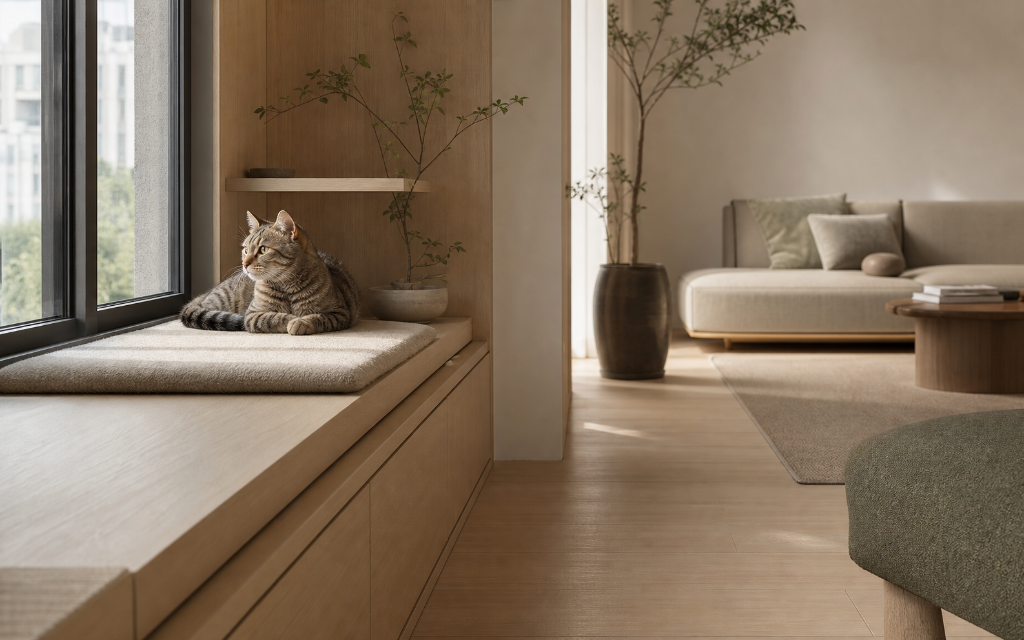
Cats often rest where they can reduce exposure. That may mean height, a corner, a box, a shelf, a cabinet alcove, a window ledge with a retreat path, or the back of a sofa. The pattern is not random. A safe place gives the cat some control over approach. For the broader picture of feline spatial needs, see cat vertical territory.
Sources
- Source
Will a hiding box provide stress reduction for shelter cats?
Vinke, C. M., Godijn, L. M., & van der Leij, W. J. R. · 2014
Used forEvidence that refuge / hiding reduces shelter cat stress; foundation for the 'safe place first' framing for cats.
- Source
AAFP and ISFM Feline Environmental Needs Guidelines
Ellis et al. · 2013
Used forSafe places, separated resources, scent cues, and retreat as part of feline environmental care.
- Source
The use of refuges by communally housed cats
De Oliveira et al. · 2015
Used forHorizontal and vertical refuges affect space use in group-housed cats; supports residential rule that cats need more than an exposed cushion.
- Source
2024 AAFP intercat tension guidelines: recognition, prevention and management
Hammerle et al. · 2024
Used forMulti-cat resource separation and core-territory logic; framing for non-guarded resting places.
- Source
Light quality and time in shelter modulate behavior and cortisol in the domestic cat (Felis catus)
iScience · 2025
Used forLight as a design variable, not decoration; supports the careful framing of gentle vs. harsh light in resting sites.
- Source
How environmental conditions affect sleep? An investigation in domestic dogs (Canis lupus familiaris)
Behavioural Processes · 2022
Used forEnvironmental factors and dog sleep quality; supports principle that disturbance and conditions shape rest.
- Source
The cyclic interaction between daytime behavior and the sleep behavior of laboratory dogs
Scientific Reports · 2022
Used forDaily behavior and sleep are linked in dogs; supports the principle that quiet, predictable resting matters.
- Source
The importance of the secure base effect for domestic dogs: evidence from a manipulative problem-solving task
Horn, L., Huber, L., & Range, F. · 2013
Used forSecure-base effect supports the framing that many dogs rest better near familiar people.
- Source
A population-level study reveals hidden patterns in resting site choice of free-ranging dogs
Bhattacharjee et al. · 2024
Used forResting site choice in dogs depends on disturbance, visibility, shade, light, resources, and territory; principle transfers cautiously to indoor dogs.
- Source
Heat stress in domestic dogs: morphological and environmental risk factors for dog welfare in a warming world
Frontiers in Animal Science · 2025
Used forHeat risk depends on morphology, coat, age, solar radiation, and environment — not a single room temperature.
Limitations
- A high scorecard reading does not guarantee that a pet will use the place. Animals have history, habits, scent preferences, body comfort, and health needs that a spatial model cannot fully know.
- A low score does not mean the home is unsafe. It means the location has design friction. Sometimes a small change is enough: rotate the bed, open one side, add shade, move it out of a walking path, or create a second option.
- This article and the scorecard do not replace veterinary advice. Sudden changes in sleep, hiding, heat seeking, stiffness, or restlessness should be discussed with a veterinarian.
- Research on shelter cats, kennel dogs, and free-ranging dogs is referenced for design principles only. It does not transfer directly to every family home, breed, age, or health profile.
Frequently Asked
Free Resource
Get the Spatial Brief Checklist
A printable A4 checklist covering the measurements, photographs, and companion details needed before commissioning a pet space — the same brief HĀM uses with clients.
We'll occasionally send studio notes on companion space design. No spam, unsubscribe anytime.
Begin with the animal, the room, and the routine
If you are considering a companion space, the next step is not choosing a size. It is understanding the animal, the home, and the way you live together.