
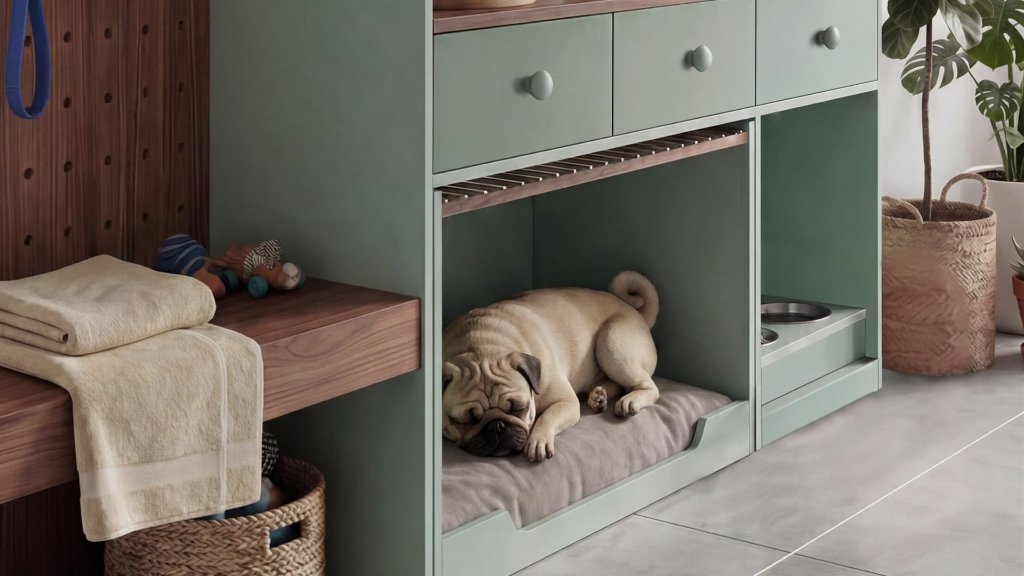
Bespoke Pet Furniture vs Built-In Pet Furniture vs Pet-Friendly Furniture
Customization, architectural relationship and material performance are three different decisions, not three tiers of the same product.
- Category
- SPATIAL DESIGN
- Type
- Guide
- Author
- HĀM Studio
- Published
- JUL 2026
- Reading time
- 12 min
Topics
Bespoke pet furniture is made for a particular commission. Built-in pet furniture is fixed to, fitted within or closely related to the building. Pet-friendly furniture usually means ordinary human furniture chosen to cope with hair, stains, scratches and cleaning. The terms overlap, but they describe different decisions: customization, architectural relationship and material performance. The right choice depends on what the animal, household and room actually need.
Direct answers
What is bespoke pet furniture?
Bespoke pet furniture is designed for a particular client, animal, function or room rather than selected only from standard stock. Its dimensions, layout, finish or removable parts may be developed for the commission. The word does not tell you whether the piece will be freestanding, modular or fixed to the building, and it does not guarantee that the brief has addressed animal behaviour or daily care.
What is built-in pet furniture?
Built-in pet furniture is planned as part of a wall, cabinet run, stair, alcove or other architectural condition. Traditional built-in joinery is measured and fabricated for one site and may be adjusted or scribed during installation. A built-in appearance can also be created with coordinated modules and planned clearances, but that is a different fabrication and installation method.
What does pet-friendly furniture mean?
Pet-friendly furniture usually refers to sofas, chairs, rugs and other human furniture selected for durability and easier maintenance in a home with animals. Common concerns include hair, moisture, stains, claws, removable covers and access for cleaning. It may make shared furniture easier to live with, but it does not necessarily provide a bed, feeding place, litter area, retreat or movement route for the animal.
Which type is right for a home?
Choose by the unresolved problem. Use pet-friendly furniture when the main issue is how an ordinary sofa or surface copes with animals. Consider bespoke furniture when dimensions, functions or materials need to be developed for a particular brief. Use site-built joinery when close alignment with the building and permanent local installation are necessary. Choose a freestanding or modular approach when future movement, remote fabrication or adaptability matters.
The terms describe different layers
The three labels are often presented as a ladder from ordinary to premium. That is misleading. Each describes a different layer of the decision.
| Term | What it describes | What it may include | What it does not guarantee |
|---|---|---|---|
| Bespoke pet furniture | Degree of customization | Commission-specific dimensions, layout, materials, finishes or functions | Site-built fitting, whole-room planning, animal acceptance or future adaptability |
| Built-in pet furniture | Relationship to the building | Fixed joinery, a recess, wall integration or a closely coordinated cabinet run | Correct location, animal-specific dimensions, removability or better use |
| Pet-friendly furniture | Performance in a home with animals | Durable upholstery, washable covers, cleanable surfaces and repairable parts | A dedicated animal function or a made-to-measure spatial solution |
A bespoke dog bed can be entirely freestanding. A local joiner can build a fixed cabinet around a standard litter tray. A sofa can be pet-friendly without being pet furniture. A modular console can look and function as part of a room while retaining visible joints and the tolerance needed for transport.
This distinction matters because a label can sound reassuring while leaving the important part of the brief unresolved.
Five practical approaches
Most homes are not choosing between only three products. They are choosing among different levels of customization, permanence and room integration.
| Approach | Relationship to the room | Delivery or installation | Adaptability | Best suited to | Main limitation |
|---|---|---|---|---|---|
| Off-the-shelf pet furniture | Placed as an independent object | Bought finished and positioned in the room | High; easy to move or replace | Clear, common needs and uncertain locations | Standard size, finish and storage may not resolve the room |
| Pet-friendly human furniture | Serves people while tolerating animal use | Conventional furniture delivery | Varies by product | Sofas, chairs and surfaces affected by hair, stains or wear | Does not create a dedicated companion space |
| Bespoke freestanding pet furniture | Designed for a specific brief but remains independent | Fabricated to order and delivered as an object | Moderate to high, subject to size and construction | Animal fit, unusual functions or a refined object without building work | May still leave gaps, duplicated storage or visual separation from the room |
| Site-built fixed pet joinery | Measured for and physically integrated with one site | Local fabrication or on-site adjustment and fixed installation | Low; alteration usually needs trades | Renovations requiring close alignment with walls, floors or existing joinery | Permanent, site dependent and harder to move or repurpose |
| Architecturally integrated modular pet furniture | Coordinated with the room through scale, placement, function and materials | Developed from supplied site information, fabricated off site, transported and arranged as modules | Moderate; components can be planned for transport, service and future change | A built-in spatial character where remote development and modular delivery are useful | Requires planned clearance and cannot promise site-scribed, perfectly flush fitting |
None of these approaches is automatically better. A movable bed in a tested location can serve an animal and room better than fixed joinery in an attractive but unsuitable recess. A locally fitted cabinet can be appropriate where the building geometry is difficult and a continuous junction matters. A modular system can provide stronger visual and functional integration than a catalogue object without pretending to be conventional site-built work.
Off-the-shelf pet furniture: useful when the problem is already clear
Standard furniture is often the sensible starting point. A well-sized bed, stable feeding stand, open litter tray, scratching object or crate can work when its location is known, the animal uses it comfortably and the household can maintain it.
Its greatest advantage is reversibility. The object can be moved while the household observes where the animal rests, how a route works, or whether a feeding or litter position creates conflict. It can also be replaced as body size, mobility, habits or the home changes.
The limitation appears when the object starts carrying jobs it was not designed to solve. A standard bed does not organize nearby care storage. A litter enclosure does not automatically provide good access or air movement. A cat tree may add height without creating a connected route. At that point, buying a more decorative version may not fix the underlying room problem.
Pet-friendly furniture: furniture for people that anticipates animals
Current search results for pet-friendly furniture are dominated by sofas, upholstery and material advice. Retail guides discuss performance fabrics, microfiber, leather, removable covers, vacuum access and the visibility of hair or wear.
That is a legitimate category. Shared seating has to survive ordinary life, and material selection can reduce maintenance friction. Yet pet-friendly is a broad marketing description, not a universal technical certification. Fabric performance varies by construction, finish, cleaning method, animal behaviour and the manufacturer's care instructions. Claims such as scratch-proof, stain-proof or pet-safe need product-specific evidence.
Pet-friendly human furniture solves a surface and maintenance problem. It should not be expected to resolve where a dog rests undisturbed, how a cat reaches a safe place, where litter is separated from food, or how care equipment is stored.
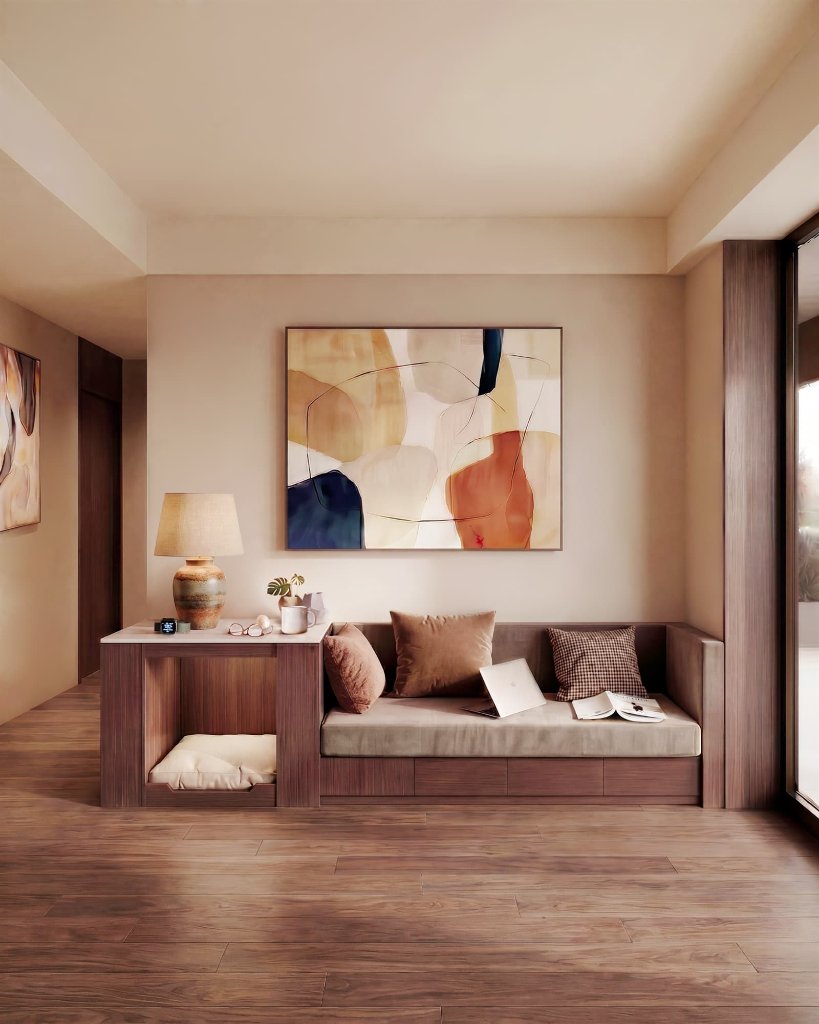
Bespoke pet furniture: customization needs a defined scope
Dictionaries define bespoke as specially or custom made. In the pet-furniture market, the word is used for many levels of service. It can mean selecting a finish and size from a product family. It can mean adapting a dog bedroom to a particular animal. It can also mean designing a new object around a room, routine and set of functions.
The useful question is not whether a seller uses the word. Ask what is actually being customized.
| Scope question | What to establish before commissioning |
|---|---|
| Animal | Species, body dimensions, observed postures, mobility, routines and any professional guidance already received |
| Function | Rest, feeding, drinking, litter, retreat, scratching, observation, storage or a defined combination |
| Location | Traffic, doors, windows, heat, noise, other animals, cleaning route and the animal's existing preferences |
| Furniture | Usable internal space, external size, openings, removable layers, hardware and service access |
| Material | Finish, cleaning chemistry, moisture, abrasion, hair, claws and replacement expectations |
| Delivery | Maximum transportable component size, stairs, lifts, corners, doors and handling route |
| Installation | Freestanding placement, anchoring, fixed joinery, planned clearance, local adjustment and responsibility for site work |
| Future change | Replacement inserts, aging, changed routines, relocation, repair and disassembly |
A precise scope protects both the animal and the project. It also exposes the difference between personalization and a genuinely developed commission.
Built-in pet furniture: form and installation are separate decisions
Built-in describes a relationship to architecture, but the same visual idea can be delivered in different ways.
Traditional fixed joinery is usually the strongest route when the work must follow irregular walls, continue an existing cabinet line, meet a sloping ceiling, conceal building services or become a permanent part of a renovation. Local measurement and site adjustment can produce close junctions that transported furniture should not claim.
The word can also be used more loosely for a cabinet that fills a planned zone or appears integrated with the room. In those cases, look past the photograph and ask how the work is made, moved, levelled, fixed and serviced. Skirting, floor variation, wall irregularity, module seams and access panels do not disappear because a rendering looks flush.
The earlier HĀM guide to designing a built-in dog bed examines one use case in detail. Its central lesson applies more widely: a built-in appearance cannot compensate for the wrong location, poor access or difficult cleaning.
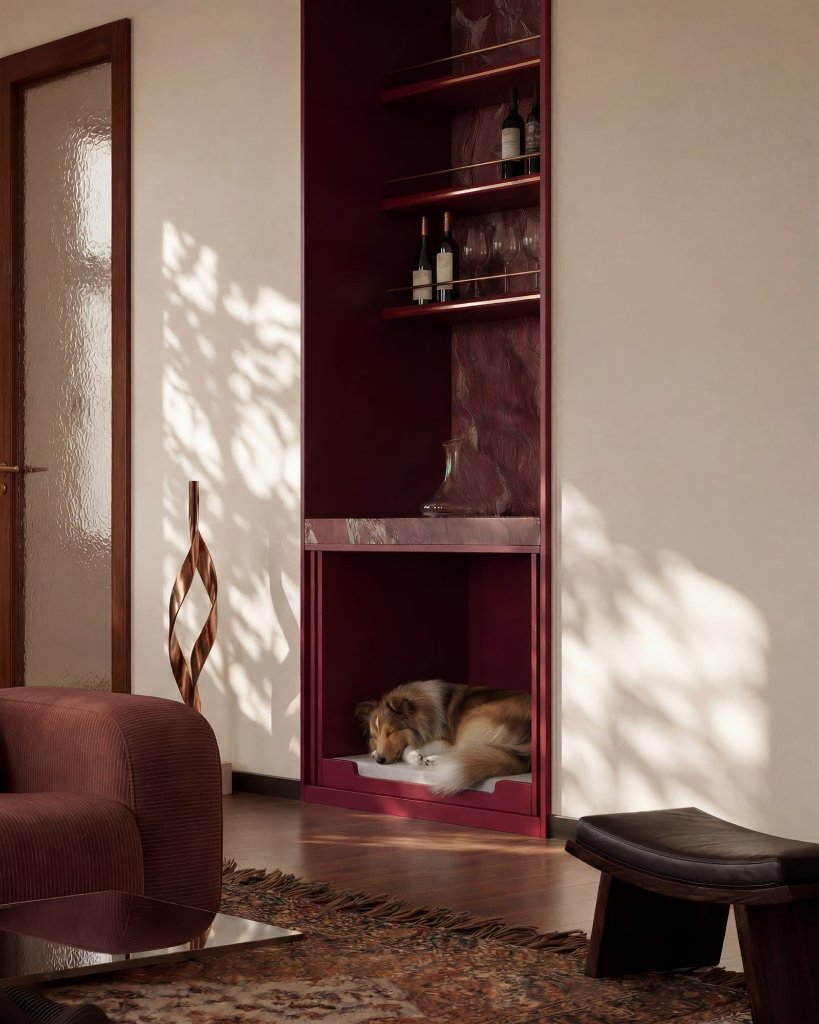
Choose by the problem, not the label
| If the main problem is... | Start by considering... | Why |
|---|---|---|
| Hair, stains or wear on a sofa | Pet-friendly human furniture | The unresolved issue is surface performance and maintenance |
| A bed, feeder or retreat does not fit the animal or routine | Bespoke freestanding or modular pet furniture | Dimensions and functions need commission-specific development |
| Pet objects create repeated storage and circulation clutter | Integrated modular furniture or site-built joinery | Several room functions need to be coordinated |
| A cabinet must follow irregular walls or existing fixed joinery closely | A local site-built solution | Site measurement and adjustment are part of the required outcome |
| The project is developed remotely but should read as part of the room | Architecturally integrated modular furniture | Off-site fabrication can be coordinated with room information and planned tolerance |
| The location has not been tested | Off-the-shelf or temporary furniture | A movable object allows observation before permanent work |
| The household rents or expects to move | Freestanding or transportable modular furniture | Reversibility has more value than a fixed architectural junction |
| The animal's mobility or routine is changing | A simple adaptable object, or a modular brief with replaceable parts | The solution needs to change without rebuilding the room |
This is why the most expensive or permanent option is not automatically the most resolved. The right level of intervention follows the certainty of the brief.
What a useful commission brief should contain
A good brief names conditions before it names a product. Our guide to preparing a pet-space brief goes deeper, but the following information is enough to distinguish the likely furniture route.
- Identify the animal and the exact function to be supported.
- Record where the function happens now and what is not working.
- Photograph the full room, nearby routes and the proposed position.
- Measure the room and the animal-related item that must fit, such as a bed insert, litter tray or bowls.
- Note doors, drawers, sockets, radiators, vents, skirting, floor changes and cleaning access.
- Explain which parts must be removable, washable, replaceable or reachable by hand.
- Record the delivery route, including lifts, stairs, door widths and tight turns.
- State whether close site fitting, local adjustment, transportability or future relocation matters most.
- Keep product care instructions, veterinary advice or behaviour guidance separate from design assumptions.
- Decide what should still work if the animal's size, mobility, routine or preferred location changes.
This information may lead to a custom object, a fixed intervention, coordinated modules or no new furniture. That is a useful result. A brief should improve the decision, not force a commission.
When a simple or movable option is better
Professional guidance for dogs recommends comfortable resting places in quiet, calm and draught-free positions, with options where appropriate. Feline environmental guidance emphasizes safe places, access and the distribution of resources. Neither body of guidance says that those conditions must be delivered through custom joinery.
A simple solution is often better when:
- the animal has several preferred resting places;
- the proposed location has not been observed through normal household routines;
- another animal may block a narrow route or single entrance;
- the household expects to move;
- the animal's mobility is changing;
- cleaning or replacement would be harder after integration;
- the existing object already works and the remaining concern is mostly visual.
Moving the right object to a better position can be a stronger design decision than building the wrong object into the room.
How HĀM fits within the comparison
HĀM designs bespoke pet furniture as architecturally integrated modular systems. We begin with the companion, room and routine, then develop coordinated functions such as rest, feeding, retreat, litter, storage or care.
The work is developed from measurements, photographs, plans and use information supplied remotely. Modules are fabricated off site, transported to the home and arranged with planned dimensional tolerance. The aim is a built-in spatial character through proportion, placement, material coordination and functional relationship to the room.
This is closer to built-in furniture than a conventional catalogue object, but it is not site-scribed joinery. We do not use a flush rendering as a promise that every edge will be trimmed against an irregular wall, floor or ceiling. Module divisions, clearances, access and the delivery route are part of the design.
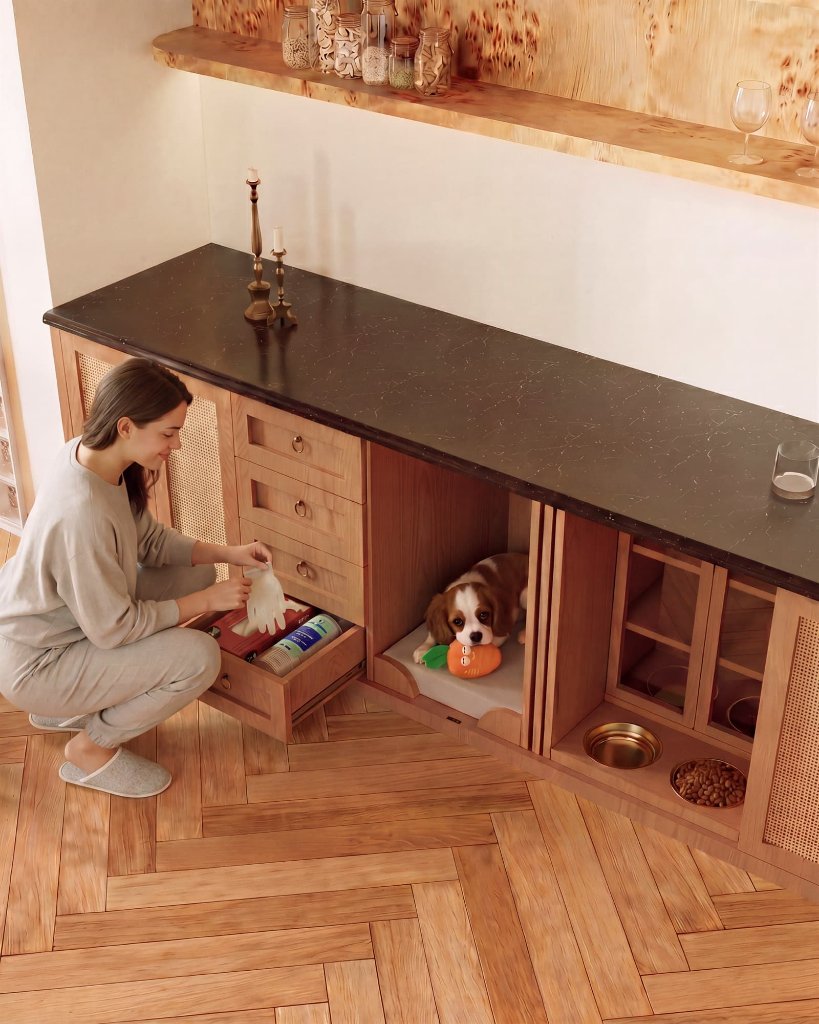
The current product collection shows how different companion functions can become furniture rather than loose accessories. The broader argument appears in The End of Pet Furniture, while Why Most Pet Furniture Fails Beautiful Homes offers a diagnostic framework for scale, placement and maintenance.
Before an enquiry, Prepare Your Space explains what to measure, photograph and note. The FAQ covers the current commission process and should be treated as the source of truth for any live service details.
What this does not mean
These terms are not regulated furniture classifications. Different makers use bespoke, custom, integrated and built-in in different ways. Confirm the actual scope, drawings, dimensions, fabrication method, delivery and installation responsibility.
Bespoke does not guarantee that a piece suits the animal. Built-in does not guarantee that the animal will use it. Pet-friendly does not certify a material as scratch-proof, stain-proof, non-toxic or appropriate for every species.
Spatial design also cannot diagnose pain, anxiety, conflict or a sudden change in behaviour. A new avoidance pattern, mobility problem or toileting change may require veterinary or qualified behavioural advice rather than a furniture revision.
To discuss a room, companion function or modular commission, contact HĀM with photographs, measurements and a short account of what is not working now.
Sources
- Source
Bespoke
Cambridge Dictionary
Used forDictionary definition establishing that bespoke describes customization, not an installation method.
- Source
Bespoke
Merriam-Webster
Used forSupporting dictionary definition of bespoke as specially or custom made.
- Source
Create a safe space for dogs
RSPCA Education · 2026
Used forWelfare guidance on comfortable, calm, draught-free resting places for dogs.
- Source
Choosing the Perfect Dog Bed
RSPCA
Used forPractical guidance informing the discussion of off-the-shelf dog beds.
- Source
AAFP and ISFM Feline Environmental Needs Guidelines
Ellis, S. L. H., Rodan, I., Carney, H. C., Heath, S., Rochlitz, I., Shearburn, L. D., Sundahl, E., & Westropp, J. L. · 2013
Used forFeline environmental guidance on safe places, access and resource distribution.
- Source
Getting Another Cat
Cats Protection
Used forGuidance on resource distribution relevant to multi-cat households.
- Source
Pet-Friendly Couches & Furniture for the Living Room
Rooms To Go
Used forExample of retail pet-friendly furniture guidance focused on materials and maintenance.
- Source
Bespoke Pet Furniture Specialists
The Pet Carpenter
Used forMarket example of the bespoke pet furniture category.
Frequently Asked
Free Resource
Get the Spatial Brief Checklist
A printable A4 checklist covering the measurements, photographs, and companion details needed before commissioning a pet space — the same brief HĀM uses with clients.
We'll occasionally send studio notes on companion space design. No spam, unsubscribe anytime.
Begin with the animal, the room, and the routine
If you are considering a companion space, the next step is not choosing a size. It is understanding the animal, the home, and the way you live together.