
Why Most Pet Furniture Fails Beautiful Homes
A critique of the catalogue object, and a framework for designing companion space into the room rather than onto it
- Category
- CASE STUDY
- Type
- Essay
- Author
- HĀM Studio
- Published
- MAY 2026
- Last updated
- May 2026
- Reading time
- 12 min
Topics
Why does pet furniture look bad in a beautiful home? Often, not because the object is ugly, but because it has not been placed, scaled, maintained, or designed as part of the room.
The object may not be ugly. It may simply be unplaced.
Most pet furniture fails beautiful homes because it is designed as a standalone object, while animals experience space through placement, access, visibility, routine, and retreat.
This is not an argument against beds, bowls, crates, litter consoles, scratching posts, or cat trees. Many of these objects are useful. Some are carefully designed. Some solve a real need with intelligence and restraint.
The failure begins when a product is asked to solve an architectural problem by itself.
A dog bed can be well made and still sit in the wrong route. A cat tree can provide height and still create visual noise, instability, or poor circulation. A litter cabinet can look discreet and still fail because the cat dislikes the entry, the cleaning access is poor, or the airflow is not considered. A feeding station can match the kitchen and still place water, food, traffic, and mess in the wrong relationship.
Direct Answers
Why does pet furniture often look bad in a beautiful home?
Pet furniture often looks bad because it is added after the room is finished. The object may have its own style, but it does not share the room's proportion, material language, circulation, storage logic, or sightlines.
Why do pets sometimes ignore expensive pet furniture?
Pets may ignore expensive furniture when the location is wrong. Animals respond to access, visibility, security, temperature, scent, social pressure, and interruption, not only softness, height, or visual design.
How can pet furniture work better in an interior?
Pet furniture works better when it is planned as part of the room. The design should account for the animal's body, the household routine, cleaning access, material durability, and how the object meets nearby walls, floors, furniture, doors, and windows.
Does every home need built-in pet furniture?
No. A loose bed, bowl, mat, crate, or scratching object can work well if it is correctly sized, well placed, durable, cleanable, and compatible with the animal's behavior. Built-in design is useful when the pet function is permanent, visible, spatially awkward, or connected to storage and daily routine.
The Market Has Learned the Pet Belongs at Home
The pet category is no longer small or culturally peripheral. APPA reported that U.S. pet industry expenditures reached $158 billion in 2025 and projected $165 billion in 2026. IKEA's UTSÅDD collection is another signal that major home brands now treat eating, sleeping, playing, and hiding as ordinary parts of domestic life.
IKEA's official announcement says UTSÅDD was developed with input from veterinarians, pet product experts, and an "exigent panel of cats and dogs." It also states that the collection was based on research into the daily life, behaviours, and preferences of cats and dogs at home.
That movement is important. It means the home industry is no longer pretending that animals live elsewhere.
But the next step is harder.
Designing pet products for the home is not the same as designing pet space into the home. The first improves the object. The second changes the relationship between object, animal, and room.
The Problem Is Not Pet Furniture
The problem is the catalogue object.
A catalogue object is designed to be bought before the room is understood. It has dimensions, a finish, a price, a product name, and a photograph that shows it behaving perfectly in no one's actual home.
Real homes are less obedient. They have doors that swing, radiators that heat, windows that pull animals toward light, children who run through routes, guests who need circulation, skirting boards that interrupt flush placement, vacuums that need clearance, and pets who choose places according to their own logic.
Pet furniture fails when it is designed as if the room were empty.
A beautiful home is already a system. It has proportion, hierarchy, repeated materials, visual quiet, thresholds, storage, light, and movement. When pet furniture arrives as a separate object, the room has to absorb it. Often it cannot.
Six Ways Pet Furniture Fails a Room
The following table is the simplest diagnostic tool for this article. It turns the vague feeling of "this does not belong here" into specific design failures.
| Failure mode | What it looks like | Why it matters | Better design question |
|---|---|---|---|
| Scale mismatch | The object is too bulky, too tall, too small, or visually heavier than the surrounding furniture. | The pet item becomes the loudest object in the room, even when it is not the most important one. | What proportion would let the pet function belong to the room's existing hierarchy? |
| Placement failure | The bed, crate, bowl, or litter cabinet sits in a route, doorway, corner trap, or exposed zone. | The animal may be interrupted, blocked, watched, or forced into conflict with household movement. | Where does the pet function support routine without disturbing circulation? |
| Material dissonance | Plastic, faux wood, glossy laminate, carpet, or novelty textiles fight the room's material language. | The object reads as a pet accessory rather than part of the home. | Which surfaces can handle claws, moisture, cleaning, and aging while still belonging to the interior? |
| Maintenance gap | The product looks clean in photographs but is difficult to vacuum, wipe, remove, ventilate, or repair. | Daily cleaning becomes friction, and the object starts to feel like clutter. | Can the owner access every surface that will collect hair, water, litter, odor, or dust? |
| Behavioral mismatch | The product provides the advertised function but not the animal's actual route, posture, visibility, or retreat need. | The pet may avoid the object or use it in an unintended way. | What does the animal need to see, enter, leave, scratch, lean against, or avoid? |
| Visual isolation | The object is styled separately from the architecture around it. | Even an expensive object feels dropped into the room rather than resolved within it. | How should the pet space meet the wall, floor, cabinet line, window, sofa, or threshold? |
The question is rarely "can this pet object look nicer?" The stronger question is "what spatial problem is this pet object trying to carry alone?"
A Practical Diagnostic Checklist
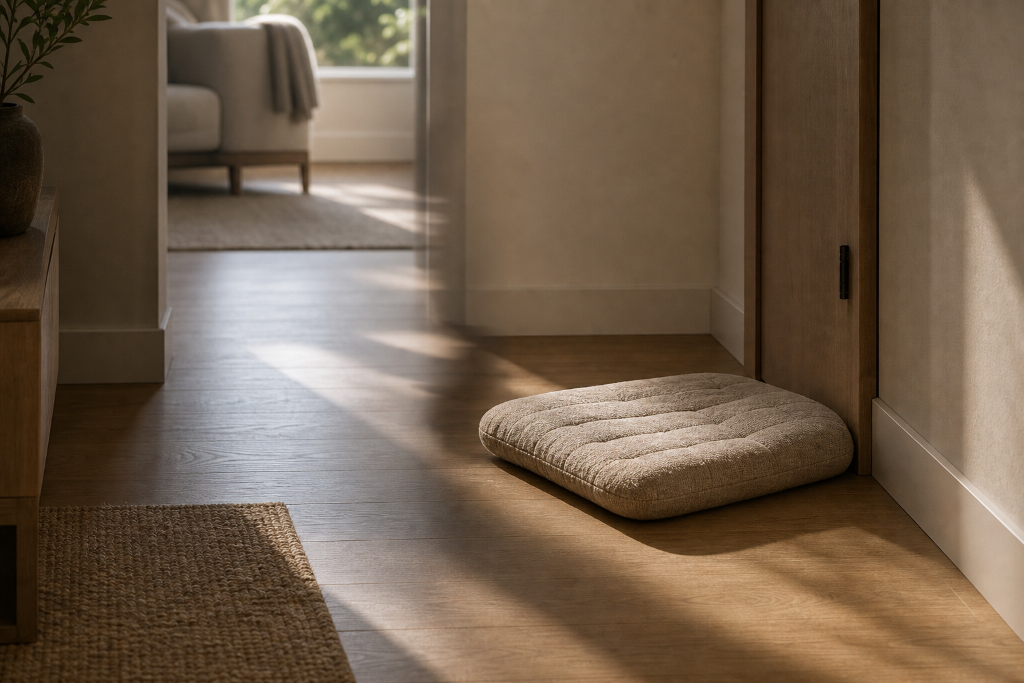
Before replacing a pet object with a more expensive version, diagnose the failure.
| Question | If the answer is no, the problem may be... |
|---|---|
| Does the animal use it voluntarily and repeatedly? | The location, access, posture, visibility, or texture may be wrong. |
| Does it avoid the main walking path? | The object may be creating circulation friction. |
| Can the animal enter, turn, rest, eat, drink, scratch, climb, or leave without forced posture? | The geometry may be wrong. |
| Can the animal see approach or retreat when needed? | The object may feel exposed or trap-like. |
| Can another animal block access? | The route may create social pressure. |
| Can every high-contact surface be cleaned easily? | The maintenance logic may be weak. |
| Does the material suit moisture, claws, hair, odor, abrasion, or litter? | The finish may be decorative rather than functional. |
| Does it share the room's material language and proportion? | The object may be visually isolated. |
| Does it preserve nearby doors, drawers, vents, windows, outlets, and skirting? | The product may not fit the architecture around it. |
| Would the object still make sense if the pet were not in the photograph? | The design may depend on novelty rather than spatial coherence. |
If several answers are no, the problem is probably not styling. It is integration.
Animals Do Not Read the Room as a Catalogue
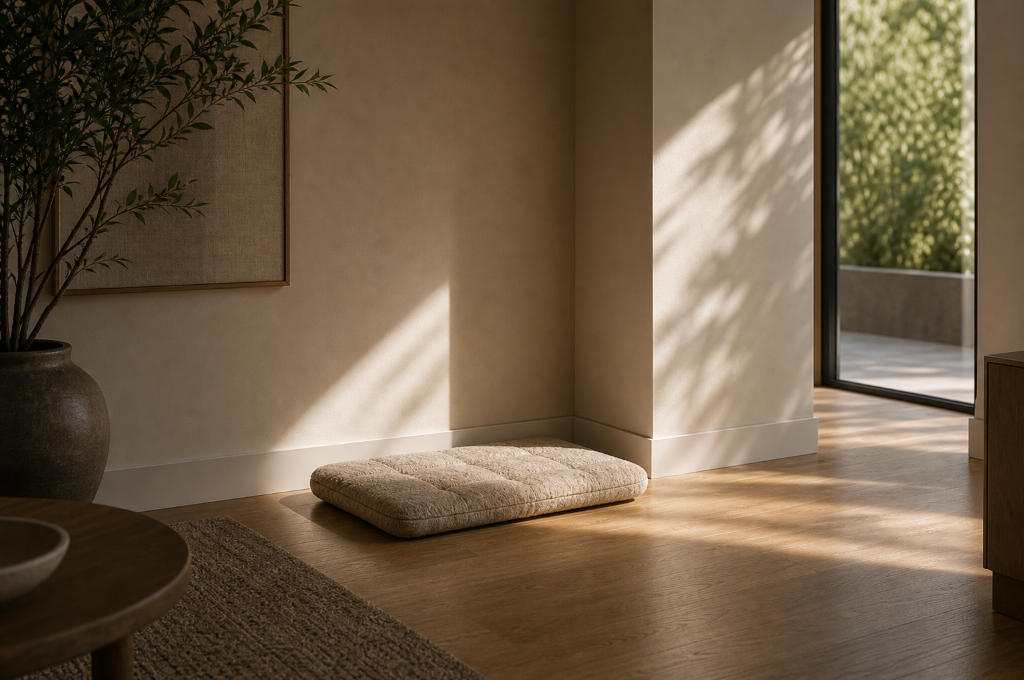
Humans often judge pet furniture by category: bed, crate, bowl, litter box, scratching post, cat tree.
Animals judge conditions.
For cats, feline environmental guidance emphasizes safe places, multiple and separated resources, scratching and resting areas, predictable interaction, and scent. The AAFP and ISFM feline environmental needs guidelines also describe safe places, elevated areas, and resource distribution as part of a healthy feline environment.
This matters for interiors because a beautiful cat object can still fail if it creates a poor route. A cat may need to see approach, retreat without being cornered, access resources without passing another cat, or use vertical space without a single unstable jump.
The 2024 AAFP intercat tension guidelines make this even clearer in multi-cat homes. Tension may appear as subtle blocking, staring, avoidance, hiding, or resource control. A handsome litter cabinet or feeding station can become a pressure point if one cat can guard the entry or path.
For dogs, the problem is different. Research on the secure base effect shows that dogs are not simply using the home as a set of objects; their relationship with the owner and the surrounding environment influences behavior. In practical design terms, many dogs rest best where they are connected to household life without being placed directly in the main traffic path.
The animal is not choosing furniture. The animal is choosing a condition of safety, access, social distance, temperature, familiarity, and control.
The Room Has Its Own Requirements
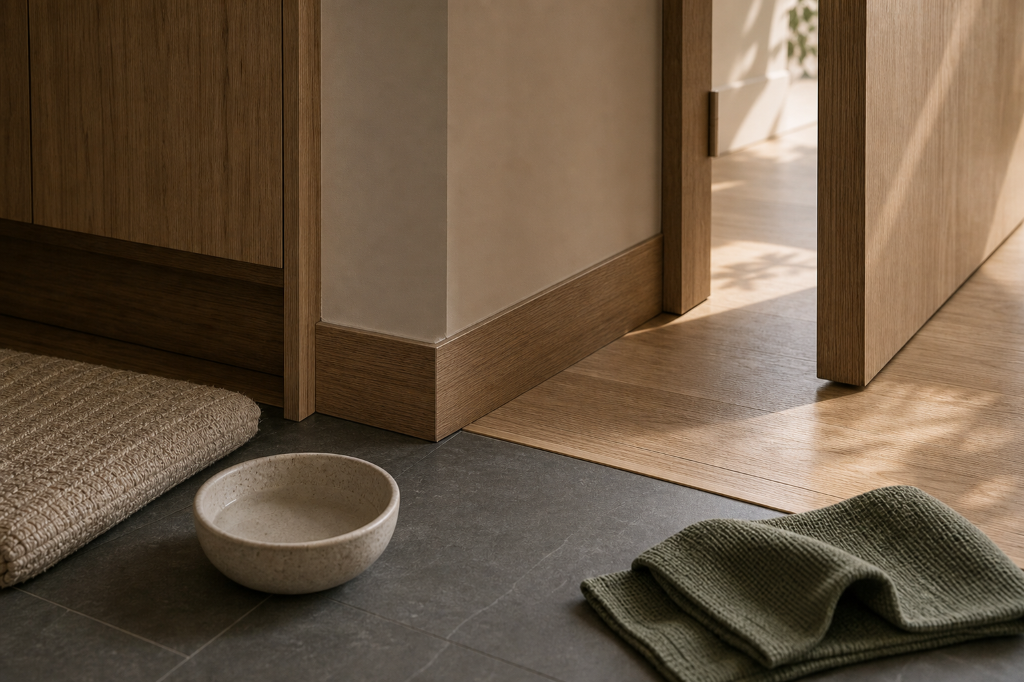
A room will reject a pet object when the object ignores the room's rules.
In a refined interior, every visible item carries weight. A sofa has scale. A cabinet has rhythm. A wall has silence. A doorway has movement. A window has light and temperature. A floor has maintenance. A corner has psychological and practical meaning.
When a pet object enters the room, it has to answer all of that.
For a dog bed, the question is not only whether the bed is soft enough. It is whether the dog can rest near the household without lying in a walkway, whether the surface supports the dog's posture, whether the cover can be cleaned, and whether the bed's thickness or edge creates access problems as the dog ages.
For a cat tree, the question is not only whether the cat can climb. It is whether the route is stable, whether the platforms form a usable sequence, whether the cat has more than one way to leave, whether scratching and observation are located well, and whether the object destroys the room's visual balance.
For a litter cabinet, the question is not only whether the box is hidden. It is whether the cat accepts the entry, whether the air can move, whether the owner can clean without awkward disassembly, whether litter tracking is controlled, and whether another animal can block access.
For a feeding station, the question is not only whether bowls are organized. It is whether food and water are separated when needed, whether the bowl height and depth fit the animal, whether the surface survives moisture, and whether the routine of filling, washing, and wiping is realistic.
This is why an attractive product can still fail. It answered the product brief, not the room brief.
What Good Integration Looks Like
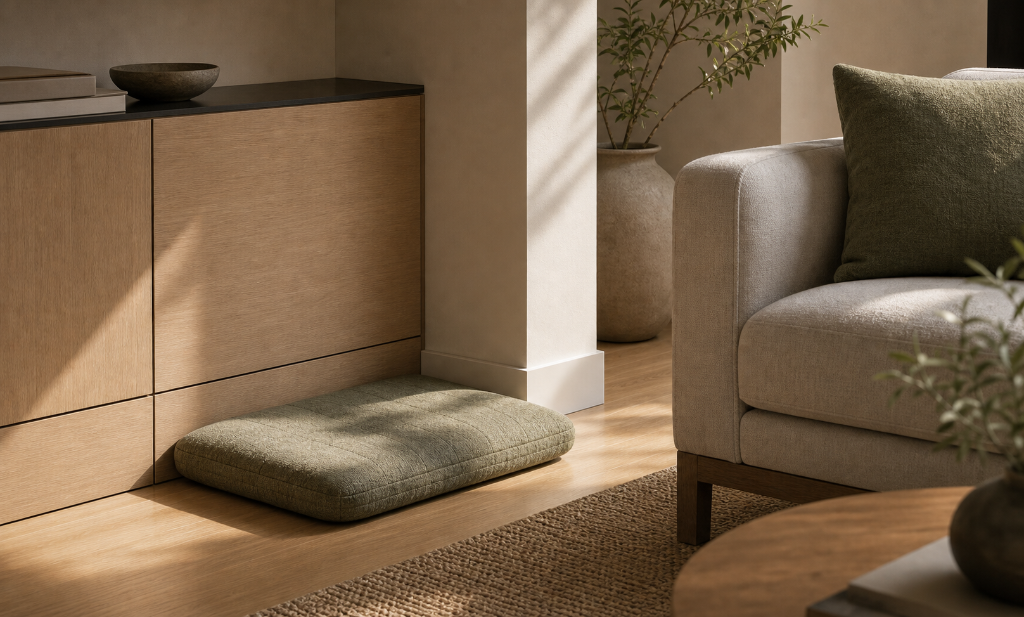
Good integration does not always mean concealment.
Sometimes the best pet space is visible. A cat's vertical route may be part of the room's architectural rhythm. A dog's resting place may be a calm alcove rather than a hidden compartment. A feeding station may remain open because water, cleaning, and daily access matter more than disguise.
Good integration means the pet function has a reason to be where it is.
| Integration quality | What it means in practice |
|---|---|
| Relationship to animal routine | The space supports how the animal already rests, eats, drinks, hides, climbs, watches, avoids, or waits. |
| Relationship to circulation | The object does not block the main walking path, door swing, cleaning route, or daily use of nearby furniture. |
| Access for both animal and human | The animal can enter and leave comfortably, and the human can clean, refill, remove, inspect, or repair the space without awkward disassembly. |
| Durable material logic | The surfaces can handle claws, moisture, hair, odor, abrasion, litter, and repeated cleaning without relying only on decorative appearance. |
| Appropriate visual weight | The pet function belongs to the room's proportion, rhythm, and material language instead of becoming accidental visual noise. |
| Boundary from household clutter | The space has a defined role, so bowls, mats, bedding, toys, litter tools, or cleaning supplies do not drift across the room. |
| Flexibility over time | The design can tolerate aging animals, changed routines, seasonal use, replacement inserts, and ordinary maintenance. |
The goal is not to make pet life invisible. The goal is to make it resolved.
The HĀM Method: From Object to Companion Space
HĀM does not begin by asking which pet furniture category the client wants.
We begin with the animal, the room, and the routine.
That means looking at where the animal already chooses to rest, eat, hide, climb, watch, avoid, or wait. It means studying doors, edges, walls, window light, cleaning routes, storage pressure, flooring, material transitions, and the parts of the home that already carry too much visual noise.
Only after that does the product type become clear.
The answer may be a built-in resting alcove, a feeding wall, a lower insert, a freestanding object, a litter console, a vertical route, a washable mat, a relocated bed, or no new object at all.
The most intelligent pet furniture is sometimes not more furniture. It is a better decision about where animal life belongs in the room.
What This Does Not Mean
This does not mean all mass-market pet furniture is badly designed. Some products are thoughtful, safe, cleanable, durable, and appropriate for many homes.
It does not mean every household needs custom joinery. A simple object in the right location can outperform an expensive built-in in the wrong location.
It does not mean pet space should always be hidden. Hiding can create worse access, ventilation, cleaning, and social-pressure problems if it is treated as the only goal.
It also does not mean design can replace veterinary or behavior support. If a pet suddenly avoids a bed, refuses a litter box, guards a resource, shows pain, changes appetite, hides persistently, or becomes aggressive, medical and behavioral causes should be considered.
The claim is narrower and more useful: pet furniture should not be asked to solve spatial, behavioral, and maintenance problems that were never designed into the room.
Sources
- Source
U.S. Pet Industry Reaches $158 Billion in 2025, Poised for Continued Growth in 2026
American Pet Products Association · 2026
Used forMarket scale context for pet industry and residential integration.
- Source
Meet UTSÅDD: the new IKEA collection that aims to brighten up the home life of cats, dogs and pet-loving humans
IKEA Global · 2024
Used forEvidence that major home brands now treat pet space as part of domestic life.
- Source
AAFP and ISFM Feline Environmental Needs Guidelines
Ellis, S. L. H., Rodan, I., et al. · 2013
Used forFoundation for understanding how cats experience space: safe places, resource separation, and vertical territory.
- Source
2024 AAFP intercat tension guidelines: recognition, prevention and management
Rodan, I., Ramos, D., Carney, H., et al. · 2024
Used forDesign basis for litter and feeding placement in multi-cat households.
- Source
The Importance of the Secure Base Effect for Domestic Dogs
Horn, L., Huber, L., & Range, F. · 2013
Used forExplains why dogs rest best near household life without being in traffic routes.
Frequently Asked
Free Resource
Get the Spatial Brief Checklist
A printable A4 checklist covering the measurements, photographs, and companion details needed before commissioning a pet space — the same brief HĀM uses with clients.
We'll occasionally send studio notes on companion space design. No spam, unsubscribe anytime.
Begin with the animal, the room, and the routine
If you are considering a companion space, the next step is not choosing a size. It is understanding the animal, the home, and the way you live together.