
Materiality · MAY 2026
Beyond Solid Wood
Solid wood vs engineered timber for pet architecture, specified by performance rather than material mythology.
- Type
- Essay
- Author
- HĀM Studio
- Published
- MAY 2026
- Updated
- May 2026
- Reading time
- 11 min
- Topics
- MaterialityEngineered TimberVeneerIndoor AirFSCMaterial Specification
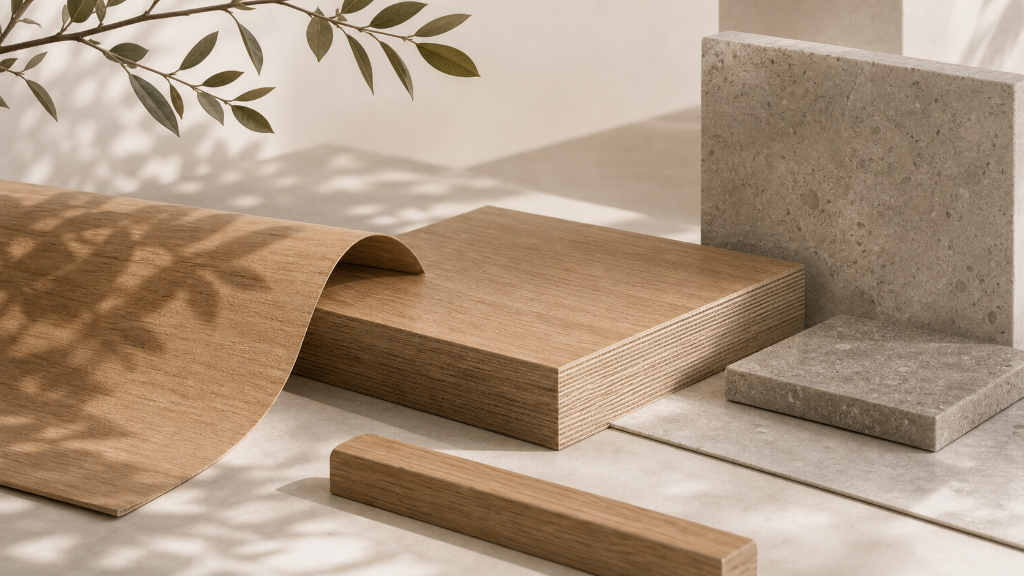
Solid wood vs engineered timber for pet architecture, specified by performance rather than material mythology.
Solid wood is not automatically the highest-quality choice for pet architecture; the better material is the one that remains stable, cleanable, low-emission, repairable, and fit for the animal's use.
The most honest material choice is not "solid wood" or "engineered wood" in isolation, but a specification that matches each part of the furniture to its structural and behavioural role.
01Direct answers
Is solid wood always better than engineered wood? No. Solid wood can be beautiful, repairable, and long-lasting, but it moves with humidity and temperature. For large panels, cabinet doors, concealed pet zones, and millimetre-tolerance hardware, high-quality engineered timber with natural veneer can be more stable than solid wood.
Is wood veneer fake wood? No. Natural wood veneer is a thin layer of real timber applied over a stable core. Its quality depends on the veneer species, matching, thickness, adhesive system, edge treatment, finish, and the quality of the substrate beneath it.
Why does HĀM use engineered timber in pet architecture? Pet architecture often requires large panels, integrated doors, washable surfaces, ventilation details, and precise openings. Engineered timber can provide dimensional stability and cleaner tolerances when specified correctly.
Is engineered wood safe for pets? It can be appropriate when the material system is specified carefully. The relevant questions are emission compliance, adhesive type, finish chemistry, edge sealing, cleaning durability, ventilation, and supplier documentation.
What is the best material for pet furniture? There is no single best material. The right material depends on the function: structural panels, exposed edges, chew-prone areas, litter zones, resting surfaces, feeding areas, hardware interfaces, and cleaning routines all have different requirements.
02Why solid wood is not always better
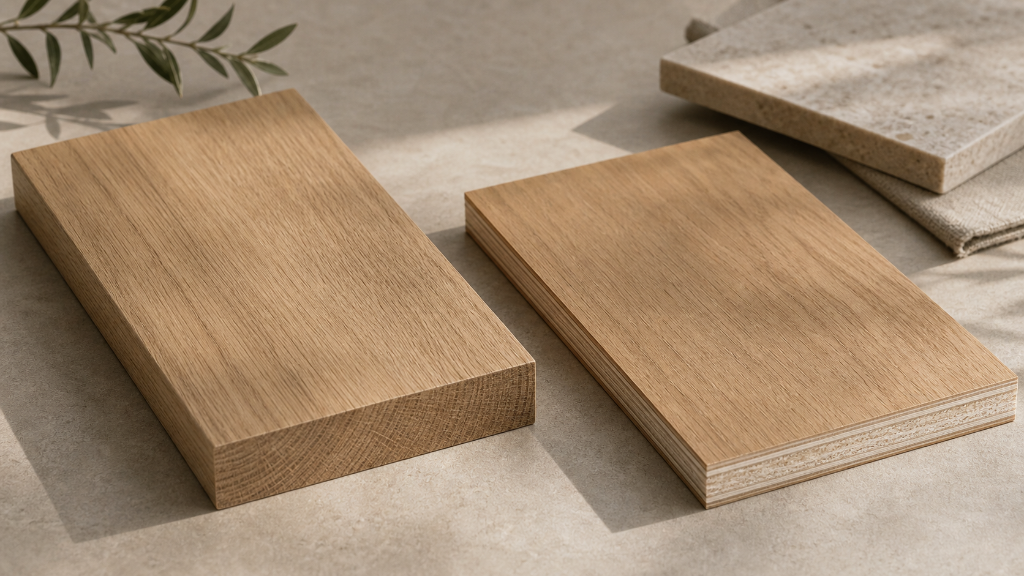
A material can be natural and still be wrong for the job. That is the simplest way to understand the problem with "solid wood" as a universal quality claim.
Solid wood has an emotional advantage. It sounds honest. It carries the language of craft, inheritance, and natural material. That reputation is not imaginary — a well-made solid wood table, chair, or shelf can last for decades, be refinished, and age with dignity. The problem begins when "solid wood" becomes a shortcut for quality.
In residential furniture, the phrase often tells the buyer very little. What species is it? How was it dried? How wide are the boards? How are they joined? Is the panel allowed to move? Is the piece exposed to moisture, heat, cleaning chemicals, claws, saliva, litter, or repeated pet contact?
Those questions matter more in pet architecture than in ordinary decorative furniture. A pet-integrated cabinet, resting alcove, feeding station, or litter console has to manage movement, ventilation, cleaning, odour, moisture, body heat, hinge tolerances, removable inserts, and repeated use. The question is not whether a material sounds more natural. The question is whether it keeps working.
03Why solid wood moves
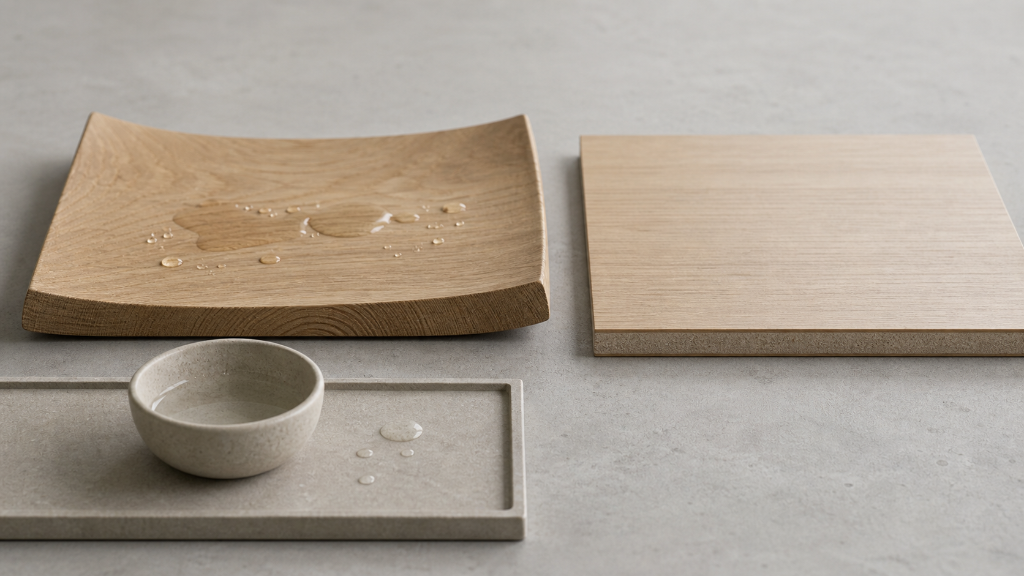
Wood is hygroscopic. As relative humidity changes, wood gains or loses moisture and changes dimension. This is not a defect; it is part of what wood is. The USDA Forest Products Laboratory's Wood Handbook treats moisture content and dimensional change as central facts of wood engineering, varying by species, grain direction, cut, moisture history, board width, and environmental conditions.
In small parts, this movement can be managed beautifully. In large panels, wide doors, or tightly fitted built-ins, it becomes harder to ignore.
| Solid wood movement | Why it matters in pet architecture |
|---|---|
| Door warping | Concealed litter doors and cabinet fronts may lose alignment |
| Joint opening | Moisture cycles stress corners, seams, and mitres |
| Panel cupping | Large surfaces may no longer sit flat or flush |
| Hardware misalignment | Hinges and drawer slides depend on stable tolerances |
| Finish cracking | Expansion and contraction stress surface finishes |
| Cleaning vulnerability | Moisture around bowls or litter can enter exposed grain or joints |
This does not make solid wood bad. It means solid wood must be used where movement is expected and designed for.
04What engineered timber solves
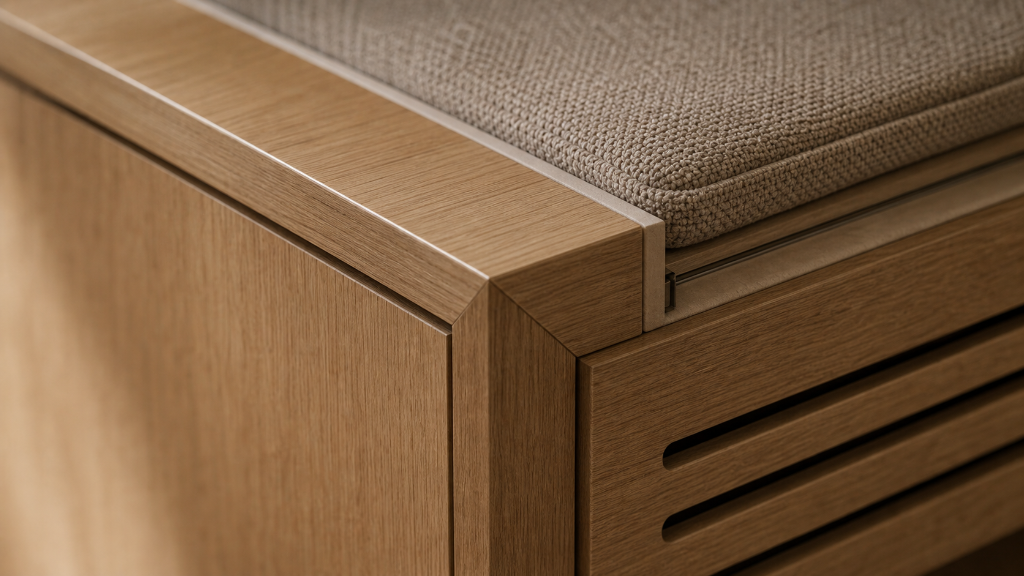
Engineered timber is a broad category: plywood, MDF, particleboard, laminated panels, veneer-core panels, and other composite or layered materials. Some are excellent, some are poor; the category alone does not guarantee quality.
The reason high-quality engineered panels are used in kitchens, wardrobes, and architectural millwork is simple: they can be more dimensionally stable than wide solid boards. Engineered timber with natural veneer can outperform solid wood in large cabinet panels because it reduces warping and seasonal movement that disrupt doors, drawers, hinges, and concealed pet spaces.
| Design requirement | Why engineered timber can help |
|---|---|
| Large flat panels | Reduces cupping and seasonal distortion |
| Concealed doors | Maintains consistent gaps and alignment |
| Integrated hardware | Supports predictable hinge and drawer tolerances |
| Veneered surfaces | Natural wood appearance over a stable substrate |
| Built-in pet zones | Keeps openings and ventilation details consistent |
| Edge detailing | Allows intentional sealing, banding, or solid-lipping |
For HĀM, this matters because companion spaces often live inside architectural furniture. A dog alcove may sit beneath a credenza. A litter zone may be integrated into a console. In these applications, the question is whether the piece will keep working after months and years of use.
05Solid wood still has a place
The case for engineered timber should not become a new myth. Solid wood is still valuable for exposed rails, legs, handles, thick edge details, replaceable chew-prone components, or tactile surfaces where repairability matters. A mature material strategy often uses both.
| Furniture part | Often better material logic |
|---|---|
| Large cabinet doors | Stable engineered core with natural veneer |
| Wide side panels | Engineered panel to reduce movement |
| Exposed edges | Solid lipping or hardwood banding |
| Legs and frames | Solid wood when strength, repair, and touch matter |
| Interior pet surfaces | Cleanable, sealed, replaceable, low-emission material |
| Litter and bowl zones | Sealed surfaces, ventilation, removable trays |
| Scratch/contact zones | Replaceable or intentionally durable surfaces |
The point is not to reject solid wood. The point is to stop using it as a universal proof of quality.
06A practical material decision table
| If the design needs... | Look for... | Be careful of... |
|---|---|---|
| Large flat doors | Stable engineered core with natural veneer | Wide solid panels without movement allowance |
| Natural wood appearance | Real veneer, clear matching specification | Printed imitation described as "wood finish" |
| Pet-sensitive indoor use | TSCA Title VI / CARB compliance where applicable | Unsupported "non-toxic" claims |
| Water resistance | Sealed edges, removable trays, durable finish | Exposed core near bowls or cleaning zones |
| Cleanability | Smooth sealed surfaces and replaceable inserts | Soft porous materials in hygiene areas |
| Repairability | Solid edges, replaceable panels, refinishable surfaces | Permanent glued-in wear zones |
| Scratch resistance | Surface hardness, replaceable contact layers, grain direction | Treating Janka hardness as the only measure of durability |
| Sustainability | FSC or verified sourcing, efficient veneer use | Vague "eco" language without documentation |
| Long service life | Stable joinery, accessible hardware, maintainable finishes | Trend-led forms that cannot be repaired |
Material quality should be judged by moisture behaviour, surface durability, indoor air safety, cleanability, edge protection, and long-term maintenance — not a simple "solid" or "engineered" label.
07Veneer is real wood, but it needs honesty
A veneer is not printed imitation. It is a thin slice of real wood, selected for grain, colour, figure, and consistency. High-end architectural interiors often use veneer because it allows large surfaces to be visually calm, matched, and stable.
A veneer surface is real wood, but it is not a guarantee of quality by itself; the substrate, adhesive, edge detail, finish, and emissions certification matter just as much as the visible grain. Veneer can also make better use of valuable timber — a single log produces far more finished surface area as veneer than as thick solid boards.
| Veneer quality factor | Why it matters |
|---|---|
| Veneer species | Grain, hardness, colour, repair behaviour |
| Veneer thickness | Sanding and refinishing potential |
| Matching method | Visual continuity across doors and panels |
| Substrate quality | Flatness, strength, screw performance |
| Adhesive system | Durability and emissions |
| Edge treatment | Protects vulnerable corners and exposed layers |
| Finish | Stain resistance, cleanability, touch |
The useful question is not "is it veneer?" but "what veneer, over what core, with what edge and finish strategy?" A poor veneer over a poor core is not premium. A carefully selected veneer over a stable, compliant, well-finished core can be an excellent architectural material.
08Moisture is a design condition
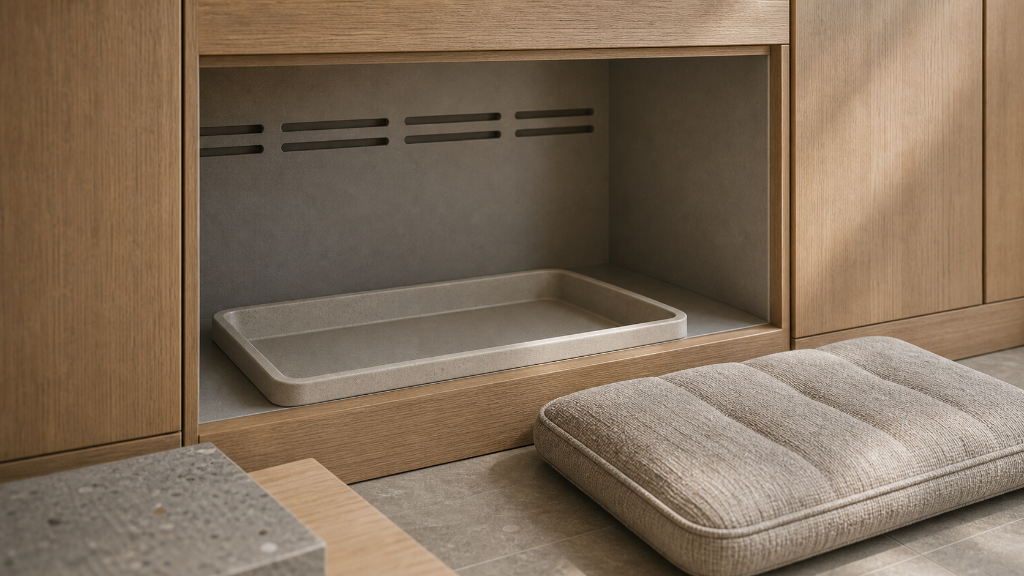
Pet furniture is rarely dry in the abstract. Water bowls spill. Dogs bring in damp coats. Cats track litter. Enclosed zones trap body heat. Litter areas produce localised humidity. Feeding stations are wiped daily.
An unsealed MDF edge near a daily-use water station can swell quickly if water repeatedly reaches the core. A litter console with poor ventilation may expose interior panels to odour, humidity, and cleaning chemicals more often than a normal cabinet. These are not decorative conditions; they are use conditions.
| Use zone | Material risk | Better design response |
|---|---|---|
| Water station | Swelling, staining, edge damage | Removable tray, sealed edge, water-resistant insert |
| Feeding area | Oil, saliva, residue | Cleanable surface, replaceable mat, easy access |
| Litter console | Odour, humidity, abrasion | Ventilation, sealed interior, removable liner |
| Dog alcove | Body heat, fur, cleaning | Washable insert, ventilated back, durable base |
| Cat resting shelf | Claws, repeated jumping, edge wear | Stable substrate, grippy replaceable surface |
| Cabinet door | Seasonal movement | Engineered panel with stable hardware tolerances |
Janka hardness can help compare wood species for denting, especially in exposed scratch/contact zones. It should not be treated as the whole answer. Material design is about assigning the correct material behaviour to each zone.
09Indoor air, adhesives, and pet use
Material conversations often stop at what the surface looks like. For pet architecture, that is too shallow. Pets occupy lower zones than humans, rest close to panels, spend time inside alcoves, and sniff surfaces directly. This makes ventilation, curing time, adhesive choice, and finish chemistry more consequential in pet architecture than in ordinary residential cabinetry.
In the United States, EPA's TSCA Title VI rules regulate formaldehyde emissions from certain composite wood products. California's CARB Phase 2 standards are closely aligned. Compliance is a baseline — not a claim that a product has no emissions. Low-VOC, ULEF, or no-added-formaldehyde systems can reduce concern, but they still need documentation, curing time, ventilation, and appropriate use.
For pet-integrated furniture, HĀM asks for a material stack, not a marketing phrase: TSCA Title VI / CARB compliance where applicable, supplier documentation, adhesive system, finish chemistry, sealed edges, removable inserts, ventilation, and proven behaviour under routine cleaning.
10Sustainability requires documentation
FSC certification can be meaningful because it is built around forest management standards and chain-of-custody systems that track material through processing, manufacturing, and distribution. The important word is not just "FSC." It is "traceable."
A responsible specification should be able to answer: Is the wood or veneer FSC certified, reclaimed, or otherwise verified? Is the supplier's chain-of-custody documentation current? Is the veneer used efficiently? Can the product be repaired or refreshed? Are inserts replaceable? Is the design likely to remain useful over time?
A piece that lasts, can be maintained, and does not need replacement after a few years is often more responsible than one that simply uses a romantic material name.
11What this does not mean
This does not mean engineered timber is always better. Low-quality engineered panels can swell, emit, crumble at fasteners, chip at edges, or fail under moisture. Solid wood remains one of the best materials for many furniture parts. Veneer is only as good as its substrate, edge detail, finish, and application. And certifications — FSC, TSCA Title VI, CARB, low-VOC, ULEF, no-added-formaldehyde — are useful only when documented and relevant to the exact material being used.
12How HĀM applies this
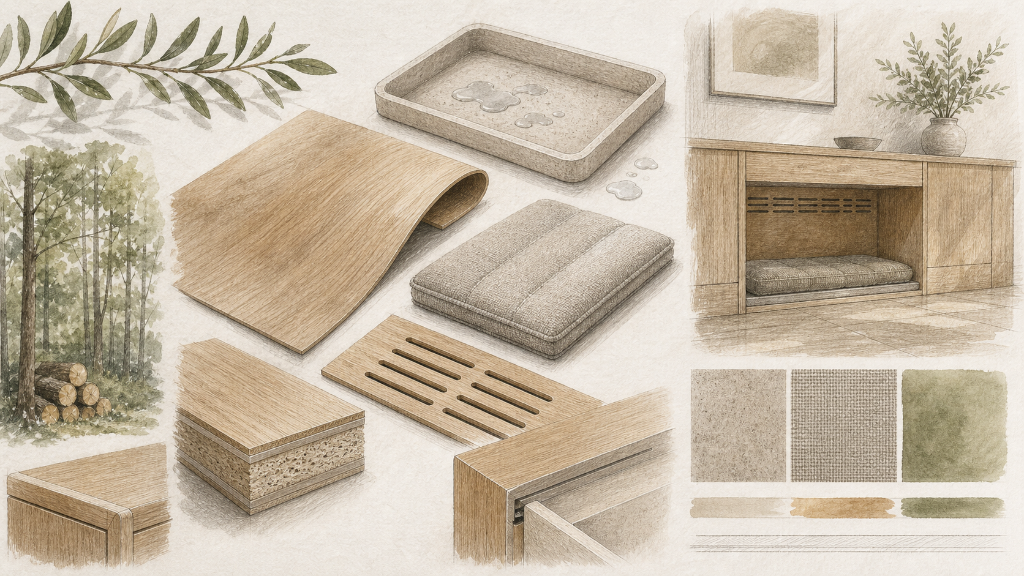
HĀM does not treat material selection as a style choice at the end of the process. The material strategy begins with use.
A litter console is specified differently from a dog resting alcove. A feeding station is specified differently from a cat observation shelf. A cabinet front is specified differently from a removable insert. Each part has a job, and each job has a material logic.
HĀM's material framework asks:
- Does this component need dimensional stability?
- Will it be exposed to moisture, cleaning, saliva, litter, claws, or body heat?
- Does it need to hold precise hardware tolerances?
- Is the surface touched by the animal, the human, or both?
- Can it be cleaned without damaging the finish?
- Can the wear layer be replaced?
- Is the sourcing documented?
- Is the emission profile appropriate for indoor use?
- Does the material still make sense five years from now?
This is why engineered timber with natural veneer can be the more honest choice for many HĀM commissions. It preserves the visual and tactile language of real wood while allowing the underlying structure to perform with the stability required by integrated pet architecture.
The goal is not to defend engineered wood. The goal is to specify materials without mythology.
References
Sources
- 01
Wood Handbook: Wood as an Engineering Material
USDA Forest Products Laboratory · 2021
Used for: Foundation for dimensional movement, moisture behaviour, and the engineering treatment of solid wood.
- 02
Physical properties and moisture relations of wood
USDA Forest Products Laboratory · 2010
Used for: Detailed treatment of how moisture content and species affect dimensional change in wood.
- 03
Formaldehyde Emission Standards for Composite Wood Products
U.S. Environmental Protection Agency · 2024
Used for: TSCA Title VI framework for regulating formaldehyde emissions in composite wood products used indoors.
- 04
Frequent Questions for Consumers about the Formaldehyde Standards for Composite Wood Products Act
U.S. Environmental Protection Agency · 2024
Used for: Plain-language reference for what TSCA Title VI compliance does and does not guarantee.
- 05
Chain of Custody Certification
Forest Stewardship Council · 2024
Used for: Basis for traceable FSC sourcing claims through processing, manufacturing, and distribution.
- 06
Volatile Organic Compounds' Impact on Indoor Air Quality
U.S. Environmental Protection Agency · 2024
Used for: Context for VOC behaviour, curing, and ventilation in indoor environments shared with pets.
Scope
Limitations
- 01This article is a residential design essay, not a structural engineering, toxicology, or veterinary document.
- 02Material behaviour varies with species, supplier, climate, and use; specifications should be confirmed with the maker for each commission.
- 03Certifications such as TSCA Title VI, CARB Phase 2, and FSC are compliance baselines, not a guarantee of zero emissions or universal sustainability.
- 04Janka hardness and similar single metrics are useful comparisons, not a complete measure of durability under real pet use.
Questions
Frequently asked
Free resource
Get the Spatial Brief Checklist
A printable A4 checklist covering the measurements, photographs, and companion details needed before commissioning a pet space — the same brief HĀM uses with clients.
We'll occasionally send studio notes on companion space design. No spam, unsubscribe anytime.
Continue reading
Read next
Begin with the animal, the room and the routine
If you are considering a companion space, the next step is not choosing a size.
It is understanding the animal, the home, and the way you live together. A free concept is the place to begin.