
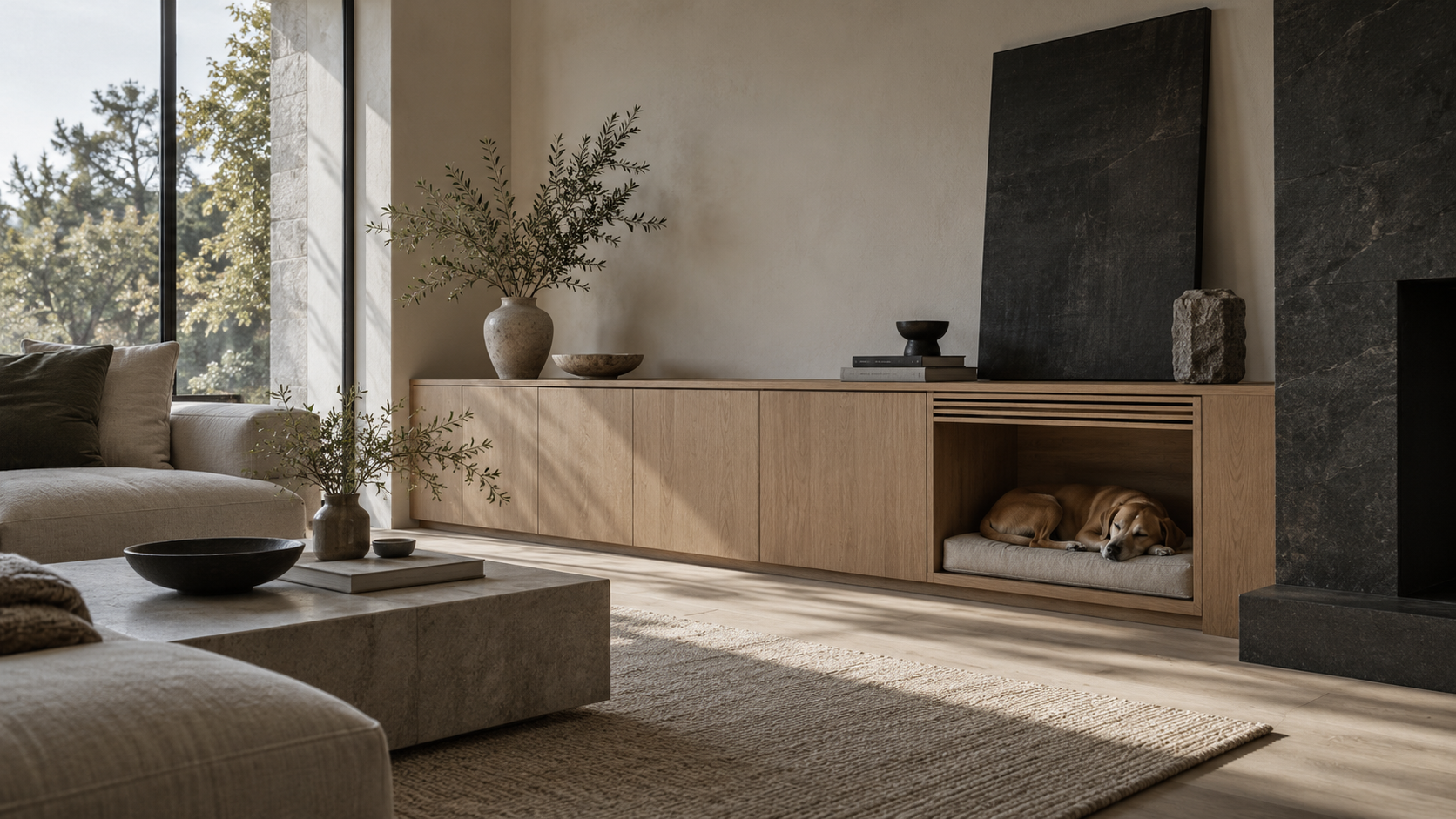
Is It Safe to Lick? Specifying Pet-Safe Finishes and Materials
What actually determines whether a finish, board, adhesive or textile is safe in a home shared with animals — and which certifications mean something.
- Category
- MATERIALITY
- Type
- Guide
- Author
- HĀM Studio
- Published
- SEP 2026
- Reading time
- 9 min
Topics
A companion animal meets furniture with its mouth, its nose and its skin. It sleeps against the panel for fourteen hours a day, licks the edge where food once fell, and breathes the air inside an enclosed recess. That is a different exposure profile from the one most furniture specifications are written for, and it is the reason "pet-safe" cannot be settled by a marketing word on a product page.
This guide explains what actually determines whether a finish, adhesive, board or textile is safe in a home shared with animals: which emissions standards mean something, which certifications are about people rather than pets, where the real risk sits, and what to ask a maker before you commission anything.
HĀM writes this as a studio that specifies materials for furniture animals live inside. It is not veterinary advice, and it is not a claim that any material is risk-free.
Direct answers
What makes furniture pet-safe?
Three things, in this order: cured low-emission surfaces that no longer off-gas into the animal's breathing zone; construction that does not expose raw adhesive, fasteners or friable material to chewing; and a surface that survives the cleaning products you will actually use, because repeated damage to a finish creates more exposure than the finish itself ever did.
Is engineered board safe for pets?
Modern certified board is usually safer than the fear suggests. Composite wood panels sold in the United States must meet the formaldehyde limits in EPA TSCA Title VI, harmonised with California's CARB Phase 2 rule; in Europe the equivalent conversation is E1, with E0 and "super E0" describing lower-emitting products. The issue is rarely the board itself and almost always what happens at the edges: unsealed cut faces, unbanded joints, and interiors finished less carefully than the parts a human sees.
Are water-based finishes safer than oil-based ones?
Generally yes, while curing, because they carry far fewer volatile organic compounds. But every cure has a timeline. A fully cured oil-modified surface can be inert while a freshly applied water-based one is not. The specification question is not only which chemistry, but how long before the animal sleeps against it.
Which certifications are worth asking for?
Ask for the emissions evidence, not the adjective. Useful references include TSCA Title VI or CARB Phase 2 compliance for composite panels, low-VOC emission certification such as GREENGUARD Gold for finished furniture and coatings, FSC or PEFC for the sourcing question, and ISO 22196 test data if antimicrobial performance is being claimed for a laminate. None of these are pet-specific, which is exactly why they need interpreting rather than displaying.
What is more dangerous than the finish?
In most homes: the cleaning cupboard. Phenolic disinfectants, pine oil cleaners, concentrated quaternary ammonium products and a long list of essential oils are documented hazards for cats in particular, and they are applied deliberately, repeatedly, to the surfaces an animal lies on.
Rewrite the exposure, then specify
Human furniture is specified for contact through clothing, occasional touch, and a room of moving air. A companion animal changes four variables at once.
| Exposure | What changes for an animal | Specification consequence |
|---|---|---|
| Duration | Twelve to eighteen hours of daily contact in one chosen place | Emissions must be judged after cure, in a real room, not on a data sheet |
| Route | Mouthing, chewing, licking, grooming ingested residue | Edges, fasteners and coatings need to survive contact, not just resist it |
| Air volume | Breathing inside a small enclosed recess, near the panel | Enclosed volumes need ventilation, not just holes for appearance |
| Cleaning load | Repeated wet cleaning of accidents and food residue | Surface must tolerate the products you already use, or the finish becomes the failure |
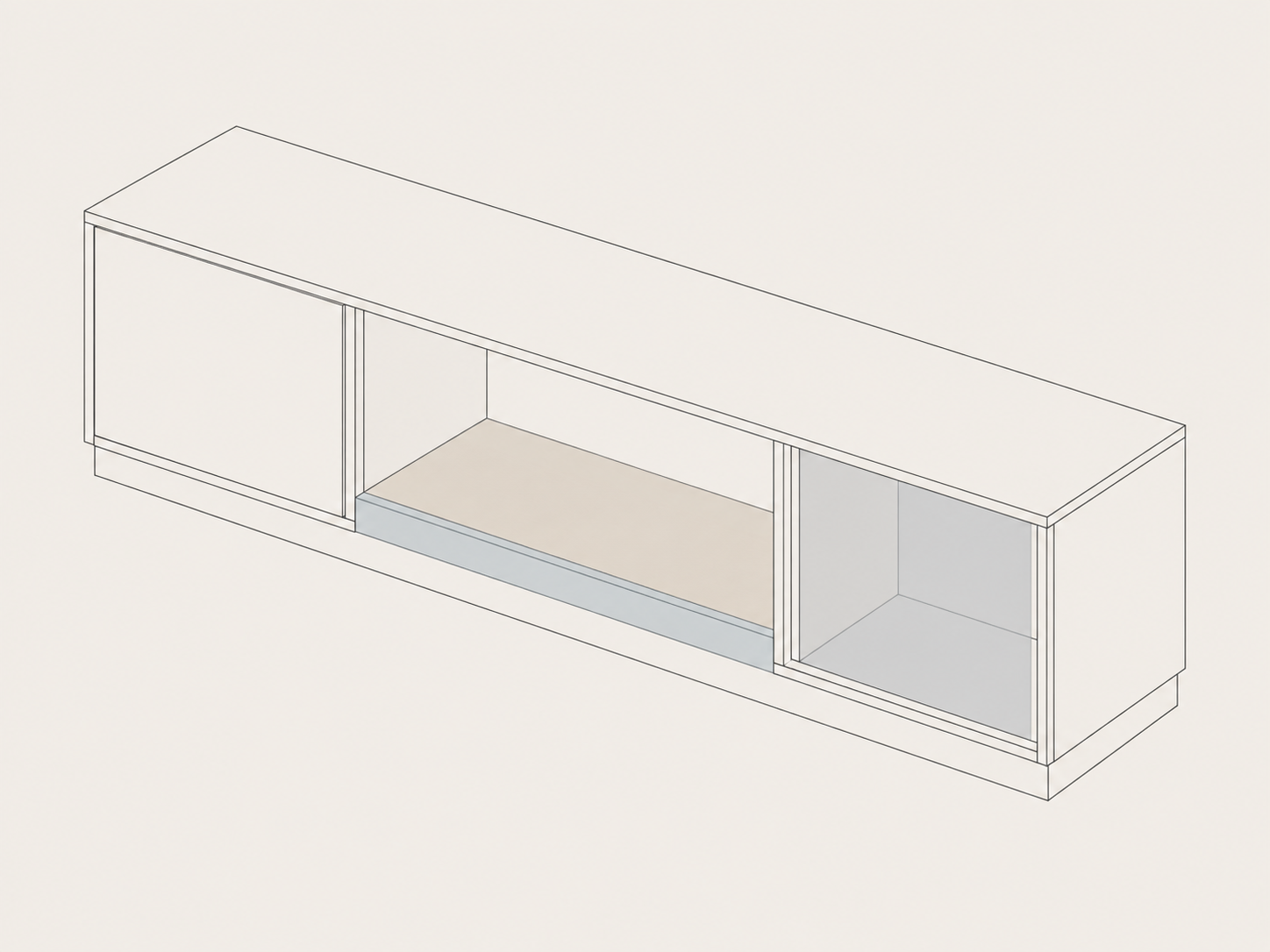
Read that table once and the usual question — "is this material toxic?" — becomes a better one: how much of this material will end up in the animal, by which route, over how long?
The four layers that decide safety
1. The substrate
The board or timber carries the structural and emissions baseline. For composite panels the relevant evidence is formaldehyde compliance under TSCA Title VI or CARB Phase 2 in North America, or E1 and lower classifications in Europe. Ask which, and ask for it in writing.
Solid timber avoids the formaldehyde conversation and introduces movement instead. Seasonal expansion opens joints; opened joints trap moisture and residue in exactly the places that are hardest to clean. Safety and stability are the same problem seen from two sides.
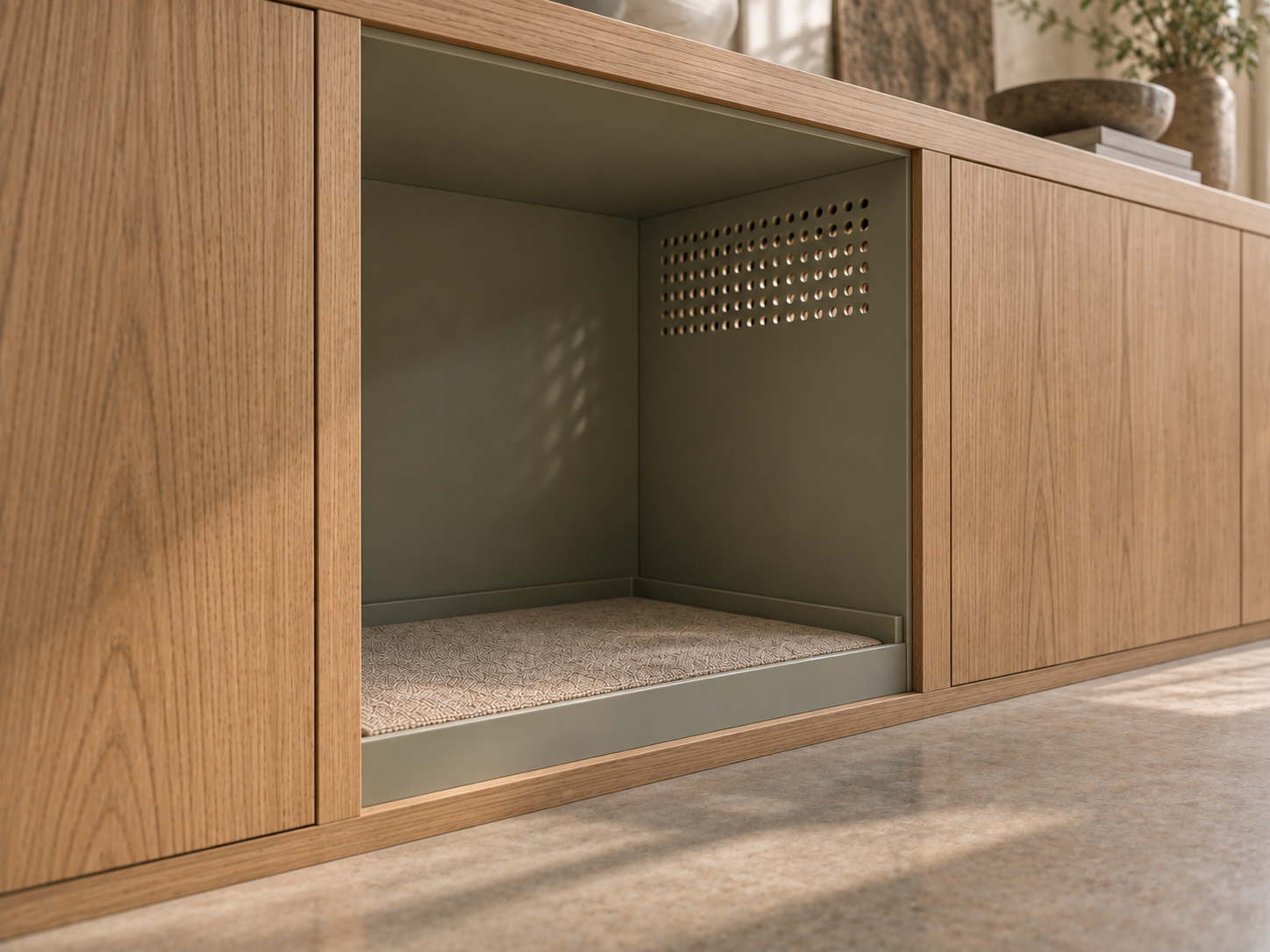
Two details matter more than the headline material. First, every cut edge should be sealed or banded, because a raw edge is both the highest-emitting face and the most chewable. Second, the inside of an enclosed compartment deserves the same finish quality as the outside, since that is the surface with the smallest air volume around it.
2. The finish
Coatings are where most "non-toxic" language is used and least often substantiated. What to establish:
- Chemistry and VOC content. Water-based polyurethanes and hardwax oils generally emit far less than solvent-based lacquers.
- Cure schedule, not dry time. Touch-dry is not cured. Many coatings continue releasing measurable VOCs for days, and reach a stable state over weeks. Ask for the manufacturer's full cure period, and keep the animal off the piece for it.
- Lead and heavy metals. Any painted or pigmented surface an animal may gnaw should reference a limit — the heavy-metal migration limits in toy standards such as EN 71-3 and ASTM F963 are a reasonable point of comparison, even though furniture is not a toy.
- Labelled art-material claims. "Non-toxic" on a paint tin often traces back to ASTM D4236 labelling, which addresses chronic hazards for human users. It is not a statement about a dog chewing a cured edge.
3. The adhesives and hardware
Glue is invisible in a finished piece and central to its safety. Interior-grade adhesives should be fully enclosed inside the joint, never smeared across an internal face where it can be licked. Edge banding adhesive must survive humidity and cleaning; a lifting band is a sharp edge and a chew target at once.
Hardware is the mechanical half of the same question. Hinges, runners and lifts should be rated for far more cycles than a household needs, because a failed moving part in a companion space is not an inconvenience but a trap. Fasteners should be concealed. Nothing that can be worked loose by a determined mouth belongs inside an animal's compartment.
4. The soft layer
Textiles and inserts are the most intimate material in the piece and the shortest-lived. Specify them as consumables. Removable covers, washable at a temperature that actually sanitises, in a construction that does not shed fibre when chewed, with fill that is not a choking hazard if the cover fails. The relevant reference for textile chemistry is an emissions and restricted-substance certification for the fabric itself, not a claim made about the cabinet around it.
Certification, read honestly
Every certification in this field was written with human occupants in mind. That does not make them useless; it makes them evidence that needs interpreting.
| Reference | What it actually covers | How to read it for animals |
|---|---|---|
| EPA TSCA Title VI / CARB Phase 2 | Formaldehyde emissions from composite wood panels | A floor, not a ceiling. Ask for compliant panels as a minimum |
| E1 / E0 (EN classifications) | European formaldehyde emission classes | Lower class is better; confirm the class rather than the country |
| GREENGUARD Gold | Low chemical emissions from finished products, tested for sensitive occupants | Closest available proxy for a long-dwelling animal; still not species-specific |
| FSC / PEFC | Responsible forest sourcing | An ethics and supply answer, not a toxicity answer |
| Cradle to Cradle | Material health and circularity assessment | Useful signal of ingredient screening; check the level awarded |
| ISO 22196 | Laboratory measurement of antibacterial activity on a surface | Evidence for a hygiene claim in ideal conditions, not a substitute for cleaning |
| EN 71-3 / ASTM F963 | Migration of heavy metals in toys | The right yardstick for surfaces that will be chewed |
Certifications are almost always held by the material supplier rather than the furniture maker. A studio that says "our panels and laminates carry these certifications through our material partners" is describing the situation accurately. A studio that implies it certified itself is not.
The risk most specifications ignore
A finish is a one-time decision. Cleaning is a daily one, and it is where documented poisonings actually come from. Veterinary toxicology resources consistently flag phenol-based disinfectants and pine oil products as hazardous to cats, warn that concentrated quaternary ammonium cleaners can cause oral and skin injury, and note that many essential oils — tea tree among them — are toxic to cats and dogs.
This has a direct design consequence. If a surface can only be maintained with an aggressive product, the specification has created the hazard. The safer sequence is: choose a finish that cleans with dilute, animal-appropriate products; keep the geometry free of crevices that force harsher chemistry; make the parts that meet food and accidents removable so they can be cleaned away from the animal and returned dry.
Ventilation belongs in the same paragraph. An enclosed retreat with a small air volume concentrates whatever is present — residual VOCs, cleaning vapour, humidity from a sleeping body. Cross-ventilation designed into the joinery, rather than drilled in afterwards, is a safety feature.
Ten questions to ask any maker
- Which panel or timber will be used, and what is its formaldehyde compliance or emission class?
- Are all cut edges sealed or banded, including inside enclosed compartments?
- What finish system is specified, and what is its VOC content?
- What is the full cure time before an animal should use the piece?
- Are painted or pigmented surfaces tested against heavy-metal migration limits?
- Where is adhesive used, and is any of it exposed on an internal surface?
- Which hardware is specified, and to what cycle rating?
- How is an enclosed compartment ventilated?
- Which cleaning products are approved for this finish, and which will void its warranty?
- Which components are designed to be replaced, and can they be reordered in five years?
If a maker can answer all ten without hesitating, the safety conversation is real. If the answer is a single reassuring adjective, it is marketing.
Limits of this guide
Safety is specific. It depends on the individual animal, its chewing behaviour, its health, the ventilation of the room, and how the piece is maintained over years. Nothing here replaces a veterinarian's judgement about a particular animal, and no material is risk-free for an animal determined to eat it.
HĀM specifies architectural-grade panel with a durable furniture-grade finish, sealed edges, designed ventilation and replaceable soft components, and asks suppliers for emissions and certification evidence in writing. That is a discipline, not a guarantee.
Sources
- Source
Formaldehyde Emission Standards for Composite Wood Products (TSCA Title VI)
US Environmental Protection Agency · 2026
Used forFormaldehyde emission limits for composite panels in North America.
- Source
Composite Wood Products Airborne Toxic Control Measure (Phase 2)
California Air Resources Board · 2026
Used forThe CARB Phase 2 limits harmonised with TSCA Title VI.
- Source
UL GREENGUARD Gold Certification
UL Solutions · 2026
Used forLow chemical emission criteria for finished products in sensitive environments.
- Source
ISO 22196: Measurement of antibacterial activity on plastics and other non-porous surfaces
International Organization for Standardization · 2026
Used forWhat an antimicrobial surface claim is actually tested against.
- Source
ASTM F963 Standard Consumer Safety Specification for Toy Safety
ASTM International · 2026
Used forHeavy-metal migration limits used as a yardstick for chewable surfaces.
- Source
Household Hazards and Poisonous Household Products
ASPCA Animal Poison Control Center · 2026
Used forCleaning products and essential oils documented as hazardous to dogs and cats.
- Source
Household Cleaners and Disinfectants: Toxicology
Pet Poison Helpline · 2026
Used forPhenols, pine oil and quaternary ammonium exposure risks in companion animals.
- Source
FSC Chain of Custody and PEFC Certification
Forest Stewardship Council / PEFC · 2026
Used forWhat forest-sourcing certification does and does not say about toxicity.
Limitations
- Safety depends on the individual animal, its chewing behaviour and health, room ventilation, and long-term maintenance.
- No material is risk-free for an animal determined to ingest it; nothing here replaces veterinary advice.
- All certifications cited were written for human occupants and are interpreted here, not species-specific.
- Certifications referenced are held by material suppliers, not by HĀM Studio.
Frequently Asked
Free Resource
Get the Spatial Brief Checklist
A printable A4 checklist covering the measurements, photographs, and companion details needed before commissioning a pet space — the same brief HĀM uses with clients.
We'll occasionally send studio notes on companion space design. No spam, unsubscribe anytime.
Begin with the animal, the room, and the routine
If you are considering a companion space, the next step is not choosing a size. It is understanding the animal, the home, and the way you live together.