
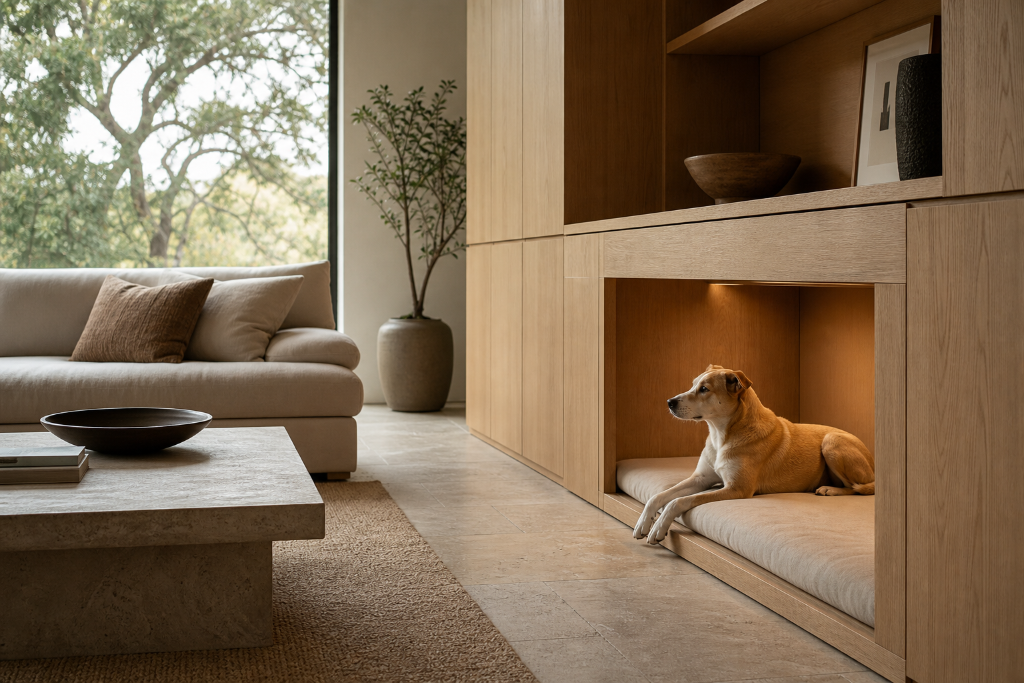
A Crate Is Not a Room
The difference between containment and an open-access refuge — and why residential pet architecture begins where the crate ends.
- Category
- SPATIAL DESIGN
- Type
- Essay
- Author
- HĀM Studio
- Published
- MAY 2026
- Reading time
- 5 min
Topics
A crate can be useful.
It can help a puppy learn routine. It can keep a dog safe during travel. It can support recovery after surgery, or give a young dog a short period of structure while the household is busy.
But a crate is not a room.
That distinction matters, because most pet furniture still begins with the same question: how do we contain the animal? HĀM begins somewhere else. We ask what kind of space a companion animal would choose to return to, and how that space can belong inside a considered home.
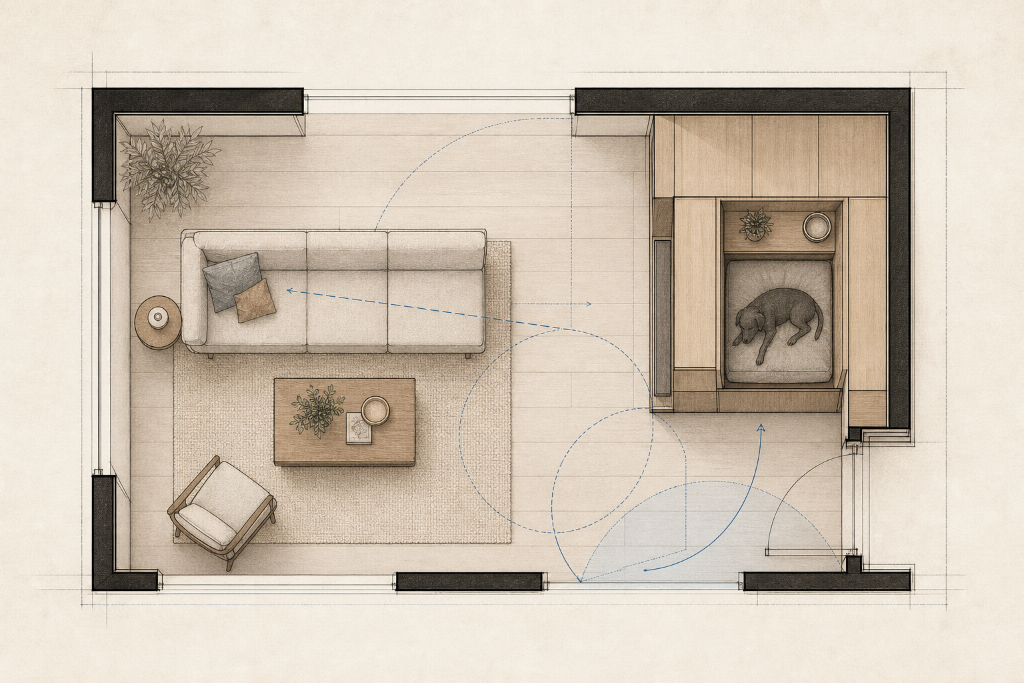
A room gives more than boundaries. It gives enough space to turn and settle. It gives a protected edge without forced isolation. It gives a view back into the household. Most importantly, it gives the animal a choice.
That is the difference between containment and refuge.
What a Crate Is For
The crate is not the enemy. Used carefully, it can be a practical tool.
A dog may need a crate for travel, veterinary care, short-term training, post-operative recovery, or safety during a specific moment. Many dogs can also learn to associate an open crate with rest, especially when the door stays open and the experience is positive.
The problem begins when a temporary tool becomes the animal's primary architecture.
A crate was designed around human management: close the door, reduce movement, simplify supervision. A long-term living space has a different responsibility. It has to support the animal's body, habits, stress level, social needs, and relationship to the home.
Those are different design briefs.
The Problem With Container Thinking
Most crates answer only one question: can the dog fit inside?
That is a very low bar.
A dog may physically fit in a crate and still lack enough clearance to turn comfortably, stretch, shift posture, or settle without folding into the geometry. The space may be technically adequate as a container and still poor as a resting environment.
Animal welfare research has been moving away from this narrow idea of enough. Modern welfare frameworks look not only at whether an animal is fed, clean, and physically unharmed, but whether its environment allows normal behaviour, agency, comfort, social contact, and positive experience.
This is where the crate becomes limited as a model for residential design. It is usually a single-function object. It does not create zones. It does not respond to the room. It often removes choice.
A room can do more.
What the Research Suggests
The strongest scientific support for this article does not come from one perfect crate study. It comes from a larger body of welfare research on confinement, housing, spatial restriction, choice, and environmental enrichment.
In 2023, the European Food Safety Authority advised that cats and dogs in commercial breeding environments should not be kept permanently in boxes, cages, or crates. That recommendation is not a household law, and HĀM does not treat it that way. But it reflects a clear welfare principle: permanent containment is a poor foundation for companion-animal housing.
Research on dogs in restricted housing also shows that space and social conditions affect behaviour. Beerda and colleagues (1999) studied dogs subjected to social and spatial restriction and recorded behavioural and physiological signs associated with chronic stress. Hubrecht, Serpell, and Poole (1992) found that housing conditions influenced activity, social behaviour, and repetitive movement in kennelled dogs.
The pattern is not subtle. Dogs are not objects that merely occupy volume. They respond to the quality of space.
A crate may be appropriate for a short task. It is not, by itself, a complete living environment.
Containment vs. Refuge
Containment asks: how do we keep the dog in?
Refuge asks: where would the dog choose to rest?
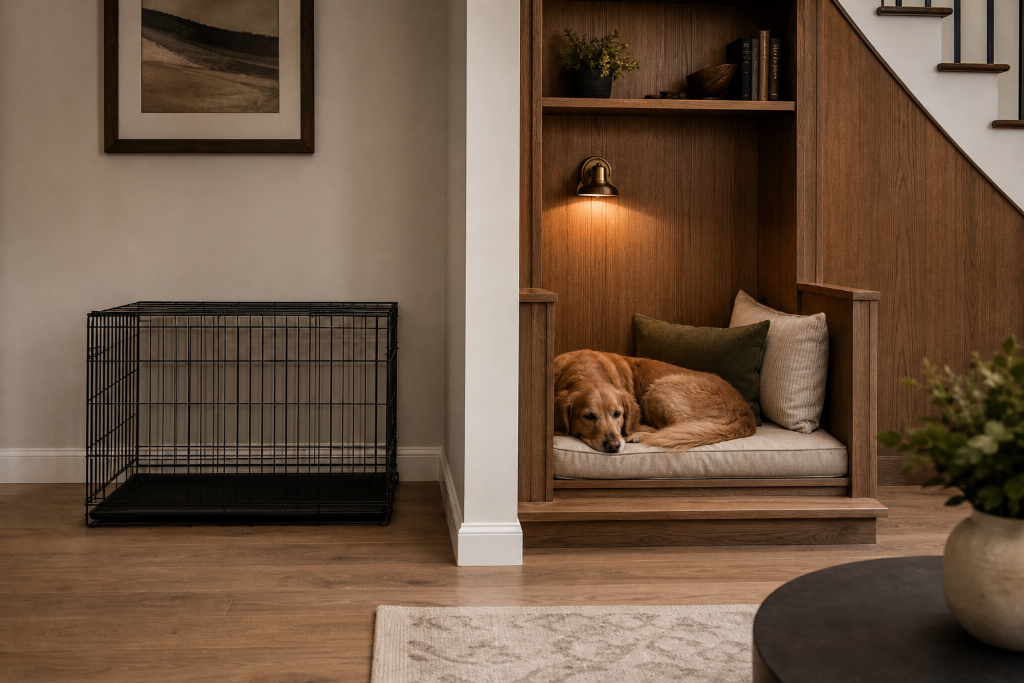
That shift changes the entire design. A refuge does not need to be large in a theatrical way. It needs to be right. It needs enough internal clearance for the animal's body. It needs a protected side or back, because many animals prefer some enclosure when resting. It needs an open threshold, so the animal can enter and leave without negotiation. It needs to sit inside the life of the room, rather than pushing the animal out of it.
A good refuge offers privacy without exile.
That is a delicate balance. Too exposed, and the animal may not settle. Too closed, and the space becomes a container again. The best solution usually sits between those extremes: held, but not locked away.
What an Open-Access Refuge Needs
For HĀM, an open-access refuge begins with five conditions.
- Voluntary entry and exit. The animal must be able to enter and leave on its own. A space changes meaning when the door is locked.
- Clearance for the body in motion. The interior must fit turning, circling, lowering, rising, and stretching — not only the body at rest.
- Partial enclosure. A protected back or side can make a resting place feel safer without turning it into a box.
- Connection to the household. Dogs are social animals. A resting suite in a living room, bedroom, study, or reading area can give the animal quiet without removing it from the family.
- Considered material language. Surface temperature, sound, grip, scent retention, cleanability, and edge detail all shape the way an animal uses a space.
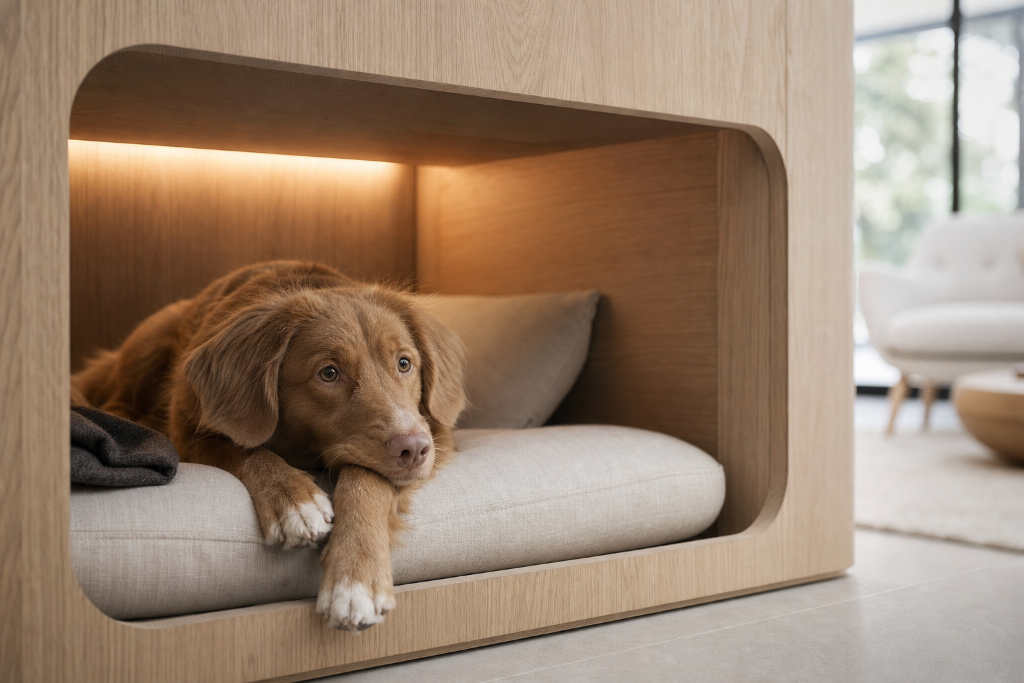
This is why HĀM does not design prettier crates. We design residential refuges.
Why This Matters in a Beautiful Home
Many pet products create a familiar compromise. The dog gets an object. The room gets visual clutter. Everyone adapts.
HĀM is built on the belief that this compromise is unnecessary.
A companion animal's space can be generous without being oversized. It can be protective without looking like equipment. It can support welfare without announcing itself as a pet product. The best pet architecture feels inevitable inside the room, as if the home had always made space for the animal who lives there.
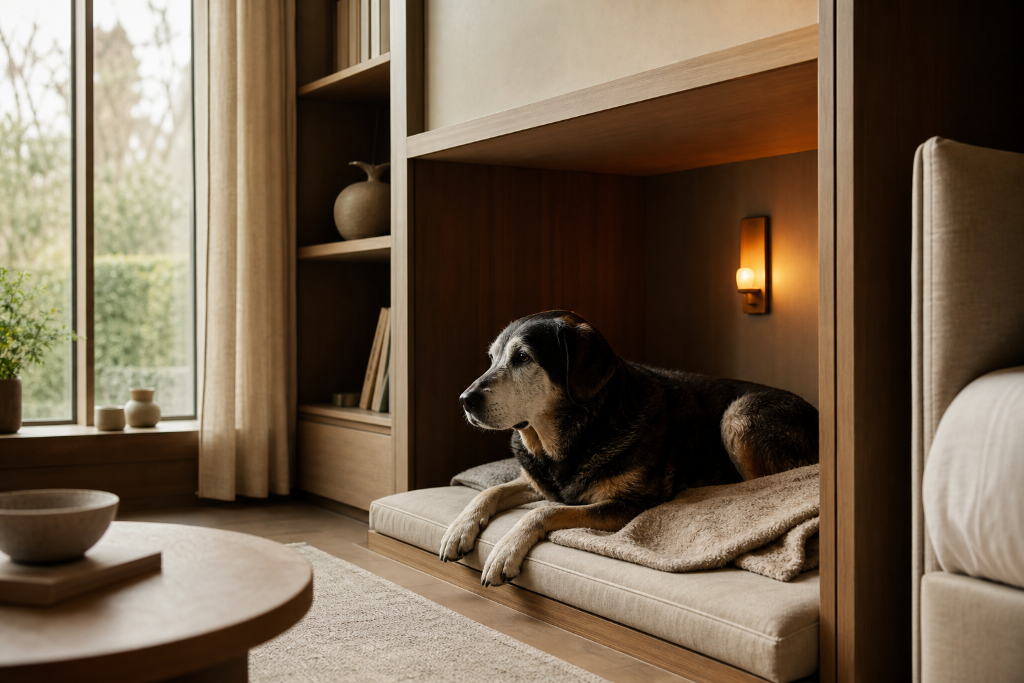
That is the point.
A crate is a tool. A room is a relationship between body, behaviour, material, and home.
We design for the second one.
Sources
- Source
Welfare of dogs and cats in commercial breeding establishments
European Food Safety Authority (EFSA) · 2023
Used forWelfare principle that permanent containment is a poor foundation for companion-animal housing.
- Source
Chronic stress in dogs subjected to social and spatial restriction
Beerda, B. et al. · 1999
Used forEvidence that spatial and social restriction produce behavioural and physiological stress responses in dogs.
- Source
Correlates of pen size and housing conditions on the behaviour of kennelled dogs
Hubrecht, R.C., Serpell, J.A. & Poole, T.B. · 1992
Used forEvidence that housing conditions affect activity, social behaviour, and repetitive movement in kennelled dogs.
- Source
Environmental enrichment for kennelled dogs
Wells, D.L. · 2004
Used forSupporting literature on environmental enrichment and welfare in confined dogs.
- Source
Housing and environmental needs of companion animals
RSPCA Australia
Used forPolicy reference on housing and environmental needs of companion animals.
Limitations
- This essay is an editorial position informed by welfare research; it is not a veterinary guideline or a substitute for professional behavioural advice.
- The cited studies span kennel, laboratory, and commercial breeding contexts. Their findings inform residential design thinking but do not translate one-to-one to every household.
- HĀM does not diagnose or treat anxiety, aggression, or medical conditions. Owners with welfare concerns should consult a veterinarian or qualified behaviour professional.
Frequently Asked
Free Resource
Get the Spatial Brief Checklist
A printable A4 checklist covering the measurements, photographs, and companion details needed before commissioning a pet space — the same brief HĀM uses with clients.
We'll occasionally send studio notes on companion space design. No spam, unsubscribe anytime.
Begin with the animal, the room, and the routine
If you are considering a companion space, the next step is not choosing a size. It is understanding the animal, the home, and the way you live together.